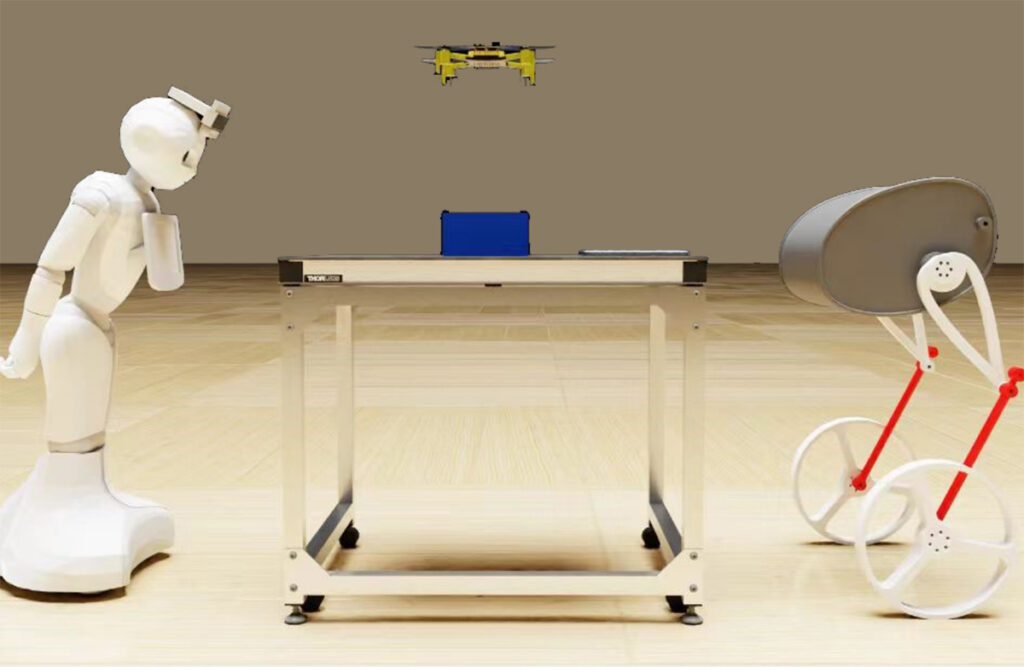
Robots are increasingly being used in manufacturing, agriculture and health care. But programming a team of robots to carry out individual tasks raises a question: How can robots learn from other robots if they are built differently?
A multi-institutional team including Chongjie Zhang, an associate professor of computer science and engineering at WashU McKelvey Engineering, developed a new method that enables robots to achieve intentions shown by their peers. The method, called Intention-Aligned Imitation Learning (IAIL), is inspired by human cultural learning. Results of their research were published March 18 in Science Robotics.
Traditional methods usually require robots to have similar physical capabilities and conditions as the demonstrator, making it hard for robots to adapt to different environments or to work with robots that have different designs. The team’s solution is IAIL, which uses high-level intentions, or goals, described in natural language to align and adapt robot behaviors. It also allows robots to understand the purpose of actions and apply them in various situations, even with different physical designs.
Read more on the McKelvey Engineering website.