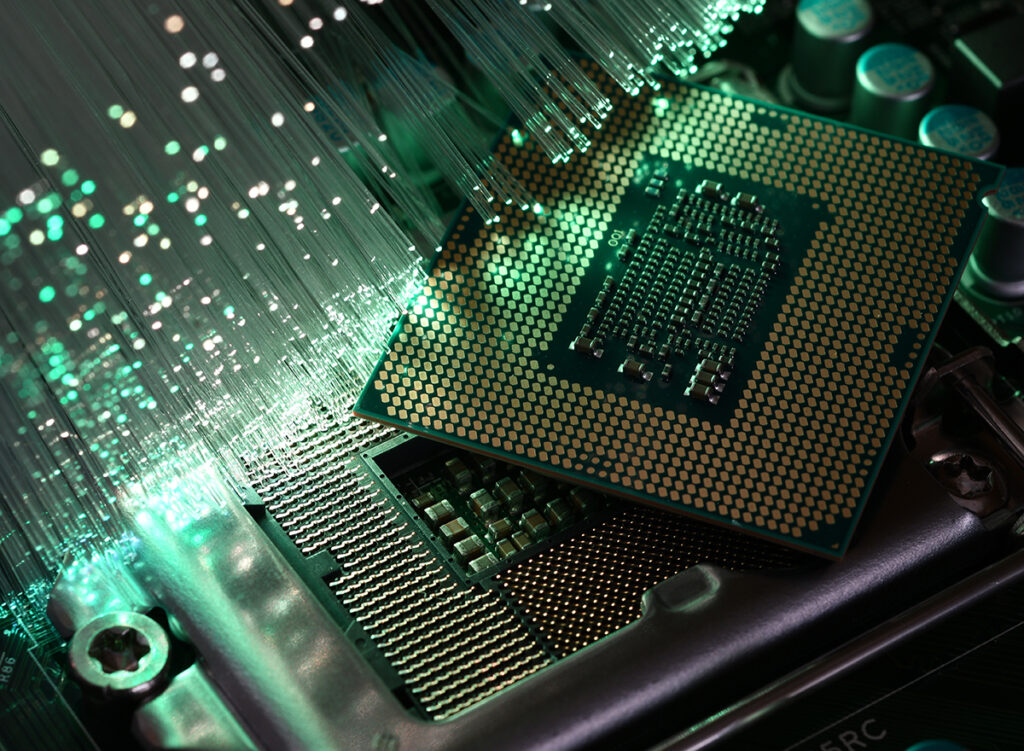
The key commodities of classical computing, those silicon wafers and central processing units powering the surge in artificial intelligence (AI) hardware, are designed to overcome thermal fluctuations that might otherwise overwhelm the signals of interest. This also applies to advanced quantum computing, where every material and component involved is cryogenically frozen, so the quantum signal is larger than any thermal fluctuations. But what if engineers could exploit that random noise, rather than fighting it, to maximize the efficiency of the AI hardware?
It might resemble what happens in biology.
“Biology has figured out how to exploit those fluctuations, that noise,” said Shantanu Chakrabartty, the Clifford W. Murphy Professor and vice dean for research at WashU McKelvey Engineering. “If we exploit principles much like biology does, we should be able to get much greater energy efficiency,” he added.
Chakrabartty already delves into the “neurobiological approach” to computer system architecture. He is part of a group of scientists that specializes in application of neuromorphic, or neurally inspired, systems.
Now, with a more than $500,000 research grant from the National Science Foundation, Chakrabartty and his team aim to create a hybrid system of neuromorphic and quantum architecture to create a room-temperature “single electron neuromorphic processor” where every electron matters.
Read more on the McKelvey Engineering website.