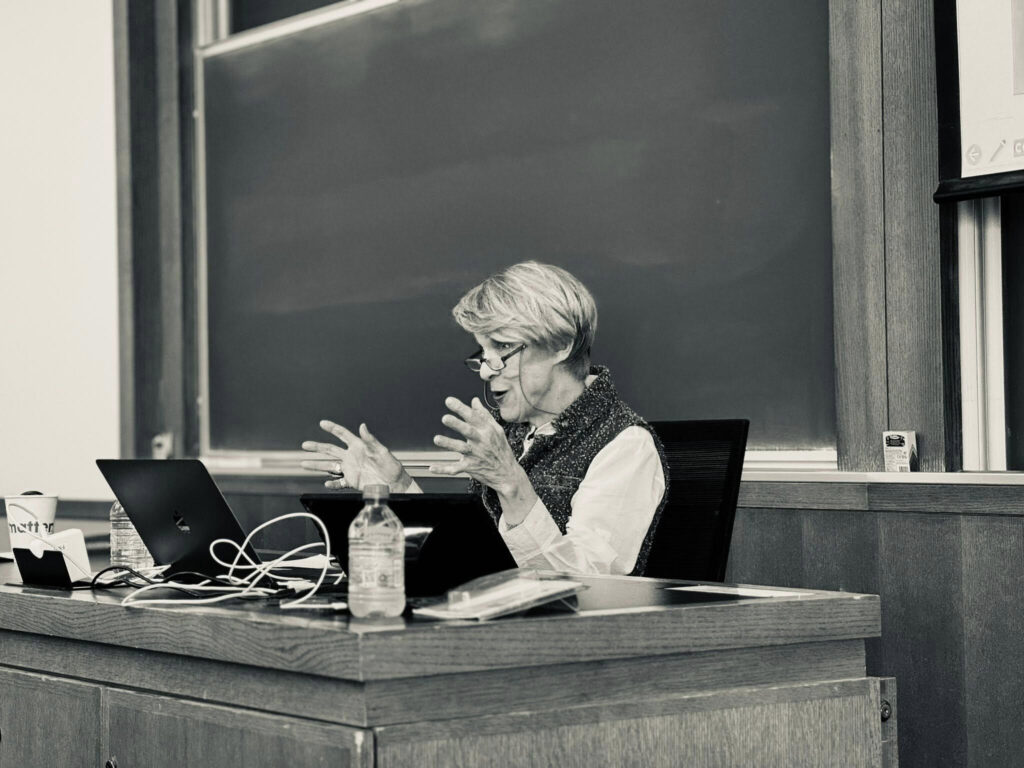
Film scholar and theorist Gaylyn Studlar, the David May Distinguished University Professor Emerita in the Humanities and former director of the Film and Media Studies program in WashU Arts & Sciences, died Wednesday, Sept. 9, 2026, in St. Louis. She was 73.
In a career stretching more than four decades, Studlar helped to shape critical discourses around the topic of film pleasure, especially relating to gender, sexuality and the fluidity of desire.
“Gaylyn was one of the most influential feminist scholars of her generation,” said Colin Burnett, an associate professor and director of film and media studies. “She was committed to rigorous film and media pedagogy and research centered on a comprehensive approach that combines film history, film theory and film analysis. At WashU, she transformed Film and Media Studies infrastructure, faculty and curriculum.”
Growing up in Lubbock, Texas, Studlar played violin and later cello. She earned a bachelor’s degree in music from Texas Tech University and a master’s in music from the University of Southern California (USC). There, Studlar began taking film classes and worked in the film library, meeting stars including Debbie Reynolds, Mae West and Charlton Heston.
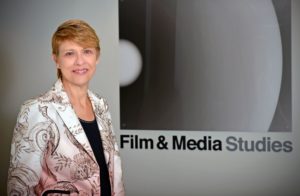
While pursuing her doctorate at USC, Studlar published an influential article on “Masochism and the Perverse Pleasures of Cinema” (1984). Later revised as “Visual Pleasure and the Masochistic Aesthetic” (1985), the piece provided an alternative to theoretical frameworks emphasizing a sadistic, controlling and voyeuristic male gaze. Instead, Studlar plumbed distinctions between sadism and masochism, arguing that “the masochistic aesthetic extends beyond the purely clinical realm into the arena of artistic form, language and the production of pleasure.”
Studlar’s analysis is now a staple of film and media studies curricula, taught alongside Laura Mulvey’s “Visual Pleasure and Narrative Cinema” (1975) and other core texts. Studlar further expanded her arguments with “In the Realm of Pleasure: Von Sternberg, Dietrich, and the Masochistic Aesthetic” (1988), her first book, which examined pleasure and sexual difference through six films starring Marlene Dietrich.
Studlar’s next book, “This Mad Masquerade: Stardom and Masculinity in the Jazz Age” (1996), interrogated the “circulation of meaning” around four male silent film stars: Rudolph Valentino, Douglas Fairbanks, John Barrymore and Lon Chaney. Here, “American masculinity negotiated various social and sexual dilemmas,” Studlar wrote. “These included the perceived rebellion of women against sexual and domestic norms, the ethnic threat of new immigrants, and the alteration of middle-class lifestyles by modern industrial economics.”
Studlar taught at the University of North Texas, Emory University and the University of Michigan before joining the WashU faculty in 2009. Under her leadership, Film and Media Studies experienced significant growth in physical facilities, tenure-track positions and student enrollment. It also launched a new master’s degree program, in 2013, and a production concentration within the undergraduate major in 2019. Her tenure further laid groundwork for new courses in digital media, video games and artificial intelligence.
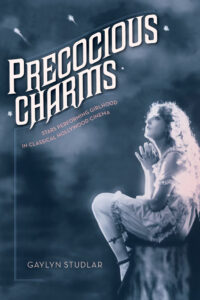
At WashU, Studlar published two additional books: “Precocious Charms: Stars Performing Girlhood in Classical Hollywood Cinema” (2013) and “Have Gun — Will Travel” (2015). Her most recent book projects were tentatively titled “Erotic Labor: Sex, Class, and Stardom in Pre-Code Hollywood” and “Westward Ho: Hollywood and Sentimental Manifest Destiny.”
Studlar co-edited four essay collections: “Reflections in a Male Eye: John Huston and the American Experience” (1993), “Visions of the East: Orientalism in Film” (1997), “Titanic: Anatomy of a Blockbuster” (1999) and “John Ford Made Westerns: Filming the Legend in the Sound Era” (2001). She published dozens of articles and book chapters and completed nearly a dozen DVD and Blu-ray commentaries. Her commentary on “The Earrings of Madame de…” (1953) is currently available on the Criterion Channel.
Studlar is survived by Thomas Haslett, her husband of 35 years. Other survivors include her brother, Donley, sister-in-law Susie, and nephews Carl and Ross Studlar. Services will be held Sept. 25 at the Weimar Masonic Cemetary in Weimar, Texas.
To honor Studlar’s legacy, Film and Media Studies has launched an annual Gaylyn Studlar Lecture. Samantha Noelle Sheppard, of Cornell University, will deliver the inaugural address Oct. 8 as part of the Film and Media Studies Colloquium Lecture Series.
For more information about Studlar’s scholarship, and for tributes and remembrances by many of her colleagues and former students, visit the Film and Media Studies website.