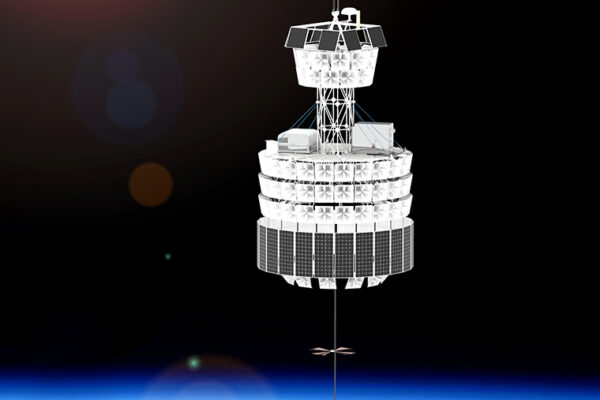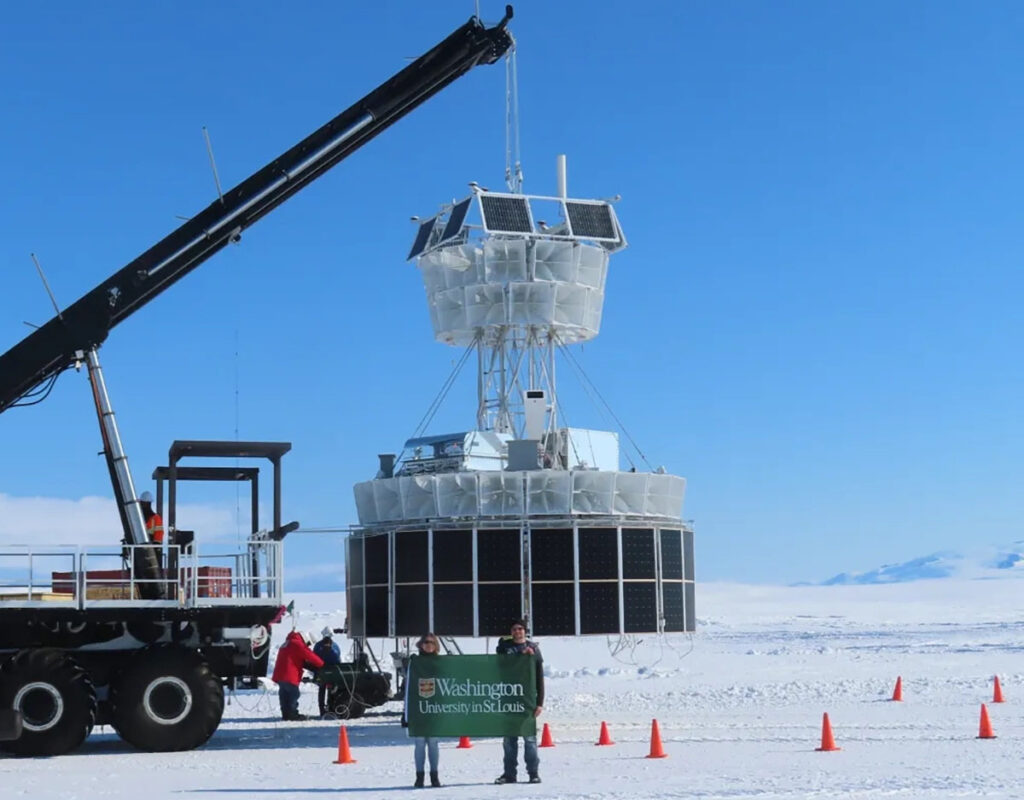
Physicists at WashU have retrieved a payload of data about ultra-high-energy neutrinos from the universe’s most extreme events, thanks to the successful inaugural flight of PUEO (Payload for Ultrahigh Energy Observations).
This long-duration balloon experiment, led by the University of Chicago and funded by NASA, reached a float altitude of 120,000 feet and operated for over three weeks, concluding its mission Jan. 12 after launching in December from the NASA Long Duration Balloon Facility on the Ross Ice Shelf in Antarctica.
WashU played a central role in both the development and recovery phases of the mission. Key contributors include Brian Rauch, a research associate professor of physics; Lindsey Lisalda, a postdoctoral research associate; and Richard Bose, a senior research engineer, all members of the McDonnell Center for the Space Sciences in Arts & Sciences. Lisalda and Bose traveled to Antarctica to support payload integration, focusing on the power system, which was developed at WashU and consists of solar panels, batteries, relays and voltage converters. Most of the gondola components were fabricated in the university’s physics machine shop.
Read more on the McDonnell Center website.