Because living systems are dynamic, biomaterials should be dynamic in their mechanics, such as stiffness, as well. The bioelectronic conducting material PEDOT:PSS is often used in electronics and biomedical applications. The material is capable of changing stiffness in response to applied voltage, but that hasn’t yet been rigorously studied — until now.
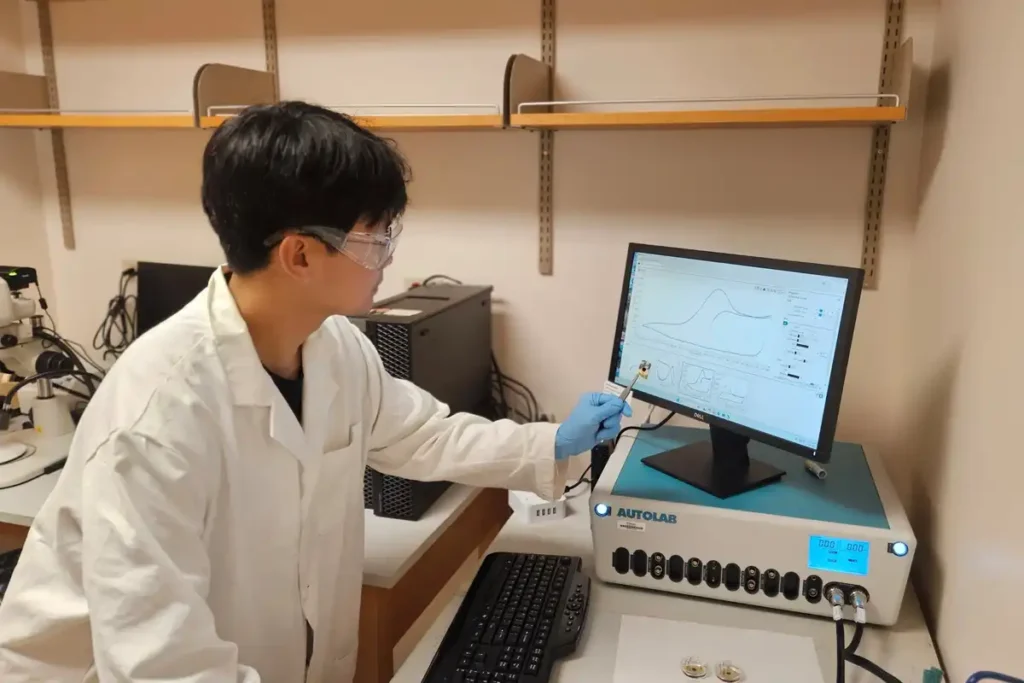
Jae Park, a doctoral student in the lab of Alexandra Rutz, an assistant professor of biomedical engineering at WashU McKelvey Engineering, has developed a unique dynamic platform with electricity-conducting biomaterials in which stiffness can be modulated by applying voltage. Such a platform can help researchers learn more about the potential to use conducting polymers to study mechanobiology and to study the effect of stiff environments on cells, which play a role in fibrosis and some types of cancer.
Results of the research were published June 1 in Advanced Functional Materials.
Read more on the McKelvey Engineering website.