When you walk into a bakery and smell fresh cookies, the enticing smell draws you in. After you eat a handful of cookies, though, the same smell likely doesn’t send you back for more. Researchers at WashU McKelvey Engineering sought to determine the biological mechanisms in the brain that controllably alters odor-evoked behavior by using an unlikely model — a locust.
Barani Raman, the Dennis & Barbara Kessler Professor of biomedical engineering, along with students in his lab, studied how two neuromodulators with opposite effects, dopamine and octopamine, changed how locusts smelled and reacted to odors. Results of their research were published Sept. 14 in the Journal of Neuroscience.
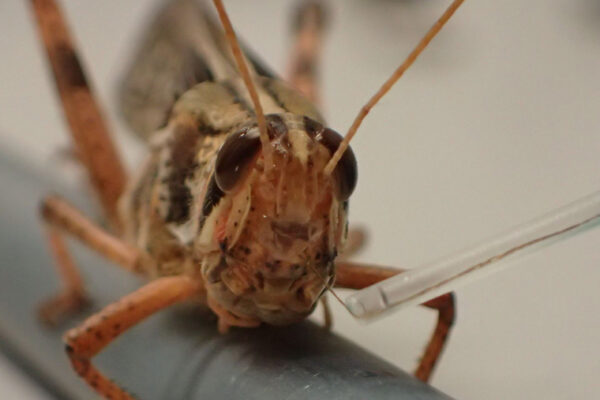
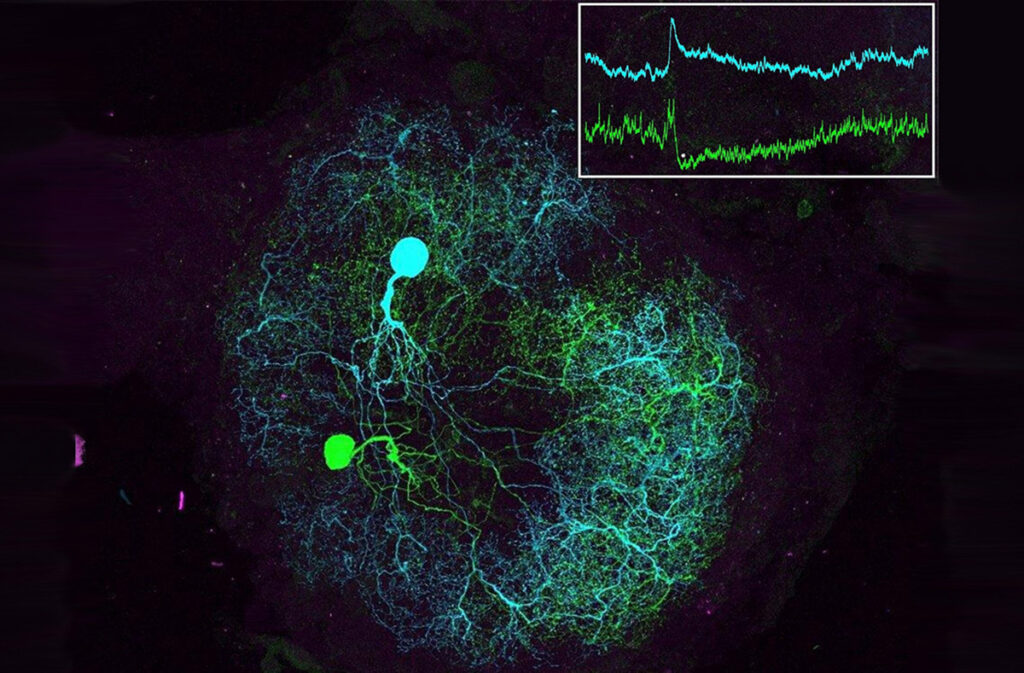
Dopamine is involved in the brain’s reward system, or a rush after doing things well. When the locusts’ brains were exposed to dopamine, the olfactory neural networks became highly sensitive to the odors presented, which included what to humans smell like grass, lemon or citrus, rose, almond and a spicy floral scent. The locusts increased the neural responses to all odorants, and an appetitive behavior response, which involved opening their sensory appendages close to mouth parts called palps that grab or touch the food.
The team also exposed the locusts to octopamine, an organic chemical behind the “fight-or-flight” neuromodulator in insects and positive learning, then presented the same odors. They found that the locusts’ odor-related brain activity and their behavioral response were reduced. Raman said the behavior differences were not random.
Read more on the McKelvey Engineering website.