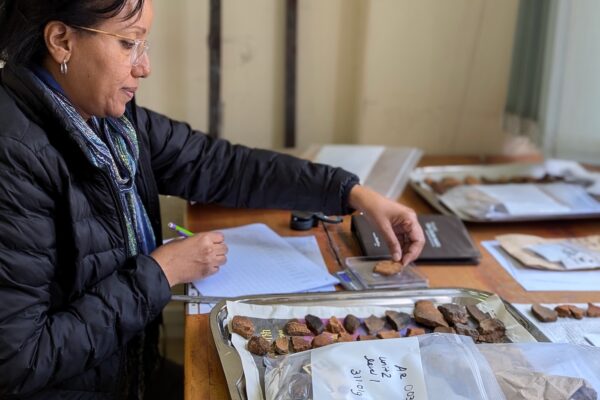
Bob Henkel, the inaugural program manager for signage in Enterprise Physical Operations at WashU Medicine, walks miles of campus each day to make sure patients, visitors, students, faculty and staff can navigate it. His preference for simple, low-cost, creative solutions and close collaboration with colleagues across campus help save money for the research, education and clinical missions. (Video: Katie Gertler/WashU Medicine)
For most of the faculty and staff who move across the WashU Medical Campus every day — and our patients and visitors — wayfinding is invisible until it isn’t. “Wayfinding” refers to a system created to help us orient ourselves and navigate through space. When it works, we find the right clinic, the right lab, the right elevator bank without trouble. When it doesn’t, an anxious patient is late to chemotherapy, a researcher is stuck in limbo instead of connecting with collaborators, or a resident misses an important mentoring opportunity.
That quiet, everyday choreography traces back in part to Bob Henkel. As the inaugural program manager for signage in Enterprise Physical Operations at WashU Medicine, Henkel oversees sign projects across the 65-plus buildings the department maintains on the Medical Campus. BJC HealthCare manages signage in its own buildings, including Barnes-Jewish and St. Louis Children’s hospitals, as well as the wayfinding along the Link, and the two organizations coordinate closely so people moving between them encounter the same look and feel. Henkel’s piece of that work is essentially translation: taking the sprawl of a busy academic medical center and turning it into something a newcomer can navigate, even on a stressful day.
A connecting thread of collaboration and service
Henkel joined WashU Medicine in 2023, continuing a career path that was largely oriented around service to others and the community. Before signage, he worked in outdoor and environmental education, led wilderness trips for young people and seniors and, for nearly a decade, ran sustainability programming and recycling operations for events across St. Louis with the nonprofit earthday365.
To Henkel, that seemingly disparate series of roles shared an underlying constant: working closely with others to solve problems, an approach to work he traces back, half-jokingly, to being the third sibling of four growing up in upstate New York and “constantly having to work with others to get your needs met.” He was drawn to WashU Medicine by the opportunity to work with “an outstanding group of people” on an internal signage program, including a joint WashU/BJC signage, branding and wayfinding committee. The program took shape after the BJC Planning, Design & Construction’s Sign Shop, which had long produced and maintained signage across campus, shifted its focus to managing signage in BJC-owned and -managed buildings and in shared public spaces.
“It’s always been kind of a team-in-the-trenches feeling,” Henkel said of his work roles. “Things like summer camps and outdoor wilderness adventures, where you’re out in the field, can be intense. You have to be a problem solver in the moment.”
Henkel spent his first six months learning the campus on foot — how to get from one building, garage and elevator bank to the next. After three years, he still puts about 5 miles on his shoes on a typical workday — “5.8 today,” he noted during a recent walkthrough of the campus — and has worn through several pairs since he started.
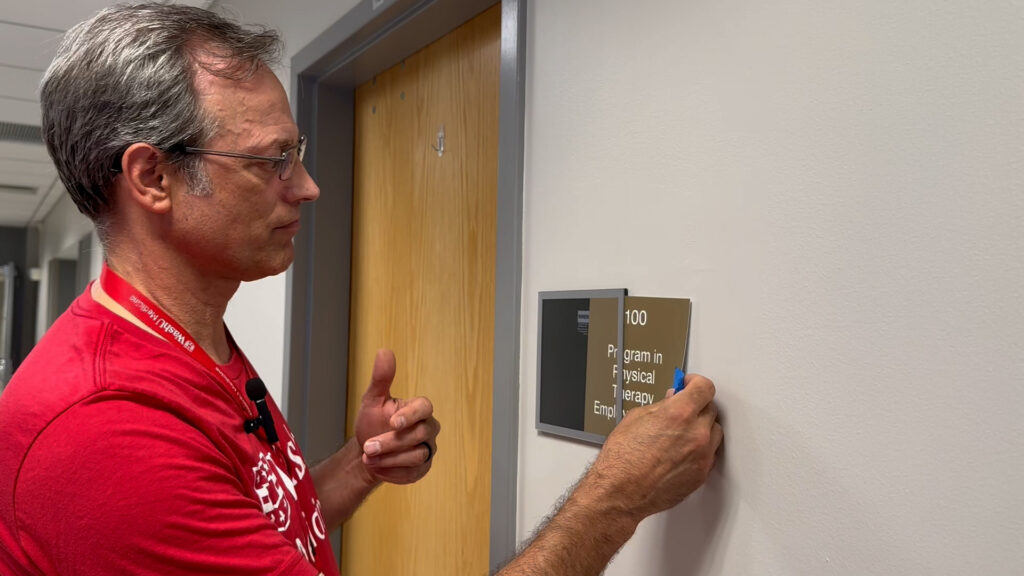
At WashU Medicine, Henkel’s problem-solving focus shapes an approach to signage geared toward hierarchy over abundance. Put up too many signs and people stop reading, so the signage program Henkel inherited and continues to develop favors the simplest possible solution: an arrow, a room number or a concise directory, rather than a surplus of details.
There’s a business case for such simplicity, too: “Sometimes people want to make a whole lot of updates to signs — they want to get their name, their department, their lab on everything,” Henkel said. “That makes it hard for us to maintain. Over time, we’d have to spend a lot more dollars to change those out every time a person or department moves. And we really want those dollars to go toward research funding, toward our students and toward our clinical practice mission.”
In other words: Dollars saved on signage are dollars available for the work that defines WashU Medicine. That thinking shows up in ways most of us have never had reason to notice.
Read the full story on the Inside WashU Medicine website.