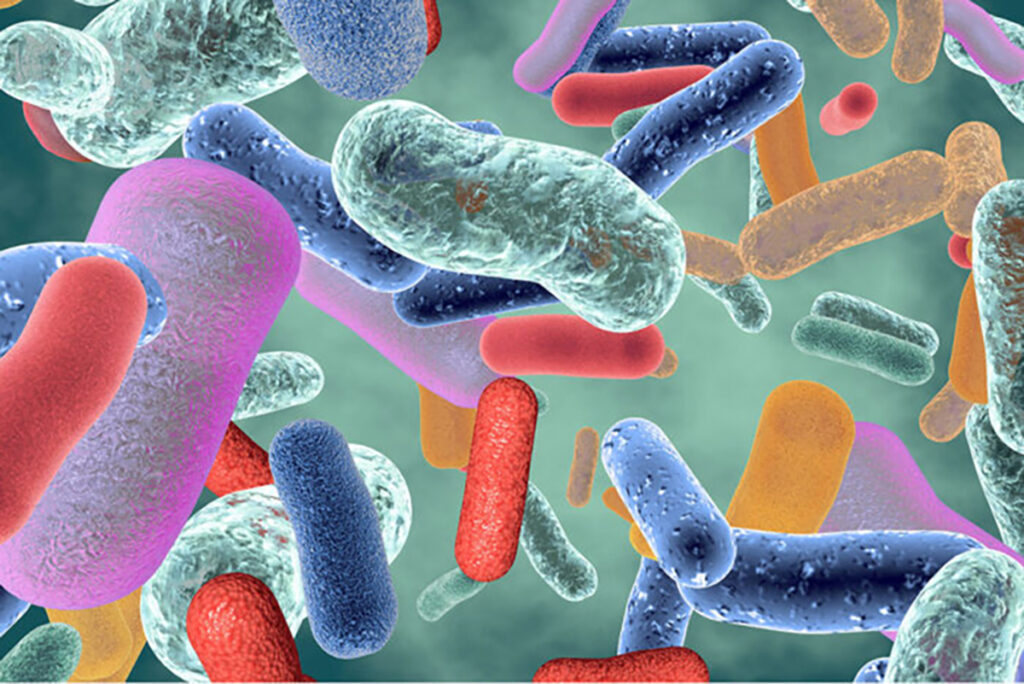
Much of the beauty — and challenge — of biology lies in its complexity. That’s especially true in the microbial world, where hundreds or thousands of different bacterial species may co-exist in a patch of soil or in a section of the human gut. Each species has its own way of life, but each also interacts with the others to shape the ecosystem.
But is there hope for some order in that complexity? A new paper in Science co-authored by Mikhail Tikhonov, an associate professor of physics in WashU Arts & Sciences, has pierced through the apparent chaos to find surprising levels of predictability in microbial systems.
“Ecologists and physicists have long had an intuition that the extremely large number of species in these ecosystems might paradoxically make them easier to understand,” Tikhonov said. “Here, we’ve shown that indeed, under some conditions, increasing the complexity of a system makes simple models increasingly predictive. But importantly, predictability is not automatic, and it’s not guaranteed by complexity alone.”
The paper — co-authored by physics graduate student Lucas Graham and former graduate student Jacob Moran, PhD ’23 — avoids the easy observations that have long clouded the picture of complex ecosystems. “One obvious explanation is that when you add a lot of different species, the quirks average out,” Tikhonov said. “That’s a very reasonable assumption, but it’s insufficient. It doesn’t deliver actual predictions.”
Tikhonov, Graham, and Moran went beyond that facile explanation to reframe the question.
Read more about their work on the Ampersand website.