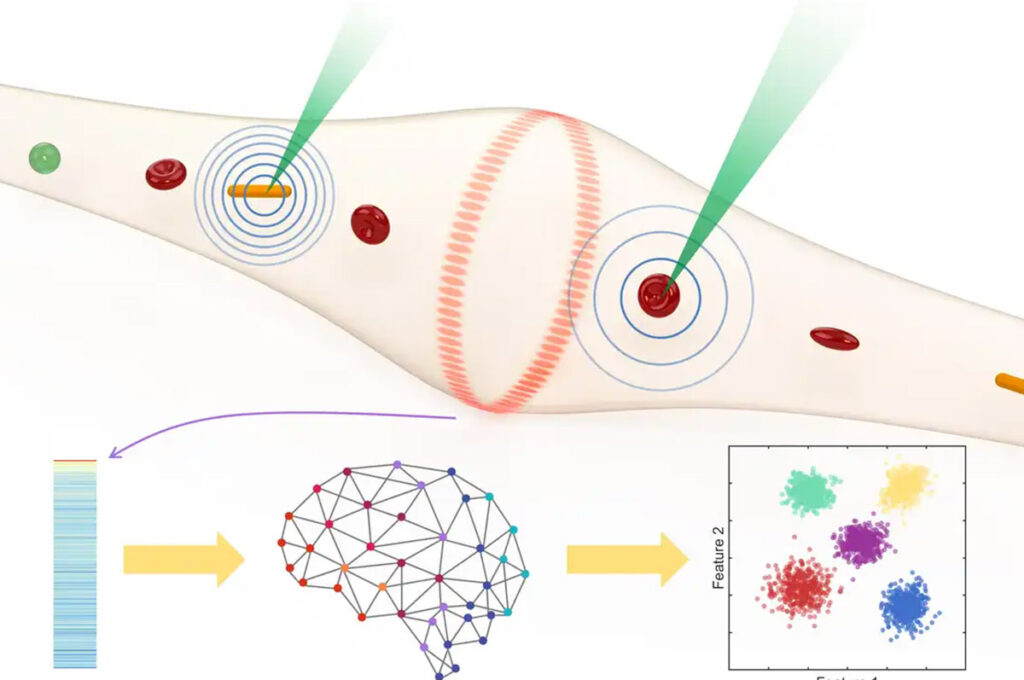
Finding a single cancer cell in a tube of blood is a bit like finding a needle in a haystack. As researchers seek to detect ever smaller and rarer targets, from viruses to circulating tumor cells, the demand for robust sensors that are both highly sensitive and practical for real-world samples continues to grow.
Many applications require sensors that are both extremely sensitive and capable of monitoring a larger volume of samples, without delicate alignment or complex preparation. In a study published in Light Science & Application, a team led by WashU’s Lan Yang reports a new strategy that closes this gap by enabling detection of particles beyond the sensors’ immediate surface.
“Over the past two decades, whispering-gallery-mode-based sensors have demonstrated exceptional capability to detect extremely weak signals across a wide range of sensing applications,” said Lan Yang, the Edwin H. & Florence G. Skinner Professor of electrical and systems engineering at WashU McKelvey Engineering. “Conventional approaches have largely relied on interactions occurring very close to the sensor surface. We wanted to unlock new capabilities for this sensing platform by extending its sensing range beyond the immediate surface, while preserving the exceptional sensitivity that has made these sensors so powerful. This can potentially open entirely new sensing modalities and applications.”
Read more on the McKelvey Engineering website.