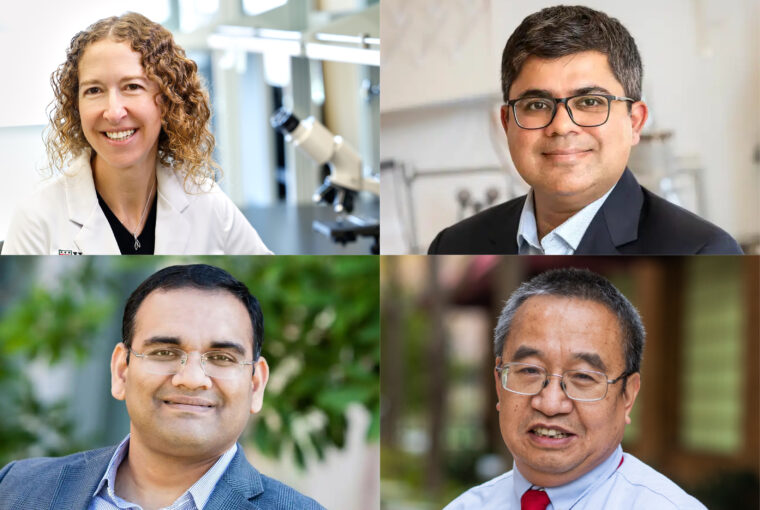
Four researchers from Washington University in St. Louis have been named senior members of the National Academy of Inventors (NAI). They include two researchers from WashU Medicine: Christina Stallings, the Theodore and Bertha Bryan Professor in Environmental Medicine in molecular microbiology, and Zhude Tu, a professor of radiology and director of Mallinckrodt Institute of Radiology’s Precision Radiotheranostics Translation Center. Two faculty from the McKelvey School of Engineering also were named: Rajan Chakrabarty, the Harold D. Jolley Professor of Engineering in energy, environmental and chemical engineering, and Vijay Ramani, senior vice provost for graduate education and international affairs and the Roma B. & Raymond H. Wittcoff Distinguished University Professor in energy, environmental and chemical engineering.
The program was created to recognize active faculty, scientists and administrators at NAI member institutions who have successfully produced, patented and commercialized technologies that have brought, or aspire to bring, real impact on the welfare of society and economic progress. WashU’s scientists are among 230 new senior members who will be inducted at the NAI’s annual conference in June.
Chakrabarty has made several breakthroughs and transformative advances in the precise measurements and characterization of wildfire smoke and developing novel technologies to address global health emergencies.
Chakrabarty’s Aerosol Interdisciplinary Research lab developed and clinically validated the world’s first portable SARS-CoV-2 instrument for monitoring the presence of the virus in indoor environments in real time. More recently, he was quick to develop the first technology for detecting H5N1 (bird flu) in air. Chakrabarty has filed eight patent applications, with three already granted, and has been an author on more than 100 peer-reviewed publications.
Ramani is recognized as an expert in electrochemical energy conversion and storage. He currently leads a nine-member research group and has secured over $17 million in competitive external funding, including leading several large, multi-institutional research grants from Department of Energy and Advanced Research Projects Agency-Energy.
Most recently, he was a member of the WashU team that secured a $26 million National Science Foundation Engineering Research Center award. Ramani’s research includes over 130 archival publications and eight granted U.S. patents. He is an elected fellow of the Electrochemical Society, among other honors.
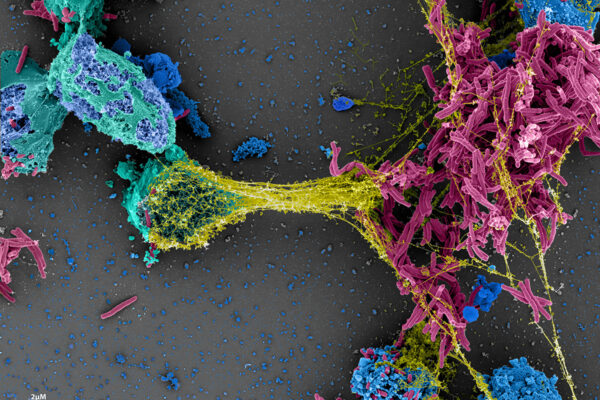
Stallings studies how mycobacteria exploit biological pathways to cause tuberculosis (TB), the deadliest infection in the world. Stallings seeks to manipulate the ways in which mycobacteria resist treatment and has discovered a method to reverse the microbes’ resistance to one of the leading TB drugs.
She has several U.S. patents based on her research, some of which have been licensed by pharmaceutical companies to develop new TB therapeutics. Stallings is the founder of the WashU Medicine Mycobacteria-focused Program for Research & Innovation in Science and Medicine and co-founder of the Philip and Sima Needleman Center for Autophagy Therapeutics and Research.
Tu conducts research that aims to develop molecules that can specifically bind to proteins involved in central nervous system disorders to make them visible and to be precisely measured by PET imaging. Such molecules, called radiotracers, are an important tool to advance the prediction, diagnosis, treatment validation and understanding of disease.
Tu’s team has recently developed a specific radioligand for Sphingosine-1-phosphate receptor 1, a promising target for multiple sclerosis therapies. Tu holds 15 patents, including three for FDA-approved radiotracers for imaging neuroinflammation in Parkinson’s disease, Alzheimer’s disease, multiple sclerosis and cerebral small-vessel disease.