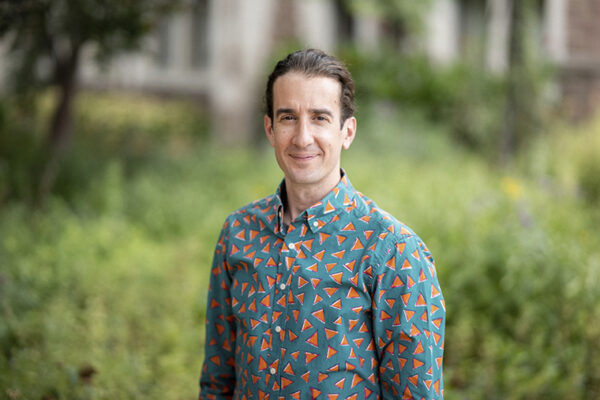
Keith Hengen, an associate professor of biology in WashU Arts & Sciences, studies the brain’s computational power. He’s now turning that knowledge toward a new endeavor: developing quantum sensors for next-generation computing.
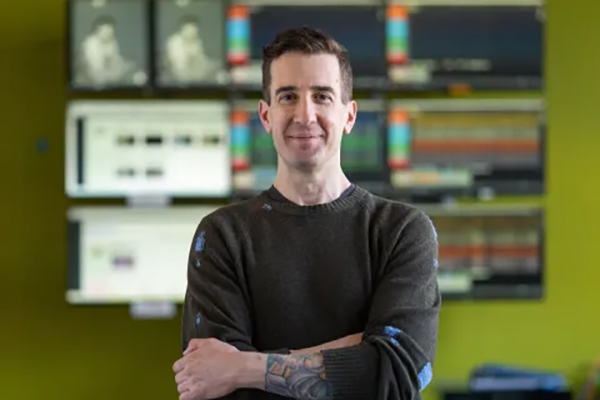
Hengen and Whitney Armstrong, a physicist at Argonne National Laboratory, are co-principal investigators of a project called “Superconducting Polychronous Computation Near Criticality.” In late July, the U.S. Department of Energy awarded $750,000 to Hengen and Armstrong as part of its Genesis Mission, a collection of research projects designed to “deliver breakthroughs to secure American energy dominance, accelerate scientific discovery and strengthen national security.”
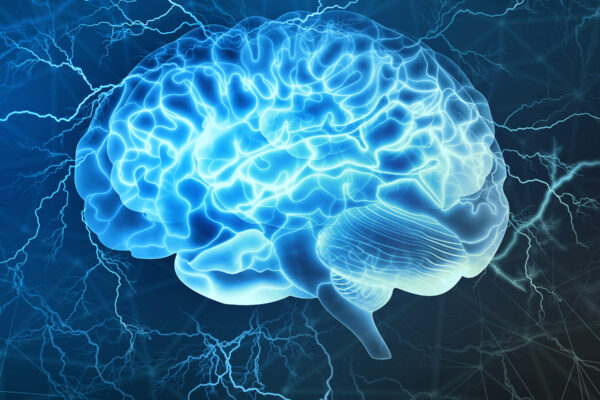
Key to this work will be Hengen’s research on criticality, a way to describe “a complex system when it’s balanced at the tipping point between order and chaos,” he said.
“At criticality, information processing is maximized. For obvious reasons, we believe the brain must be tuned near criticality for optimal thinking and learning,” Hengen said.
The idea is that concept could help increase the accuracy and reduce the energy consumption of quantum sensors, allowing the team to use quantum sensors to solve complex computational problems.
Learn more about his latest effort on the Ampersand website.