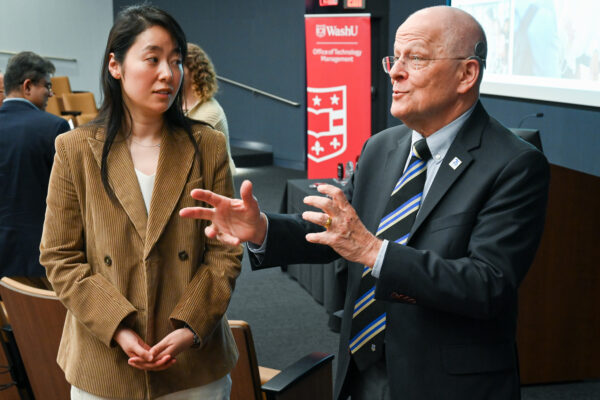
In light of economic shifts, geopolitical uncertainty and rapidly changing trade policies, companies are increasingly relying on regional supply chains and diversified sourcing strategies that prioritize resilience, faster delivery and risk mitigation, according to Panos Kouvelis, the Emerson Distinguished Professor of Supply Chain, Operations, and Technology at WashU Olin Business School and director of the Boeing Center for Supply Chain Innovation.
Kouvelis discussed the evolving dynamics of global trade during FreightWeekSTL 2026, an annual conference presented by St. Louis Regional Freightway. The conference features tours, panel discussions and interviews that highlight innovations, infrastructure improvements and trends affecting global freight movement.
Kouvelis also called attention to Foreign Trade Zones (FTZs), which have emerged as a strategic tool for businesses navigating global trade uncertainty. FTZs allow companies to store, assemble and further process goods, which can involve some manufacturing, testing or relabeling — all while deferring or reducing duties. In the St. Louis region, two established FTZs — #102, serving St. Louis and St. Louis County, and #31, serving southwestern Illinois — paired with a strong multimodal logistics network have helped position the area as a competitive hub for companies navigating global supply chain disruptions, Kouvelis said.
Kouvelis’ presentation, “Global Supply Chains in a Turbulent World,” is available online.