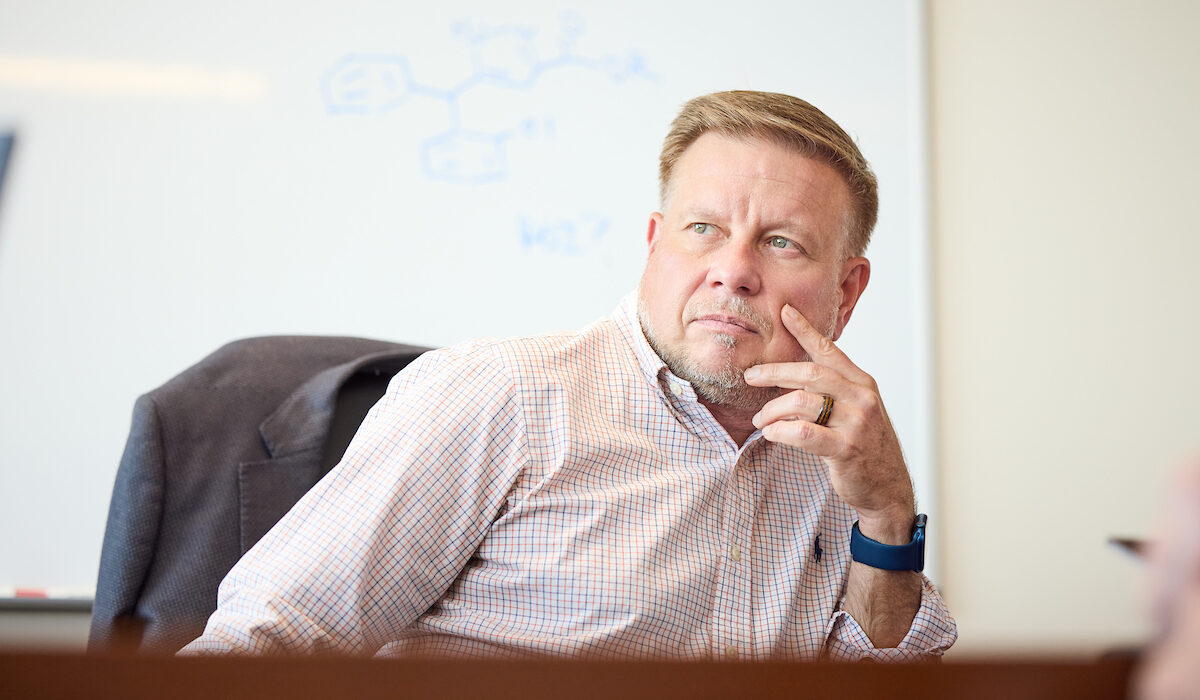
The charge on WashU’s campuses is palpable — a sense that the research happening here is not only bold but changing lives at scale. Into that current steps Doug Frantz, WashU’s new vice chancellor of innovation and commercialization. His arrival feels less like an appointment and more like a hinge moment: the instant when a great research university doubles down on building more therapies, diagnostics and devices that reach those who need it most.
Frantz brings with him a history of connecting discoveries to commercialization. He started his scientific training in East Texas and finished it with a postdoctoral fellowship in Switzerland. He came back to the U.S. to join Merck and then returned to academia to jump-start drug-development programs in the University of Texas system. This has led to his understanding of the cadence of academic inquiry and the urgency of industry development. “People here are fearless,” said Frantz. “If there is a scientific problem that needs to be solved, they will do whatever it takes to solve it. WashU is, by far, the best at tackling the toughest questions that are out there.”
WashU’s willingness to take on the toughest questions has resulted in real-world innovations with significant value to society, such as new technologies, drugs and medical devices, said Frantz. What it needs, and what Frantz has been brought here to deliver, is an accelerated pathway: Connect the right collaborators, capture the right resources and execute consistently so more discoveries travel the full distance to impact.
“It feels like it’s been my calling to develop meaningful partnerships,” said Frantz, who also is a professor in the Department of Biochemistry and Molecular Biophysics at WashU Medicine. “The opportunity to come to WashU, where the academic and intellectual resources are second to none, was irresistible.”
As an investigator with an active research lab, Frantz collaborates with scientists from the pharmaceutical industry, including with his former colleagues at Merck. It’s a common practice, and it can be a foothold to something larger, said Frantz.
“There are new ways we can work with companies and structure deals to develop scientific partnerships to fund research and innovation, and there is an eagerness here on the WashU side and with industry to come to the table,” said Frantz. He points to the recent memorandum of understanding with science and technology giant MilliporeSigma to promote research and translation efforts across WashU as an example of how collaborations with the private sector can be scaled up to support curiosity-driven science for clinical and commercial innovations.
Partnerships like that reflect a larger shift underway at WashU — one focused not simply on making discoveries, but on ensuring they reach patients and generate the resources needed to help sustain the university’s research enterprise.
Read the full profile in WashU Medicine’s Outlook magazine.