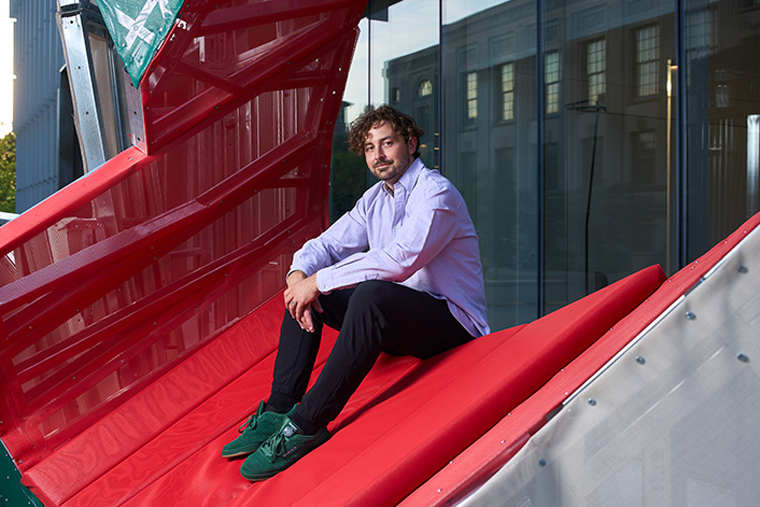
As a graduate student in architecture at the Sam Fox School of Design & Visual Arts, Scott Mitchell, MArch ’18, MS ’18, participated in a project that introduced him to the concept of misusing machines. The idea turned out to be a catalyst for a unique career.
Mitchell is now CEO of STUD-IO Computational Construction, a company that uses algorithmic tools to turn architectural drawings into code that robotic and automated tools can read to create complex architectural structures. He co-founded STUD-IO in 2019 with Adam Barnstorff, MArch ’17, MCM ’18, who serves as CPO.
During the graduate school project, which involved removing trees and clearing ground as part of renovations of the Sam Fox School site and buildings, Jesse Vogler, then an assistant professor, encouraged students to think creatively about their machines.
“We used daylight equipment, which is for uncovering underground utility cables, to expose the root system of one of the trees,” Mitchell recalls. “And then Jesse tried to use a crane to pull an entire 80-foot tree up.”
That attempt failed, as the roots were wrapped around a pipe, but the experience stuck with Mitchell.
In his work at STUD-IO, Mitchell now programs algorithms that push robotic construction machines — which are often used to build prefabricated building sections — to their limit. The work bridges his dual degrees in architecture and in computer science, which he studied at the McKelvey School of Engineering.
“These machines have a capacity to do much more than the basic tasks they were designed for,” he says. “Think of them in terms of a Venn diagram. There’s a little circle of things that people use the machine for, but there’s a much bigger circle where the boundary is defined by the actual constraints of the machine and the things it can produce.”
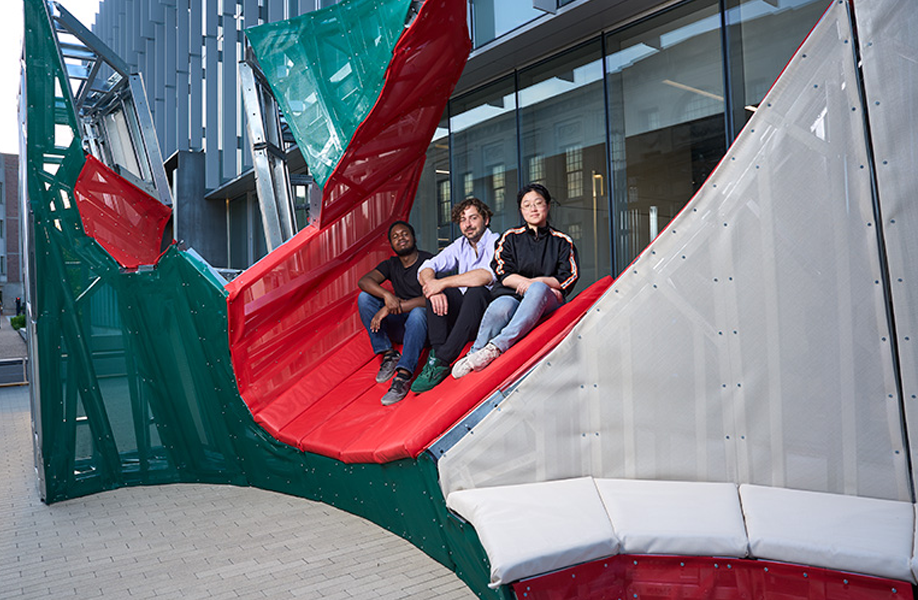
In one instance, Mitchell found that by calibrating a combination of holes that an automated metal fabricator punches in sheet metal, he could create curved studs. “You start with that punch-out action and then compose ideas and details and designs within the constraints,” he says. “To me, that’s the exact same thing as music composition or playing chess.”
For one high-profile project, STUD-IO designed a section to form the base of the Sphere entertainment venue in Las Vegas. Mitchell and Barnstorff also worked on Denver’s eye-catching One River North apartment complex, as well as Super Nintendo World at Universal Studios Hollywood. Also in California, they installed a building-scale sculpture at the 2026 Coachella festival.
“People have been building structures for houses and commercial buildings for decades, and these machines just do it faster,” Mitchell says. “But there’s a lot of latent potential to do things way beyond the manual labor they were designed to replace.”