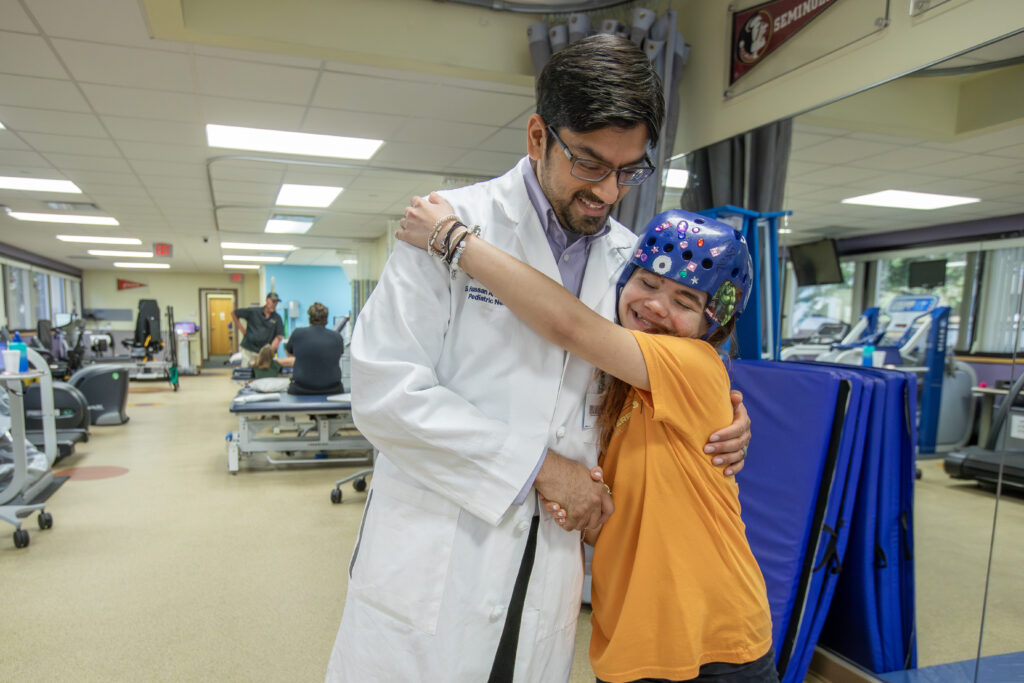
As a pediatric neurosurgeon, S. Hassan A. Akbari, MD, improves the lives of children with cerebral palsy and other muscle spasticity disorders. His areas of expertise include selective dorsal rhizotomy, a procedure he learned at WashU Medicine from the late T.S. Park, MD, who pioneered the mobility-enhancing surgery.
“When I was at WashU, I observed Dr. Park do countless selective dorsal rhizotomy surgeries,” Akbari says. “And I credit him for a lot of what I know about the surgery, as well as my passion for performing it today.”
Akbari, AB ’08, MD ’12, MS ’18, attributes his close relationships with Park and other WashU mentors for his professional foundation and trajectory.
In 2021, Akbari, who was then at Penn State Health, contacted Matthew Smyth, MD, a professor of neurosurgery and pediatrics at WashU Medicine from 2003–2021, to congratulate him on being named chief of the pediatric neurosurgery division at Johns Hopkins All Children’s Hospital. Akbari texted: “Congratulations. And if you ever have a job opening, let me know.” Smyth responded, essentially, “OK, let’s chat Monday.”
Their follow-up communication led to a job offer. “And now I get to work closely with another of my longtime mentors,” Akbari says.
At All Children’s Hospital, Akbari sees any pediatric patient who might need surgery for spasticity, a type of disruptive muscle contraction that arises from some neurological conditions. “I’ve created a spasticity clinic here with a physical medicine and rehabilitation colleague,” says Akbari, assistant professor of pediatric neurosurgery. “And I do my selective dorsal rhizotomy surgeries largely the way Dr. Park did them, except for a few minor adjustments.”
Akbari also treats patients with Chiari malformation, a structural issue where the bottom part of the brain extends into the spinal cord. “Chiari malformations are the second most common condition pediatric neurosurgeons see,” Akbari says. “The first is hydrocephalus — buildup of fluid in the brain — because that can occur for a variety of reasons.”
According to some reports, between 1% and 3% of people in the U.S. have a Chiari malformation. Akbari says that range might be low, though, because many people don’t know they have one until they get a scan for something else.
“When I was at WashU, I observed Dr. [T.S.] Park do countless selective dorsal rhizotomy surgeries. … I credit him for a lot of what I know about the surgery, as well as my passion for performing it today.”
S. Hassan A. Akbari, MD
David Limbrick, MD, PhD, co-leads the consortium — a nationwide group of children’s hospitals working to identify best treatments for children with syringomyelia, which is typically caused by Chiari malformation type 1.
Children with syringomyelia can be asymptomatic, but those with symptoms typically require surgery. There’s no medication to help alleviate symptoms, including chronic pain, headaches and progressive weakness in arms and legs.
“During surgery, you need to remove some bone in the back of the head, to give everything a little bit more space. And that’s usually enough,” Akbari says. “But sometimes you also need to open the lining to the brain, called the dura, and sew in a patch to give everything even more space.”
Akbari assisted Limbrick with research that compared these two surgeries — bone-only decompression versus decompression with duraplasty — asking which is better and when. “For the most part,” Akbari says, “we found the first option to be better.”
Today, as director of clinical research for the pediatric neurosurgery division at All Children’s, Akbari researches Chiari malformation and other neurological disorders, as well as the sociodemographic barriers to neurosurgical procedures.
Akbari also serves as the hospital’s director for undergraduate medical education, where he oversees medical students in different rotations, including pediatrics clerkships. He participates in educational outreach in the community, as well.
In a program called Medical Explorers, for example, Akbari helps introduce high school students to different professions available in medicine. “We discuss the gamut,” he says, “to give them broad exposure to what’s involved in healthcare.”
Akbari, who embodies the difference a good mentor can make, now relishes being the teacher.
“When I was going through medical training, someone said, ‘You have two big decisions to make: One is medicine versus surgery, and the other is adult versus pediatric care,’” he says.
Some medical students shy from pediatrics because it’s hard to deliver bad news to children and their families, Akbari says. “I viewed it more as an opportunity to help guide patients as well as their families. And then seeing kids who were in dire circumstance have good outcomes. It’s hard to argue with the amount of joy that brings to everyone.”