It’s not the first time college sports have been marked by chaos and uncertainty.
In the post-World War II, G.I. Bill era, campuses all over the country were bursting in enrollment with students returning to the home front older, stronger and ready to compete. College athletics was marked by creeping professionalism, an abundance of money and virtually no rules or standards.
And into the fray stepped Arthur Holly Compton.
Yes, that Arthur Holly Compton: Nobel Prize-winning physicist, a key scientist in the Manhattan Project and newly minted chancellor of Washington University. Compton, a bit of a national celebrity in the postwar years, understood that college sports was at a crossroads. So he used his fame to make it clear where he stood on amateurism in college athletics, and what might happen if it disappeared.
In January 1946 — less than a month before he would be officially installed as chancellor — Compton stepped to the podium at an NCAA executive meeting in St. Louis attended by coaches and presidents from across the country and issued a warning about the future of college sports:
“The financial pressure to win games has many coaches and college executives straining his conscience in employing athletes and urging students to devote to the game their time and their primary interest that should have been reserved for their studies,” Compton said.
“If the heavy demand for intercollegiate games as sports spectacles interferes with a program of educational athletics, the institutions that are in earnest about education will be compelled to stop intercollegiate games.”
Compton made it clear: In his view, the student came before the athlete. And he put WashU’s money where his mouth was. He abolished athletic scholarships at WashU — a highly unpopular decision at the time among students, alumni and local media who wanted WashU to have “Big Time” college football — and hired an athletic director, Blair Gullion, to implement WashU’s Amateur Athletic Program.
Compton didn’t back down. His philosophy of amateurism would be the foundation for the creation of the NCAA’s non-scholarship Division III almost three decades later and remains the foundational tenet of WashU — a clear line to today’s student-athletes.
Not about trophies — but winning them anyway
Fast forward 80 years, to February 2026. Jenae Bothe, AB ’26, was competing in an indoor track meet at Illinois Wesleyan University when she hurled an 8.8-pound shotput 15.16 meters, farther than any woman in NCAA indoor track and field by that point in 2026. How did she celebrate? By doing homework on the bus ride back to campus. “I had a class presentation that Tuesday,” she says. “I had to organize my notes.”
Fred Ware, BSBA ’26, a four-year contributor at running back for the WashU Bears football team, started his final game last November, completed his undergraduate degree requirements at Olin Business School a few weeks after that, then began a job in the spring with the Boston Consulting Group in Dallas. He returned to campus in May not only to graduate, but to address his classmates as Olin student speaker.
“WashU was a place that, for me, ended up being the best choice I could have made,” says Ware, who grew up playing football in Texas and had Division I prospects. “I ended up with a full-time job offer and found success in football with the winningest classes in WashU history.”
“Everyone in the building is committed to the heart of what we do, which is developing young people.”
Anthony Azama
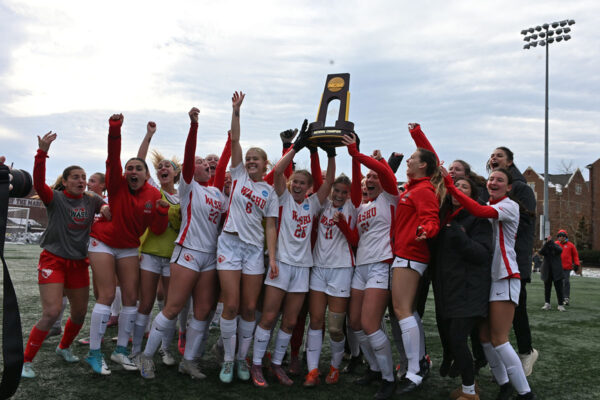
Bothe and Ware were only two of the hundreds of athletes who competed in the WashU athletics program in 2025-26 on 19 intercollegiate teams. It was a season in which WashU had arguably its most successful run ever, adding two more Division III national team titles — women’s soccer and women’s indoor track. The academic year also boasted 10 individual national champions among the women’s and men’s indoor and outdoor track and field teams, as well as two national runners-up in women’s tennis and women’s outdoor track.
And then this: For the first time in program history, WashU was awarded the Learfield Directors’ Cup, presented in June by the National Association of Collegiate Directors of Athletics, as Division III’s best overall athletic program.
WashU today boasts 29 national Division III titles among 10 teams, beginning with volleyball in 1989. That doesn’t begin to include 97 Final Four appearances, 276 conference championships and myriad other awards and accolades for individual athletes. Many more accolades, including a crystal cup and two rectangular NCAA national championship trophies, were added to the shelves of the Athletic Complex last season.
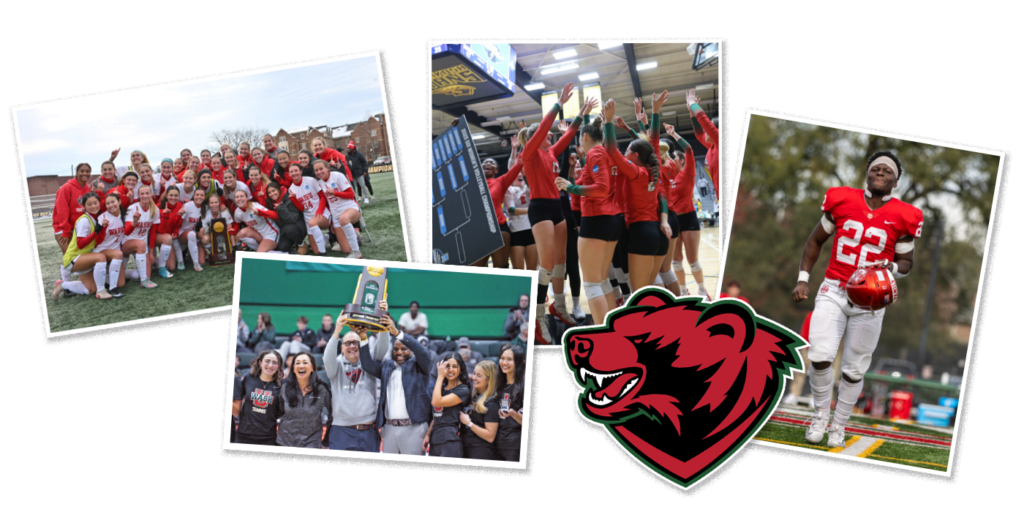
But Anthony J. Azama, associate vice chancellor for student success and the John M. Schael Director of Athletics, who is beginning his 10th year as A.D., is the first one to shout from the rooftops that Division III sports are not about trophies. Just as when Arthur Holly Compton defended “a program of educational athletics,” Azama continues to center WashU sports on athletes more than accolades.
“WashU athletics is about the people, the tradition and the foundation that’s been laid by numerous legends who have come through this program — student-athletes, coaches and administrators,” Azama says. “Our mission statement is ‘Building community; Developing champions; Impacting lives.’ Everyone in the building is committed to the heart of what we do, which is developing young people.”
And it’s working. Azama cites a 3.67 cumulative GPA (for the 2025-26 academic year) among WashU’s “scholar-champions,” a term he coined at the beginning of his tenure in 2017.
“Defending the standard is not a challenge,” he told the athletes at the program’s annual awards night in April. “It’s an opportunity.”
“We’re helping student-athletes not just meet the moment, but own the moment,” Azama says. “We’re teaching them to take ownership of how they show up during practices and how they show up on game day. We’re teaching them to be really good teammates. But it’s not just the athletes; it’s also the coaches and staff. We have to be good teammates, too. We must continue to prioritize the culture and the process.”
It’s a process that remains steadfast at WashU, even at a time when college sports — at all three NCAA levels — is changing, with name-image-likeness (NIL) rules allowing athletes to profit from endorsements, transfer at will and, at the Division I level, get paid to play thanks to a new policy of revenue sharing.
Division III athletes can receive NIL money, but WashU has enacted Missouri state policies that must be followed. How the chaos of Division I sports affects Division III overall remains to be seen, but at WashU, the philosophy will not change. “Our goal will always be to help young people go beyond their aspirations,” Azama says.
No going through the motions
Azama arrived at WashU in the fall of 2017 with a vision, a proactive approach, to develop student-athletes into scholar-champions who would be fully prepared for life after graduation. In promoting university resources to student-athletes, this approach helped prepare student-athletes during their four years for the ultimate goal of experiencing lifelong success after graduation.
“When you couple the WashU academic rigor with the life lessons you learn in sports, student-athletes are equipped with the transferable skills for success like resiliency, teamwork, perseverance and commitment, to name a few,” Azama says.
Nearly a decade later, administrators, coaches and trainers are helping prepare students holistically in several key areas, not only for competition but for life beyond the Danforth Campus. The Sports Performance Center, for example, is a 7,000-square-foot workout facility for student-athletes to build strength; and WashU Sports Medicine features five full-time licensed athletic trainers — the largest staff WashU has had to date — to provide prevention, recognition and rehabilitation of athletic injuries. In addition, athletics partners with other departments within the Division of Student Success to provide programming on everything from optimizing sleep, nutrition and mental health to marketing yourself as a student-athlete, post-graduation readiness, financial readiness and much more.
“We want to help our students improve, even if that’s only 1% better. And then do it again the next year, and then over four years, and then the next 40 years. These are the kinds of things you hear on a daily basis.”
Summer Hutcheson
Also offered are campus-wide services tangentially connected to the athletics program, such as nutrition and mental health services through the WashU Center for Counseling & Psychological Services.
“If you walk around our building, it’s amazing to me how everybody buys into this mission of holistic student development,” says Summer Hutcheson, senior associate director of athletics. “We want to help our students improve, even if that’s only 1% better. And then do it again the next year, and then over four years, and then the next 40 years. These are the kinds of things you hear on a daily basis.
“Students need to learn how to hold each other accountable, but in a positive way. How do they have those conversations without starting a rift? How do you keep yourself on track? Coaches, administrators, athletes, everyone is buying into this programming.”
For Hutcheson, the holistic approach is a point of pride. “I can talk to almost any student-athlete in the hallway, and they can talk about some cool internship they’ve had, some research they’ve uncovered or a job that they’ve already secured. And I am proud of the fact that I work at a place where we’re helping them do that.”
“We’ve developed a culture where we’re not just recruiting athletes,” Azama says. “We’re recruiting students who want to become and graduate as scholar-champions.
“There’s no going through the motions in this building,” Azama says. “Every interaction and engagement is intentional.”
At a crossroads
Even with the success on and off the field, there’s no denying that Division III college sports is at what Azama calls “an inflection point.” As in the 1940s, institutions are going to have to define what athletics means at their campuses moving forward.
But WashU will have a voice in that, Azama says. In February, Chancellor Andrew D. Martin began his first year as a member of the NCAA Division III President’s Council. As the highest governing body, the council establishes and implements policies, sets priorities and oversees the division budget. Azama is connected at the national level as well, as the newly elected 3rd vice president of the board of directors of the National Association of Division III Athletic Administrators.
“This is going to be a very important time for DIII to define itself, and not as a ‘diet’ version of NCAA Division I,” Azama says. “Whatever the future looks like, WashU’s focus will remain developing young people and getting them ready for tomorrow’s challenges. Because at some point in every athlete’s life, the sweat dries and you’ve got to hang up the jersey, right?”
“I don’t think there’s anywhere else, no DI program for sure, where I could have accomplished all that and done it well, because it was hard.”
Jenae Bothe, AB ’26
While fully committed to preparing student-athletes for their post-college futures, Azama also stresses that for the four years that WashU teammates don a Bears uniform, the university will also provide a stellar environment to train and compete.
That includes facilities. As students return this fall, a renovation of the Athletic Complex is underway and is scheduled to be completed by December. When finished, locker rooms will be renovated and expanded, and the equipment room will add much-needed space. The Field House is getting a fresh look as well. WashU athletes are on the move.
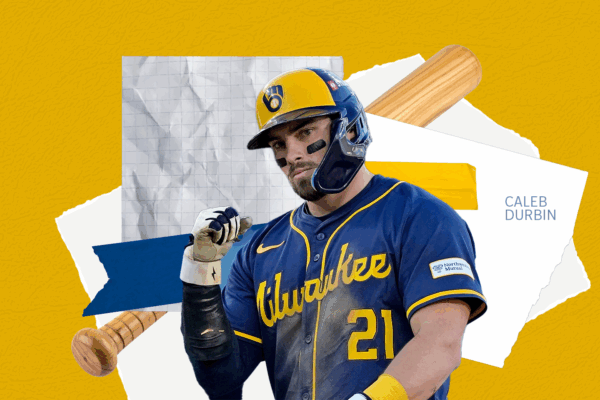
“It’s been pretty cool seeing a culture evolve,” Azama says. “WashU is one of the few places where you can earn a world-class degree, compete for championships and be ready for post-graduation opportunities. And to see students go to NASA or hear a student-athlete say that one of the things that got her into law school was an internship at the Department of Defense — that’s something. Or a guy like Red Sox third baseman Caleb Durbin [AB ’22] not only making it to Major League Baseball but getting his degree after he was drafted. Those are all proof points.”
The athletes agree. “I don’t think there’s anywhere else, no DI program for sure, where I could have accomplished all that and done it well, because it was hard,” says Bothe, who is beginning classes this semester as a first-year student at WashU Law. “But I had support. Here, there’s this shared agreement with coaches and trainers and teammates where it’s like, ‘I guess we’re doing hard things, but we’re here for the right reasons. And we’re all trying to get you where you want to go.’”
And there’s Ware, who told his Olin Business School classmates at the Commencement ceremony: “We got here through discipline, sacrifice, perseverance and the quiet decision to keep going, even on the days when quitting would have been a little easier. … We already have proof that we can succeed.”
“We’re living our mission,” Azama says. “From administrator to athlete, we’re invested in the process. And that is our biggest success.
“I’m pretty proud of the fact that WashU is a transformative place.”