Patricia Leighton Cugno, AB ’91, has just one line in the official WashU women’s soccer record book — her name on an all-time roster, with a single year listed: 1989. A second alumna, Nell Sprague Ruby, MFA ’89, doesn’t even appear on the official record. But the two women may well be the most significant figures in the history of WashU women’s soccer.
How? By noticing a gap and doing what was needed to fill it. In this case, marching into the office of then-athletic director John Schael in the fall of 1987 — a good 15 years after Title IX banned sex-based discrimination in school sports — and asking two questions: Why is there no women’s soccer team at WashU? And what do we need to do to start one?
Schael, for his part, listened. “He said, ‘Show me there’s interest, and I’ll follow your lead,’” Cugno recalls.
There was interest all right.
This is a story some 39 years in the making. It began in the second half of the 1980s, when music was played on both vinyl and cassette tapes; jeans were stone-washed; and students called their parents on residence hall pay phones. It’s a story of two young women not being afraid to step up and ask the right questions. It’s a story about how a soccer program, now beginning its 2026 season as back-to-back defending national champions, got from there — to here.
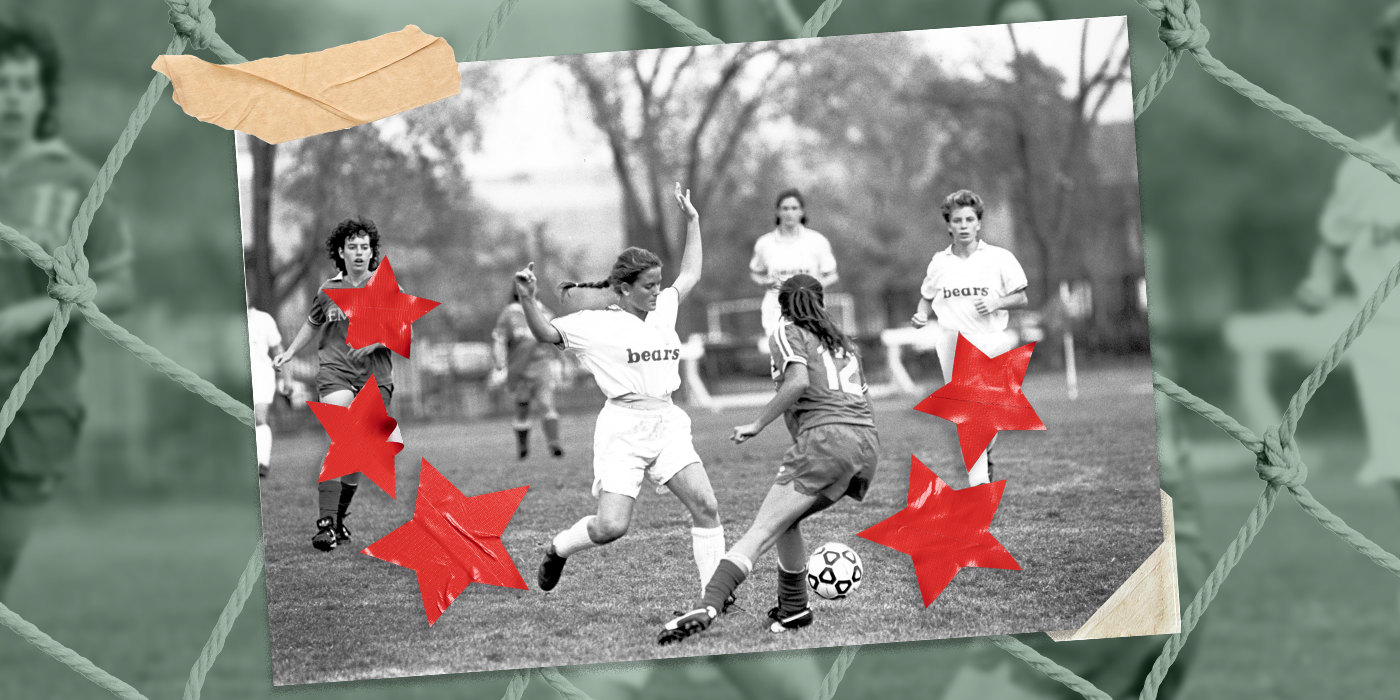
And it’s being told because of a picture that ran in the spring 2026 issue of WashU Magazine, a two-page black-and-white photograph from fall 1989 depicting the final game of the first women’s varsity season in school history. The magazine invited readers to identify any of the WashU players in the photo — three young women in white uniforms, with braids and mullets, defending against a single opponent.
And you did.
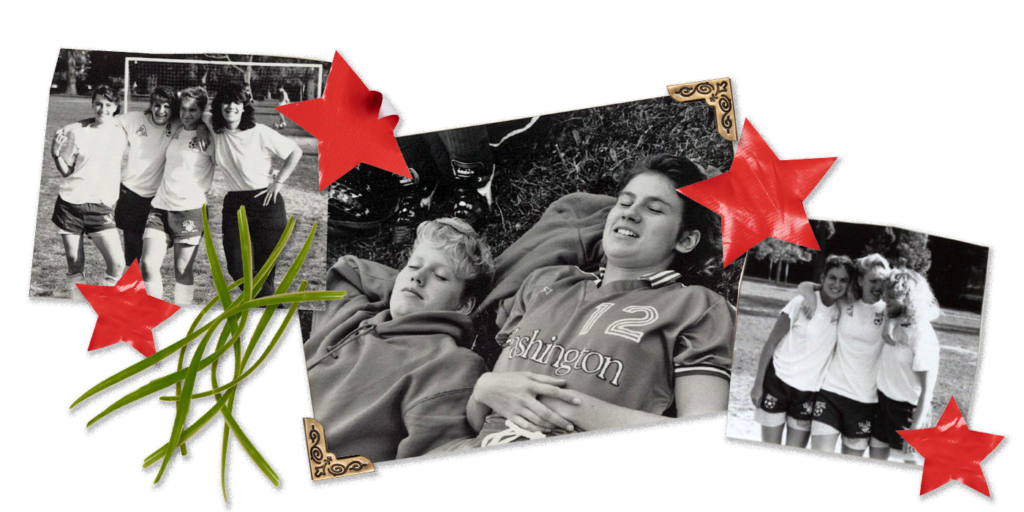
“I have a lot of information that I can share,” Cugno wrote in. “All of those faces look familiar …” Turns out, we were hearing from the source.
“Patty made the magic happen,” says Elysha Konicov Nichols, AB ’91, the woman at left in the photo. “She was like, ‘I have this vision and I’m going to see it through.’”
Cugno wasn’t necessarily looking to play a sport in college when she matriculated on the WashU campus in August 1987. She was mainly hoping to get involved in something, just like any other first-year student.
“I remember thinking, ‘Here I am in the Midwest, a girl from the East Coast who just wants to make friends and find her footing,’” Cugno says. “But the more people I met, the more girls I found that played high school soccer. We just started playing intramurals and pickup games.”
Cugno had been a high school athlete at an all-girls school in Buffalo, New York, where, she says, she and her classmates learned that “if you wanted something, you just handled it.
“When I got here, I remember thinking, ‘Why is there no women’s team when there’s a men’s team? That’s not acceptable! So what are we going to do about it?’”
She got to work.
“I recruited, I don’t know, maybe 15-20 girls, and we went out and practiced every day,” Cugno says. “We just went out and played.”
Ruby, now a professor of art at Agnes Scott College in Decatur, Georgia, says she was likely running around the Francis Field track when she first bumped into one of those pickup games. Having played club soccer as an undergraduate at Rice University, she joined in. “I remember being crazy about the game of soccer,” she says. “I think I was appalled that WashU didn’t have a team.”
As a graduate student at the Sam Fox School of Design & Visual Arts, Ruby became a valuable voice in the nascent team.
“Patty needed a ‘big sister,’” says Margaret DeMattia DeMichele, BFA ’91, the player in the center back of the photo. “She needed somebody backing her up saying, ‘Yeah, you girls deserve this. Nell’s skin in the game was just to help make this happen because she wasn’t even eligible to play as a grad student.”
They were playing to prove a point. By the end of that semester, Cugno says she went back to Schael and said, “Hey, I have 20 girls, and we’re all committed for next year.”
The foundation was laid.
A team is launched
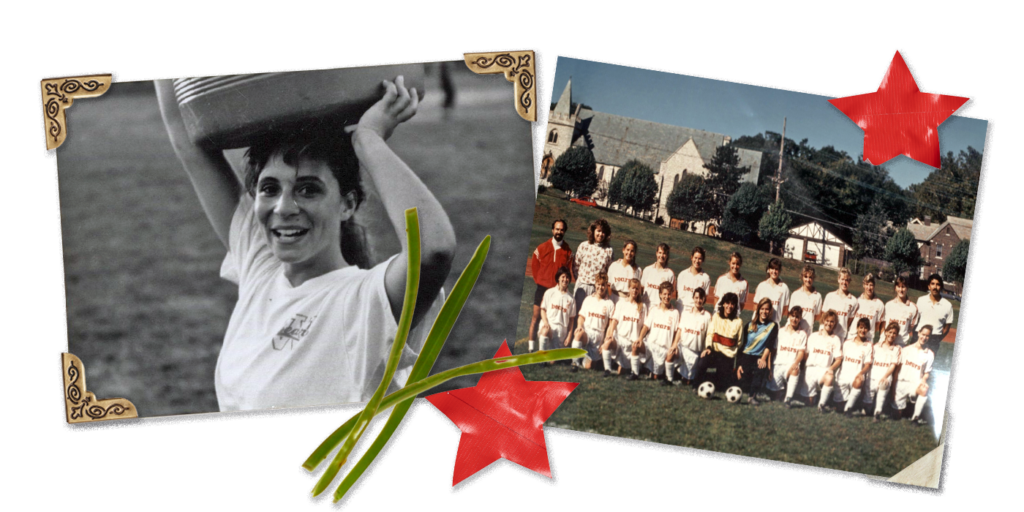
Varying memories about those years arise from Cugno, DeMichele and Nichols. They recall getting hand-me-down uniforms from the men’s team to practice in and recruiting a goalie from the men’s soccer team, Chris Scaglione, BS ’91, MBA ’91, to coach. They’d carpool to games at local colleges like Maryville University. Maybe there was one bus trip a season to Chicago or Atlanta. They’d practice wherever they found an empty field, from Francis Field to Mudd Field to the South 40 intramural fields.
“Sometimes we’d practice on Saturday mornings right outside the Beta Theta Pi fraternity house, and they would get so mad because there were you know, 20 girls on the field screaming and laughing — and playing soccer,” Cugno says.
In 1989, the first official varsity season was finally underway. The team won four out of nine games, and a local high school coach named Doug Hippler was hired. The WashU Magazine photo depicts the last game of the that first season, an overtime loss to Emory University on October 28, 1989.
“We weren’t a sorority, but we were this bonded group of women who had a really fun time. It was great to be on a team with all these badass women who brought that kind of energy. We loved playing soccer, and it felt very special to be a part of something foundational.”
Elysha Konicov Nichols, AB ’91
No matter. The varsity team was launched — with everyone except Ruby, who had already gotten her MFA in art and moved on.
The team was well aware of its status as newcomers on the pitch. “We knew the guys’ team got things we didn’t in those years, like a bigger budget for travel allowances and uniforms,” Nichols recalls. “We weren’t happy about it, and we certainly didn’t keep our mouths shut. But I do recall John Schael being supportive of us and doing the best he could for us.
“And we were very supportive of each other.”
“It was a community of women from all over the university and all different departments,” DeMichele says. “I was an art major who was siloed down in a studio for much of my time, so it was great to get out and play soccer in a WashU uniform. No one expected anything of us.”
Throughout their years at WashU, from club status to varsity, all three women speak to being on the team as a sisterhood.
“We weren’t a sorority, but we were this bonded group of women who had a really fun time,” Nichols says. “It was great to be on a team with all these badass women who brought that kind of energy. We loved playing soccer, and it felt very special to be a part of something foundational.”
Playing it forward
Current women’s Coach Jim Conlon makes it a priority to keep the WashU women soccer alumnae involved in the team. He schedules an annual alumnae game at Reunion Weekend each April along with twice-a-year alumnae Zoom calls for whomever wants to join.
He also has started a unique letter-writing program that goes both ways. Players write letters to the alumnae on Reunion Weekend telling them what the program means to them; and throughout the year, Conlon asks alumnae to write letters to the women who are wearing their numbers. These are randomly left in lockers before a game, and they have a tremendous impact on the players, he says.
Another letter campaign takes place during the three weekends that make up the NCAA tournament. Conlon says he asks the former players to write letters to the current players on what it means to be a Bear. They’re read after dinner to the team, by either an alum or a senior. “These letters mean so much to the players, who get a sense of the struggles and triumphs of the women who came before them,” he says. “You win with talent, but it also helps to have perspective.”
“I’ve written a few letters,” DeMichele says. “None of the current players on the team have a clue who I am, but it makes me feel connected to the team. Playing soccer at WashU remains one of the things I’m incredibly proud of.”
As is Nichols. “It’s one of the things that I think about when I think about WashU,” she says. “It really was a huge accomplishment for me in my life to say that I was once a part of this team. I watch the way women play the game now, and I think to myself, ‘I can’t believe I did that!’”
Ready for takeoff
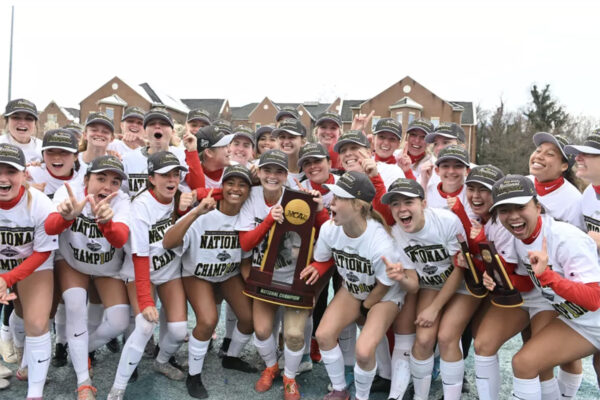
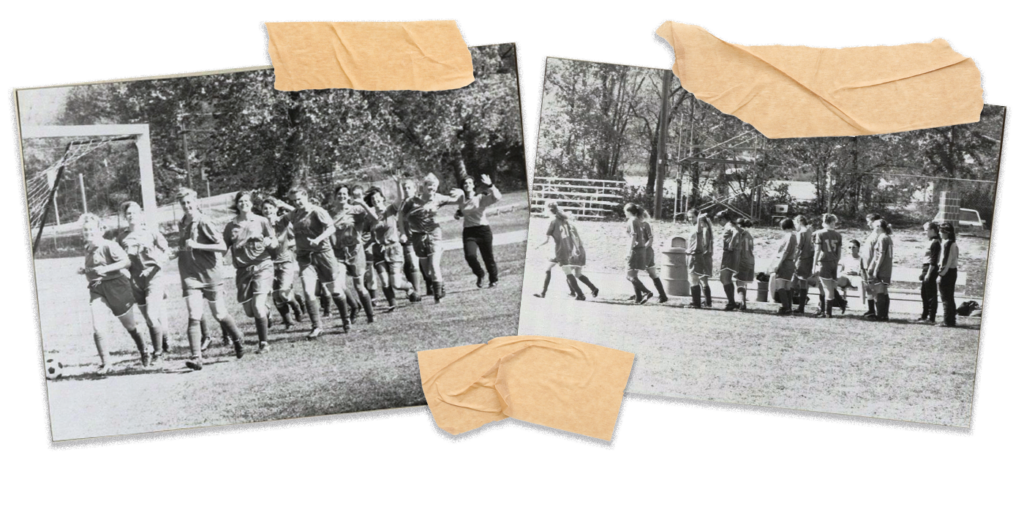
By the program’s second season, 1990, a whole new class of first-years were coming to WashU with the intent of playing soccer, and the team had its first winning season. By 1992, its first All-Americans; by 1995, its first NCAA tournament appearance; by 2009, its first NCAA title game; by 2016, its first NCAA championship. In the team’s 36 seasons (no games were played in 2020) only three have seen them finish below .500. The team began its 37th season last week as two-time defending national champions, and, with three wins through September 6, is now riding a 47-game unbeaten streak. The WashU Bears haven’t lost since Dec. 2, 2023.
Looking back, both Cugno and Ruby downplay their role in starting it all.
“I was like the Pitocin in the birth of the program,” Ruby says. “I was there at the delivery, and that was it. But I was happy to contribute because it’s such a great game.”
Cugno, for her part, is a WashU mom now. Her son, Ben, is a junior in Arts & Sciences and, at 6-3, plays on the men’s volleyball club team. She and her husband, Stefano Cugno, AB ’91, love coming back to campus to cheer him on, as she did last spring and happily shared her college scrapbook with WashU Magazine. But she too, understates her role as a catalyst.
“I just saw an opportunity and took it,” she says. “I grew up thinking that the same opportunities should be given to both men and women. But was it extraordinary? I don’t know. I feel like everyone who goes to WashU is capable of doing extraordinary things.”
Inset photo illustrations by Monica Duwel/WashU. Photos courtesy of Patty Cugno.