“Nothing ever goes from start to finish in the way you initially imagined it,” says John Moore, BFA ’66.
“You start off, you get stuck on something, you go work on something else and then try to clear your mind out of that. You get stuck again, and then you go back to the thing you were blocked with in the first place. All of a sudden, things opens up.”
Things have been opening up for decades now for Moore, an acclaimed contemporary painter and academic known for painting industrial scenes, urban architecture and abstract landscapes with gritty realism. His work is shown in museums from San Francisco to Chicago to New York to Maine – among others.
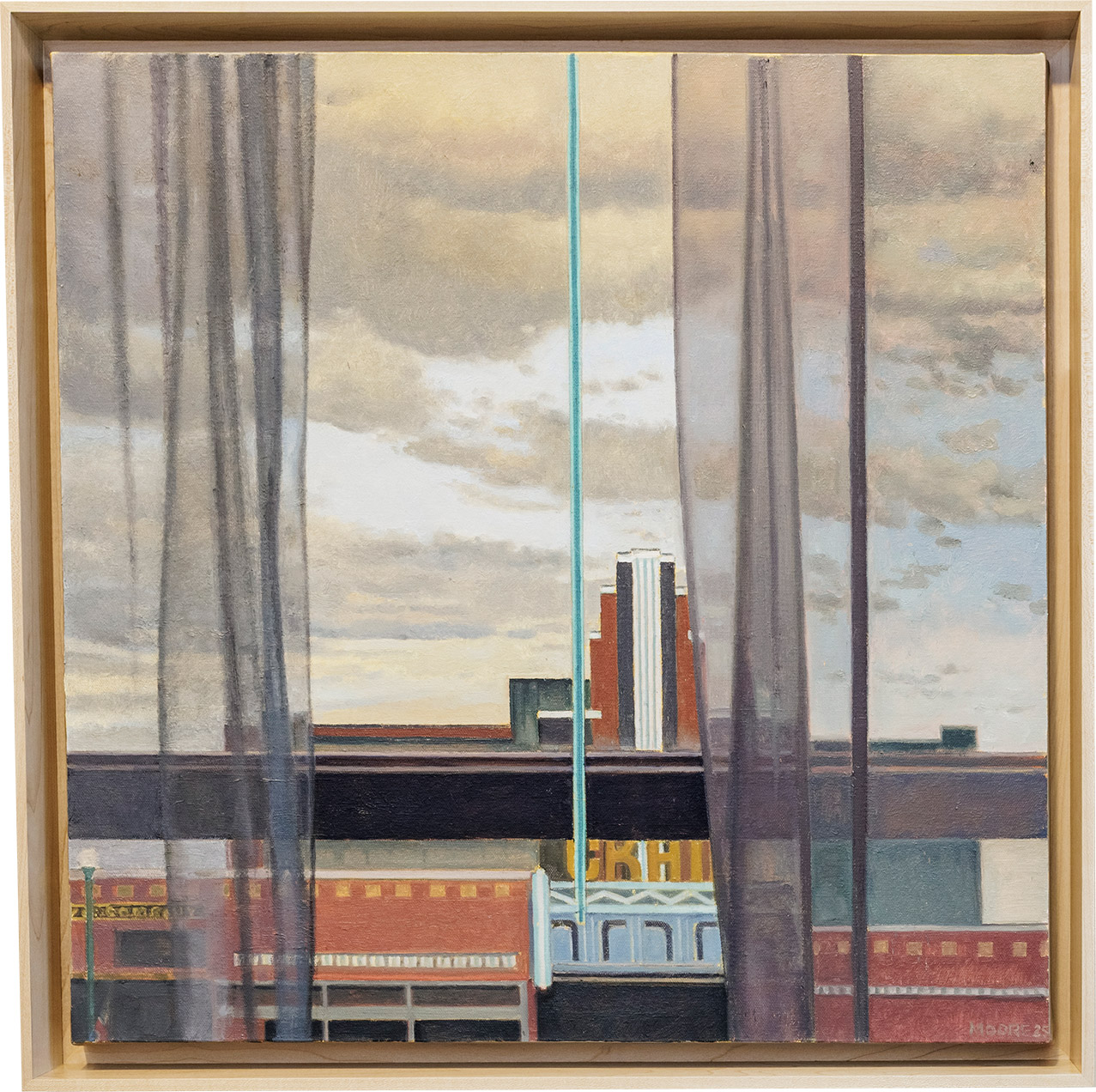
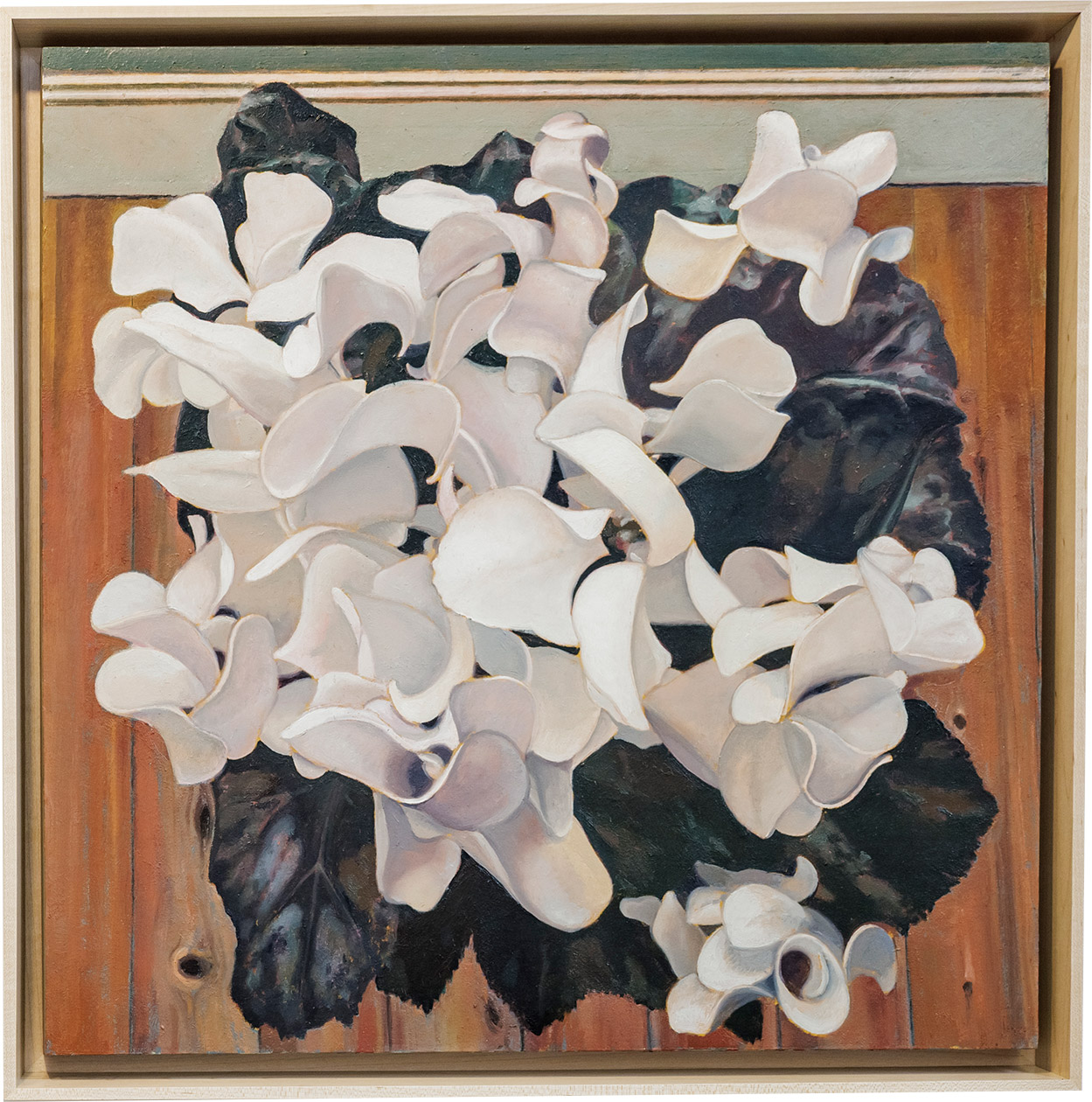
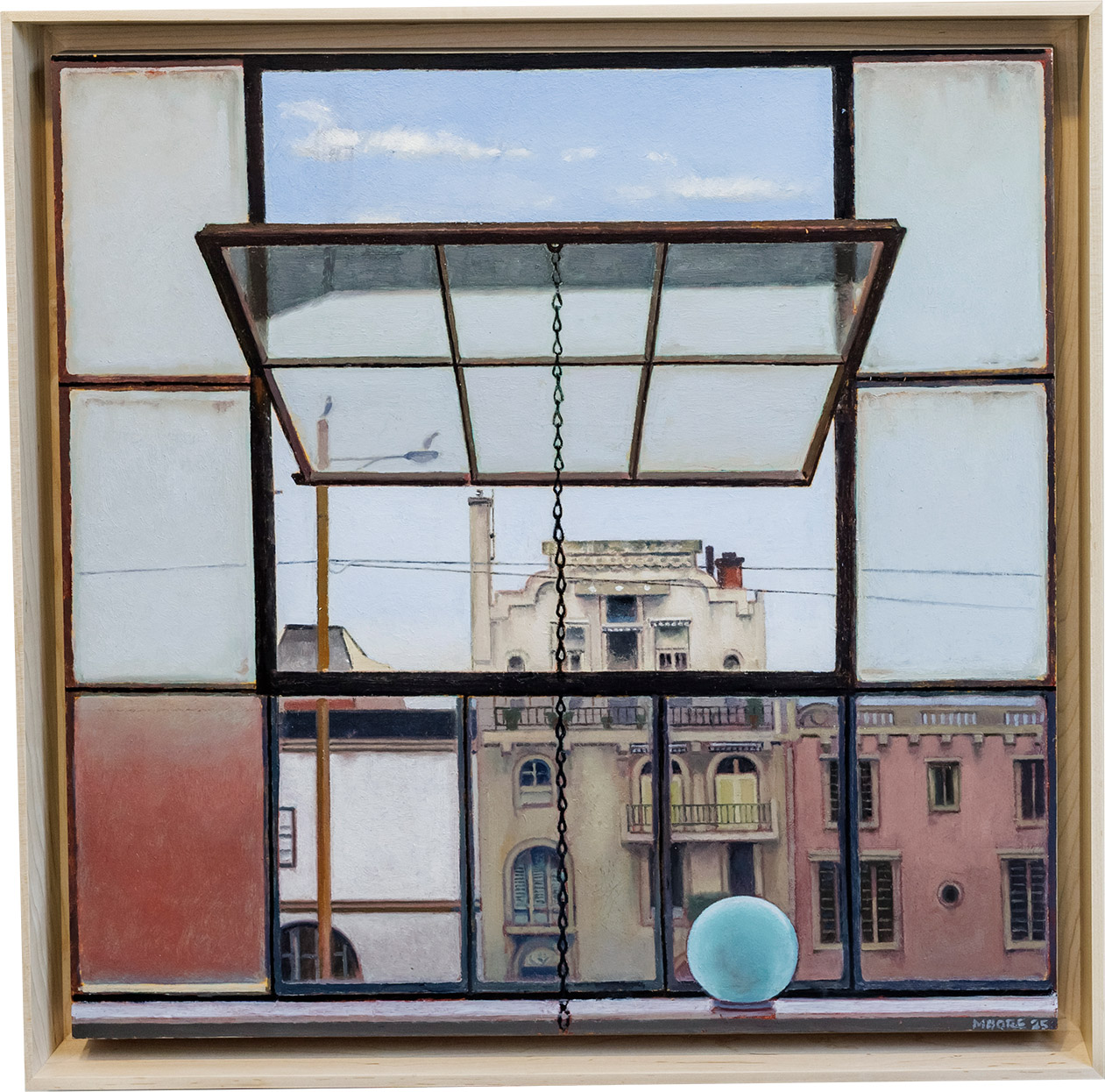
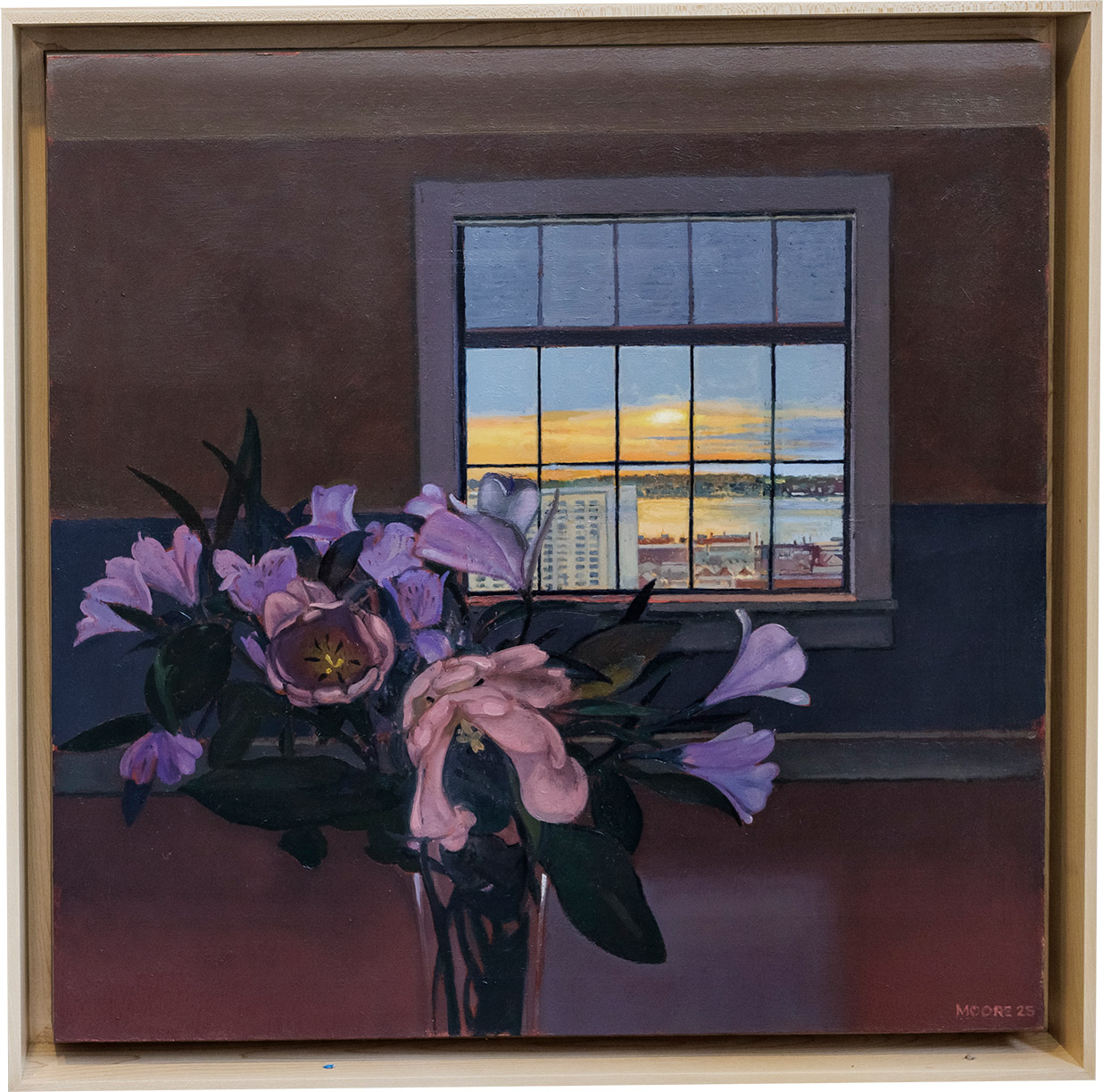
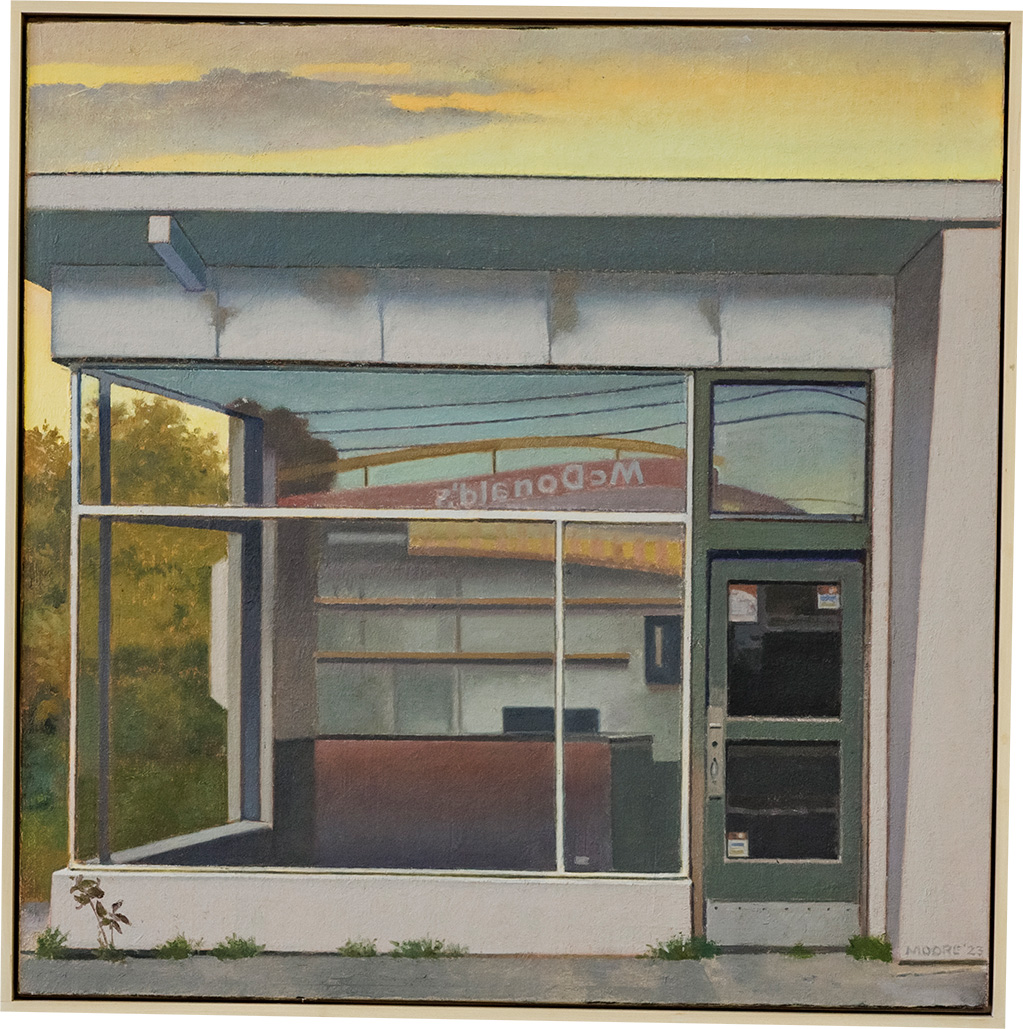
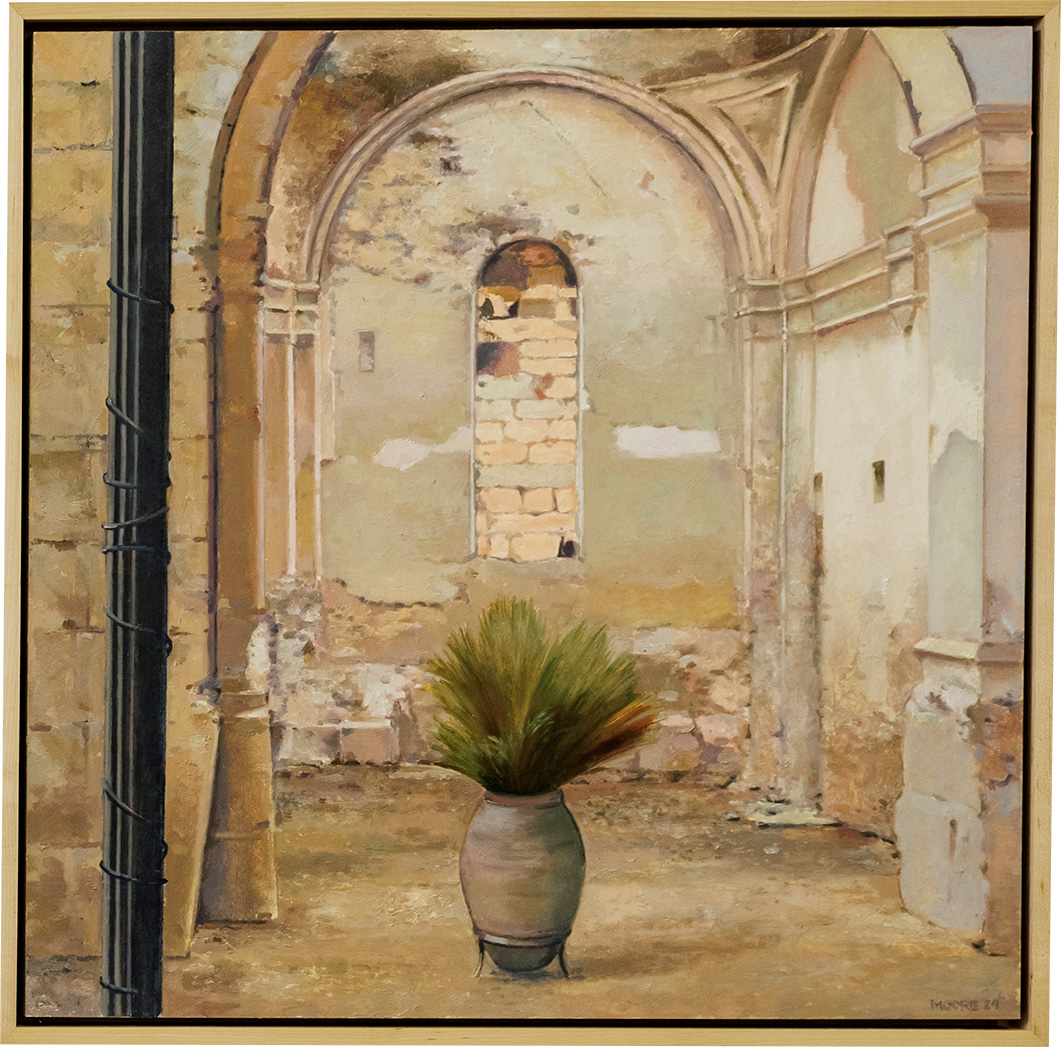
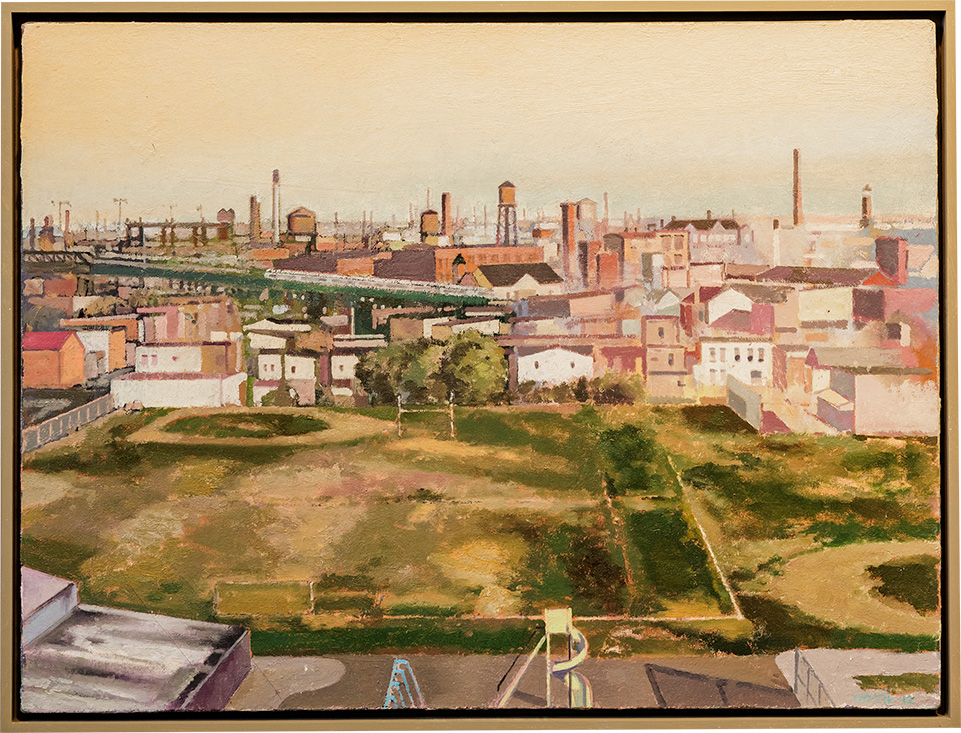
Moore paints with such precision that the artwork looks like a photograph, but his works often present a collage of images, as if the viewer is looking at a scene with one set of eyes yet different points of view. As poet John Yau wrote in John Moore: Portals, a 2024 monograph about the artist, Moore’s works evoke “a threshold moment when the daily world, and everything in it, suddenly holds our attention, and we look at it as if we are seeing it for the first time.”
For the past 34 years — since retiring from a distinguished teaching career at Temple University, Boston University, University of California-Berkely and the University of Pennsylvania — Moore and his wife, Sandra Moore, BFA ’66, have lived in Belfast, Maine.
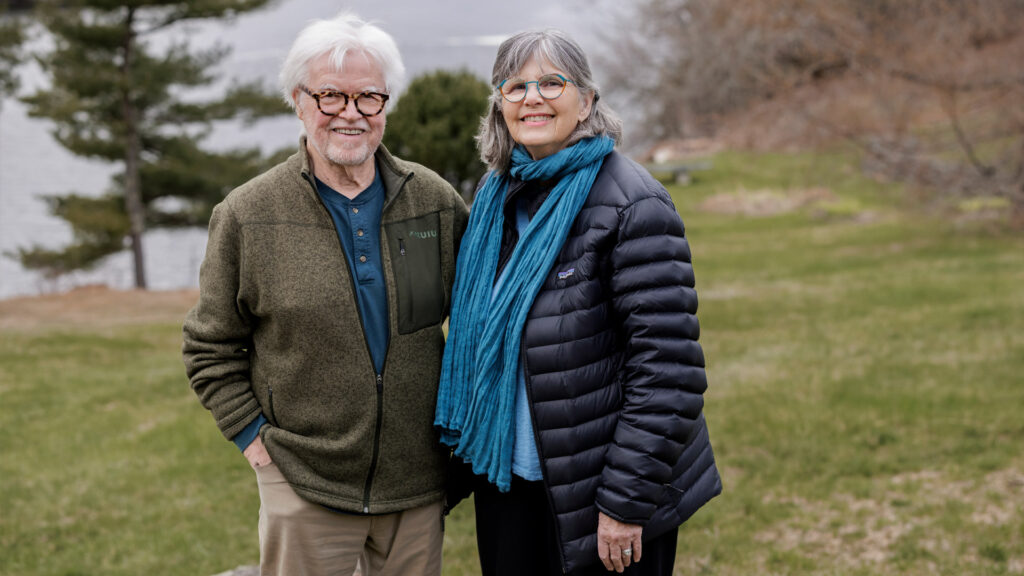
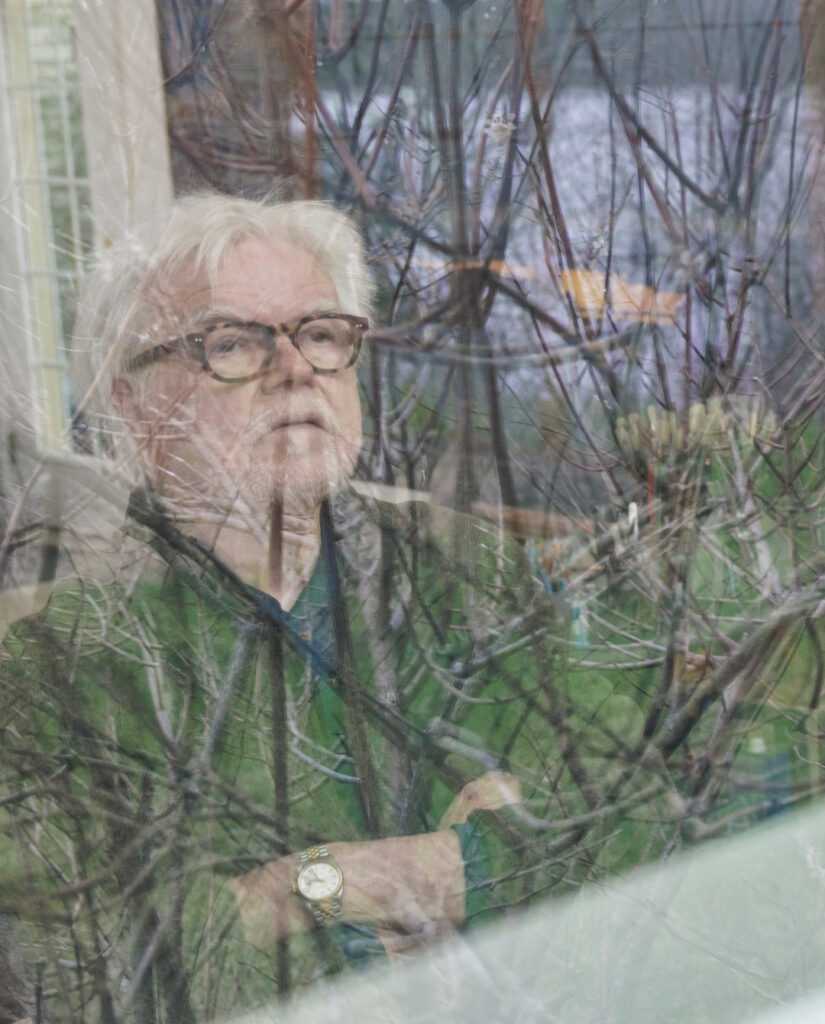
Moore and his wife, Sandra, pose outside their former home along the banks of Maine’s Passagassawakeag River.
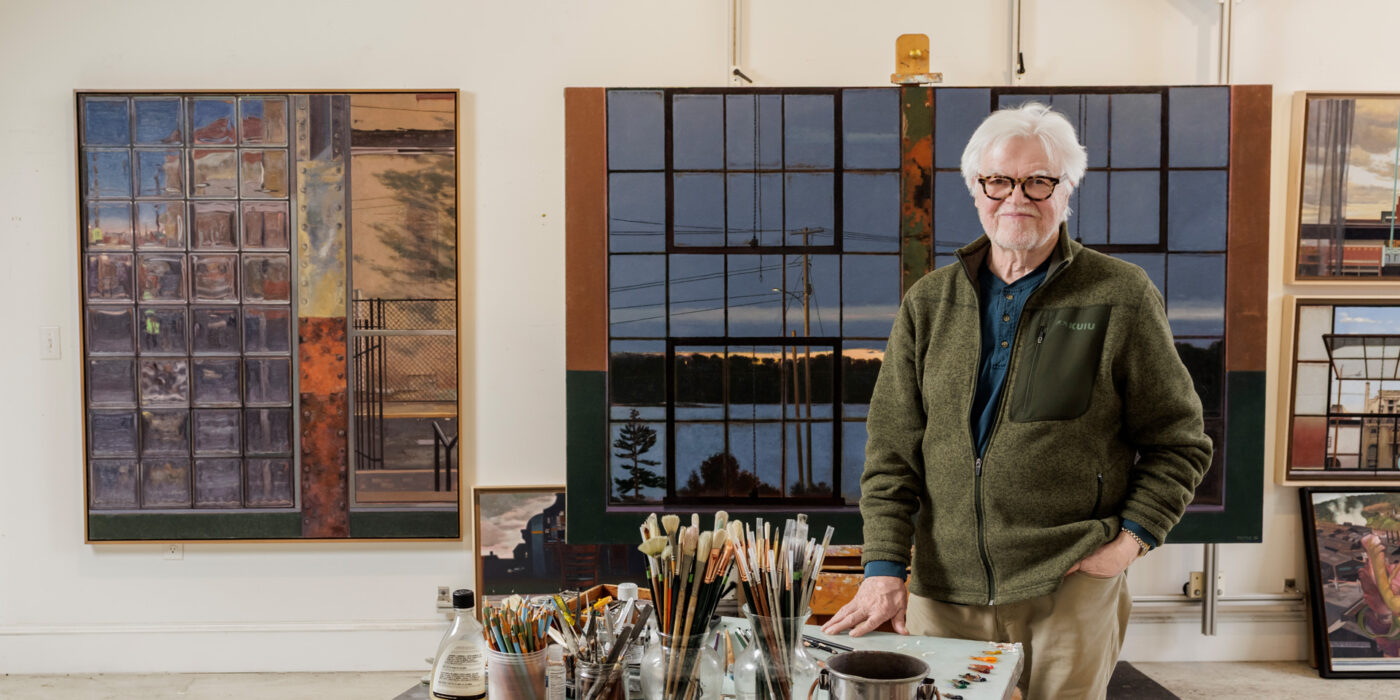
WashU Magazine photographed Moore there last spring, at work in the spacious, north-facing studio adjacent to his home on the Passagassawakeag River. But he’s speaking now from his new northern California studio, where he and Sandra relocated over the summer to be closer to family.
The new studio is bigger, but he admits it isn’t quite the same. “It doesn’t have the perfect lighting,” he says, “but it has great potential. We’ll manage.”
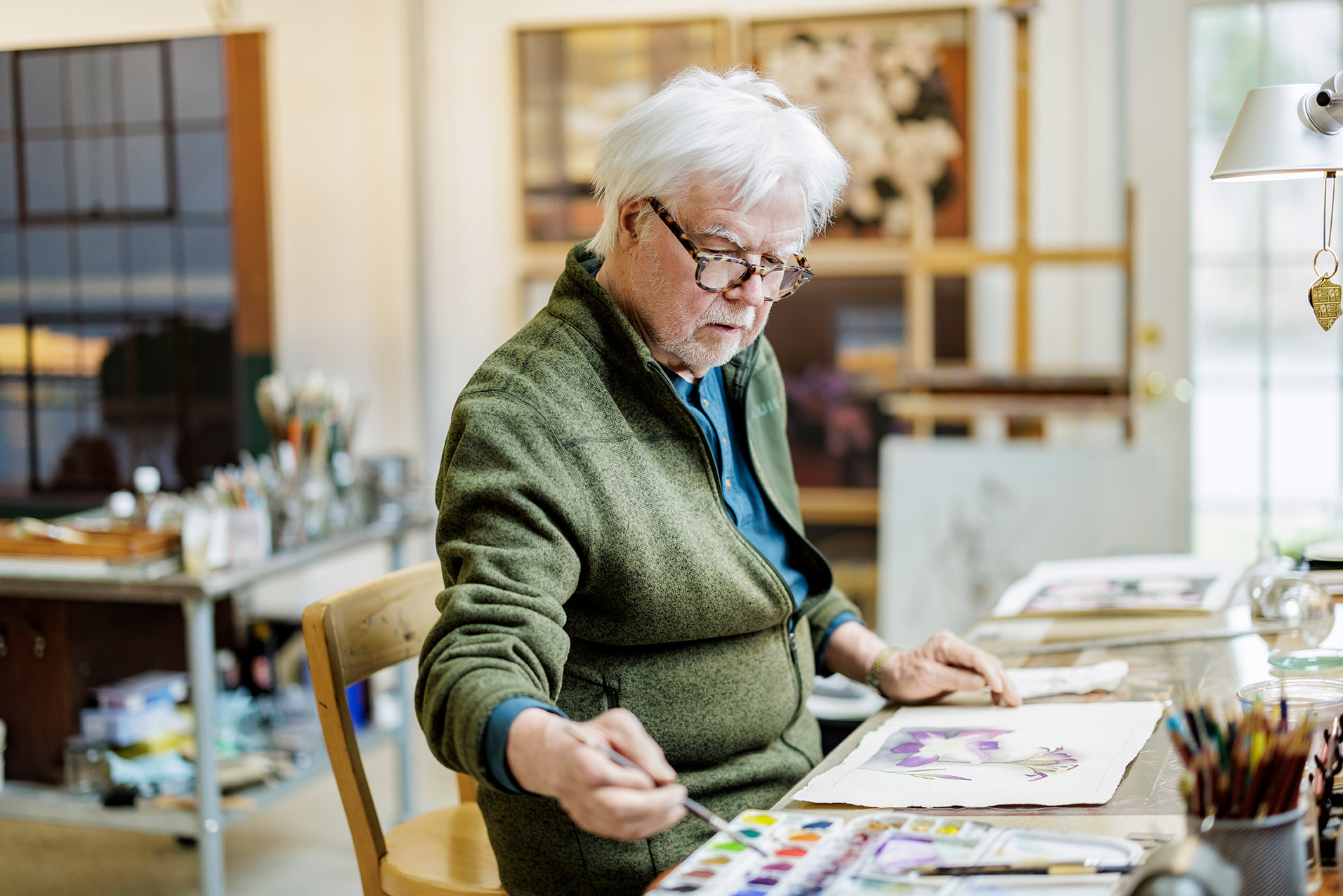
Moore, at work in his Maine studio, has wanted to be an artist since his days growing up in a gritty suburb of St. Louis.
The catalyst
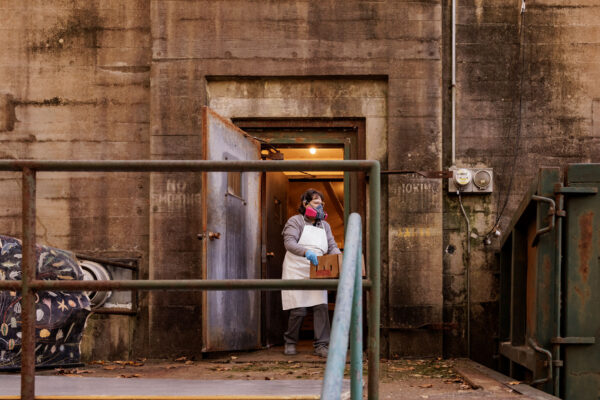
Moore grew up in Wellston, Missouri, the son of a mailman and a secretary, in a working-class inner suburb of St. Louis that was more urban-industrial than white-picket fence. The manufacturing grittiness Moore saw everyday would inform his work years later. But as a boy, he just wanted to create.
“I always wanted to be an artist,” he says, “but I had no clue on how to go about doing it.” He took mechanical drawing, the only class that remotely resembled “art” offered at his all-boys parochial high school, and he went on to earn a certificate at a St. Louis-area trade school called Ranken Technical College. His first job was at McDonnell Aircraft Corporation as a draftsman and technical illustrator drawing airplane parts.
But that childhood dream lingered, and within two years he began taking night classes at WashU in what was then known as University College. As Moore tells it, it was a single instructor in a drawing class, Mildred Bailey Carpenter, who was the catalyst for his artistic career. Carpenter told him he belonged as a full-time student in the School of Fine Arts and helped him put together a portfolio to go along with his application.
“Getting the acceptance letter from Washington University was one of the great days of my life,” he says. “Nobody in my family had ever been to college; it was a very big deal.” Tuition was $1,400 a year, he says, and he was awarded a $500 scholarship. “I lived at home so I could make it work,” he recalls. “When I walked onto that campus, I thought I was in heaven.”
In Bixby Hall, Moore studied under Ed Boccia, Barry Schachtman, Arthur Osver and Fred Conway. “I studied at WashU at a glorious moment for the School of Fine Arts,” he says. “When I got to graduate school, I was more prepared in the fundamentals of visual art than many of my classmates who had come from other schools.”
Getting the acceptance letter from Washington University was one of the great days of my life. Nobody in my family had ever been to college; it was a very big deal.
John Moore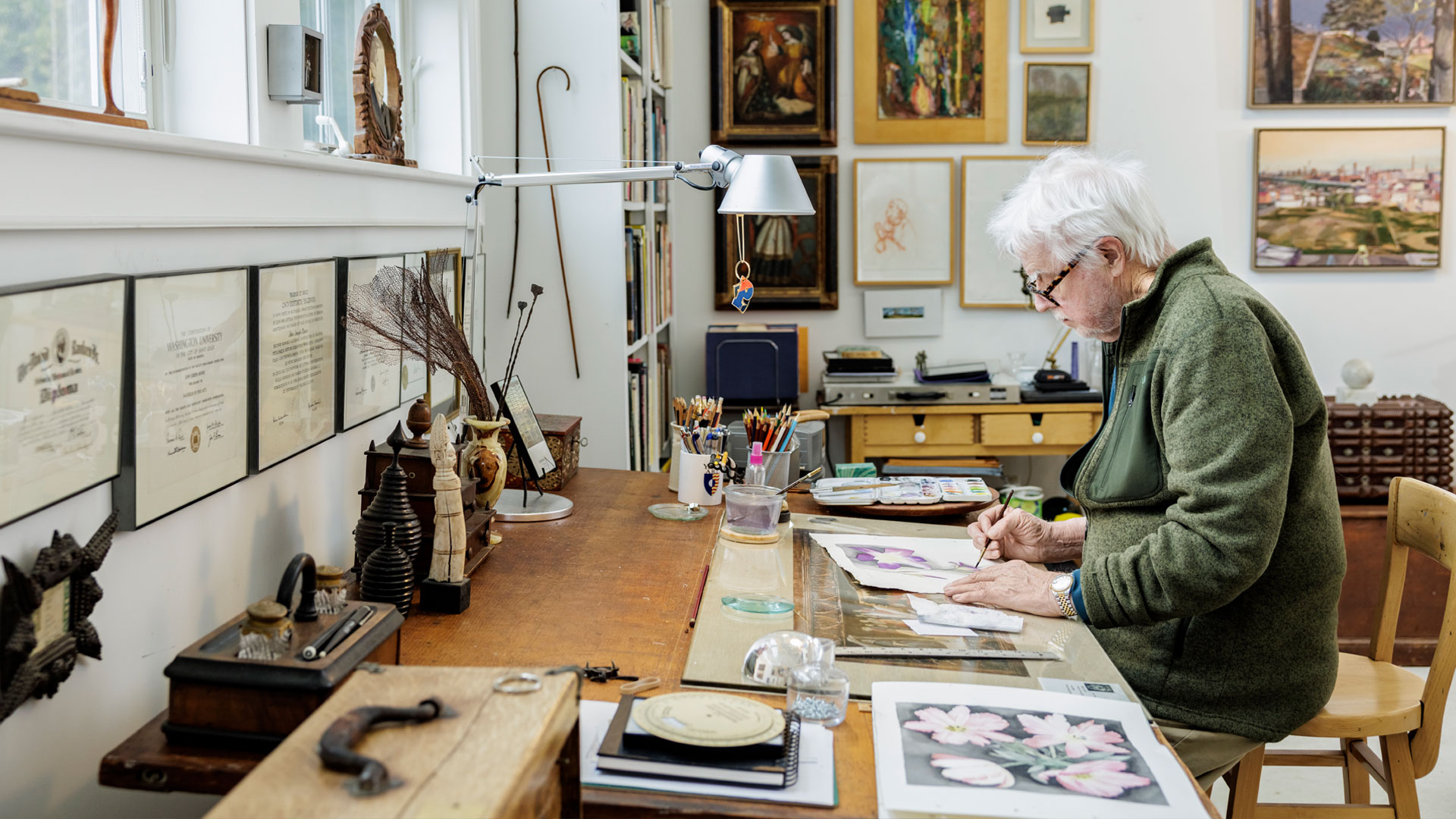
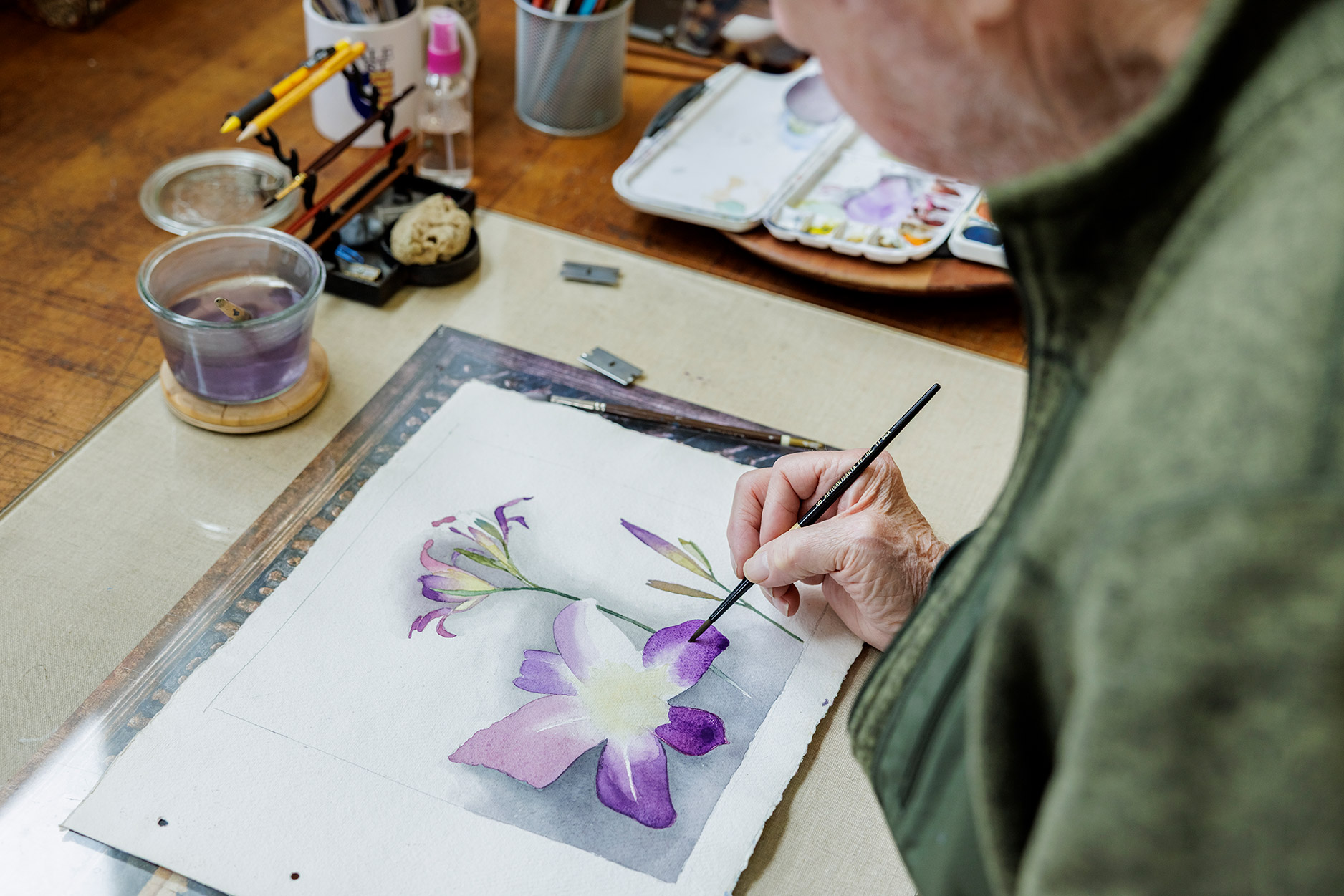
Moore often has multiple artworks in progress. Here, he paints a watercolor in his Maine studio.
As he began to hone his craft at WashU and learn the fundamentals of painting, he leaned as an undergraduate into what he called the “semi-abstract.” He recalls driving two hours north to Hannibal, Missouri, and sitting on the bluffs overlooking the town. He’d peer over the river into the expansive Illinois farmland and paint the landscape in “some sort of abstract manner,” he says. It wasn’t until he got to graduate school at Yale University — “Part two of the ‘big moments’ in my career,” he says — that he veered back to the “physical facts” of what was in front of his eyes and began painting in the style for which he has become known.
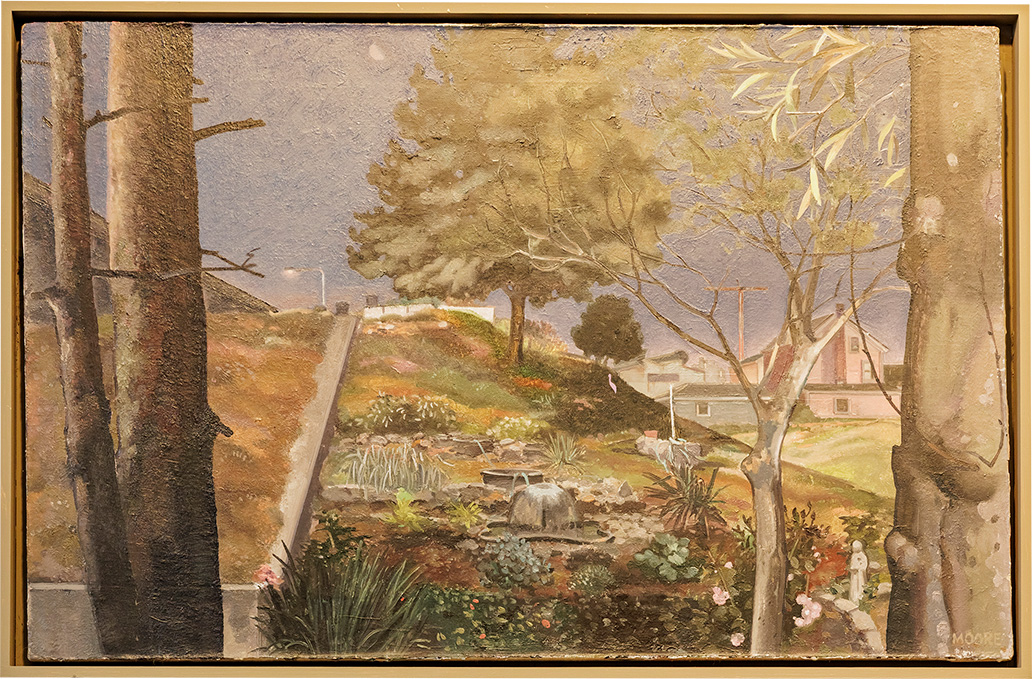
WashU opened the door to Yale and everything after, Moore says. During his junior year, he was one of two art students nominated for a summer residency at the Yale Summer School of Music and Art in Norfolk Connecticut, “the first time I had ever been out of Missouri.” The summer programs led to graduate school, and graduate school led to a lifetime of work that Moore is content to look back on — and add to.
Moore has come a long way since his days as a technical illustrator.
Still creating
At 85, the artist is still at work, always looking for new portals to take viewers through and finding inspiration in the unlikeliest of place — like his granddaughter’s softball game, which prompted him to finish a painting he began years ago in Coatesville, Pennsylvania, the setting for quite a few of his most famous works.
As Moore tells it: “One night there were these factory workers in Coatesville getting a softball game going after their shift. It was threatening rain, and they were rushing to get the game in. I thought, ‘I want to do a painting on this.”
He went back to his studio and began trying to capture the scene — an empty lot with an industrial urban background — but never finished. “For some 25 years, that painting has been in the back of my mind,” he says. “I could never get it to work.”
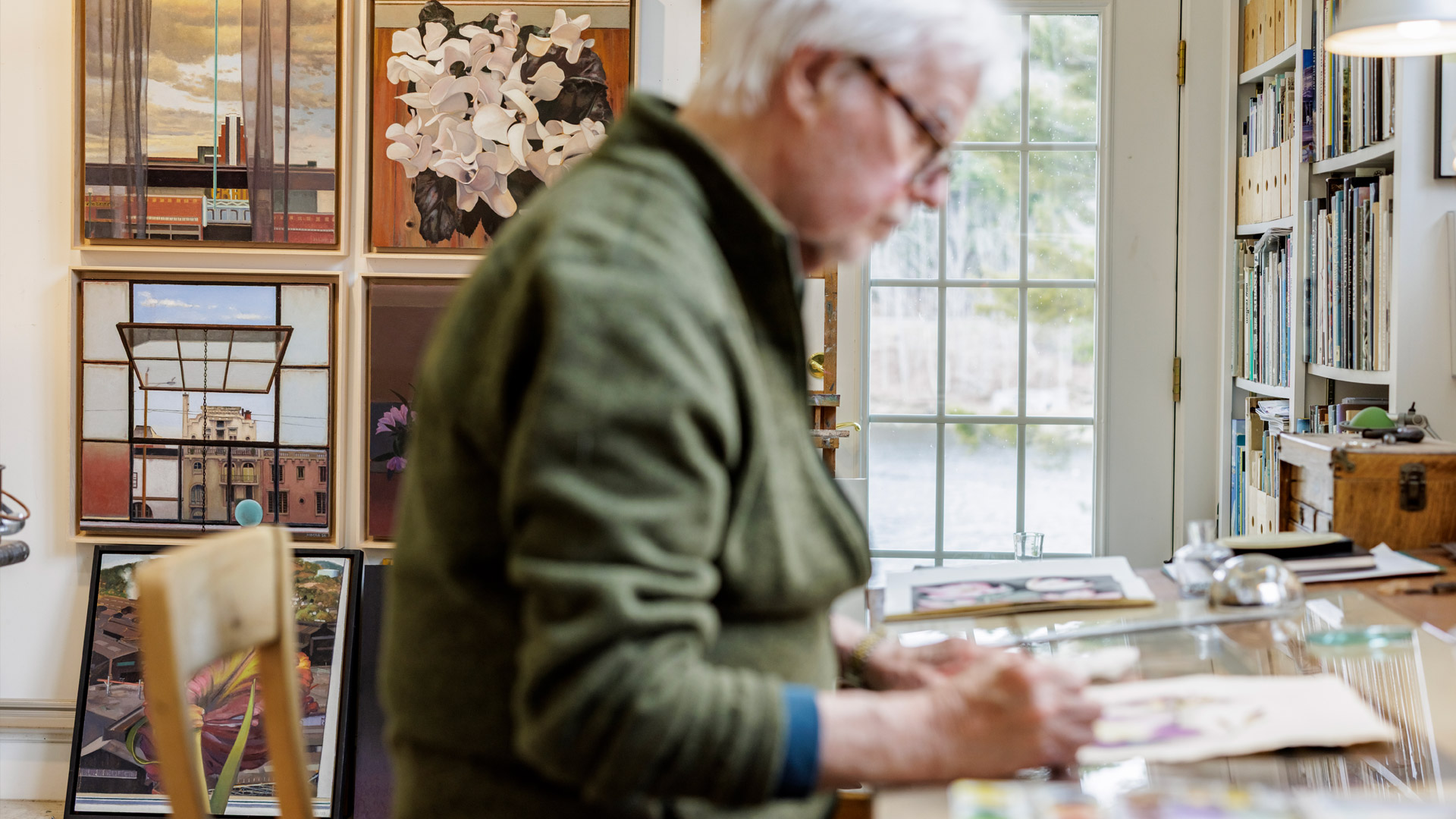
Now in his 80s, the artist is still it work, finding inspiration everywhere.
Until now. Something shifted for him while he was sitting at his granddaughter’s game this summer, and it’s one of the four paintings he’s working on in his new studio. “But the roots for that painting are in Coatesville,” he says.
And Moore’s roots are right here. “Washington University was a core experience,” he says. “I had great teachers who were also terrific people. They made an indelible impression on me that I’ve never forgotten.”
A lifetime of work
Who
John Moore, BFA ’66; MFA Yale University, 1968
Teaching career
Moore retired as the Gutman Professor of Fine Arts in the School of Design at the University of Pennsylvania, where he served as chair of the department for 10 years. He headed the graduate painting program at Boston University and also taught at the Tyler School of Art of Temple University and the University of California, Berkeley.
Honors and awards
American Academy of Arts and Letters (1973, 1988, 1996); National Endowment for the Arts (1982, 1992); and National Foundation on the Arts and the Humanities (1966). In 2007, he was elected to the National Academy of Design.
Public collections
Addison Gallery of American Art; Art Institute of Chicago; Farnsworth Art Museum; McNay Art Museum; Metropolitan Museum of Art; Museum of Fine Arts, Boston; Pennsylvania Academy of the Fine Arts; Philadelphia Museum of Art; Portland Museum of Art; Rhode Island School of Design Museum; San Francisco Museum of Modern Art; and Yale University Art Gallery
Further reading
The monograph John Moore Portals (2024, Marshall Wilkes) showcases 82 of Moore’s works, along with essays and poems that explore the four themes of his life’s work: windows, urban, industrial and elegies. Bios from two galleries that are home to his work, Hirschl & Adler in New York City and the Locks Gallery in Philadelphia, offer insight as well.
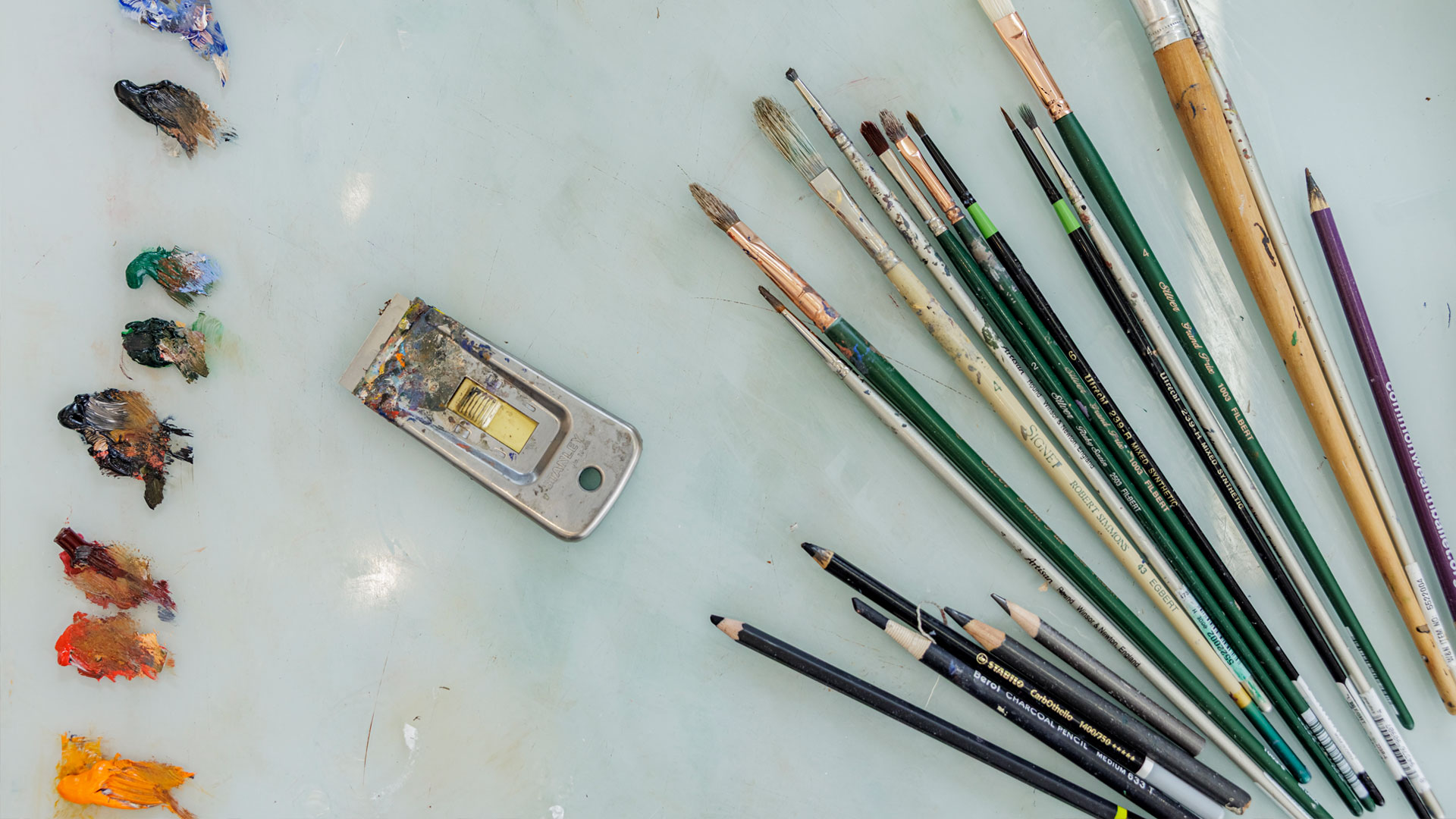
Moore’s tools of the trade.