Across the nation, universities are renewing their commitment to viewpoint diversity, civil dialogue and the study of liberal democracy. No fewer than 20 civic centers have opened in the past five years, according to the nonpartisan Heterodox Academy, and countless institutions, Washington University included, have introduced initiatives that promote constructive dialogue and free expression.
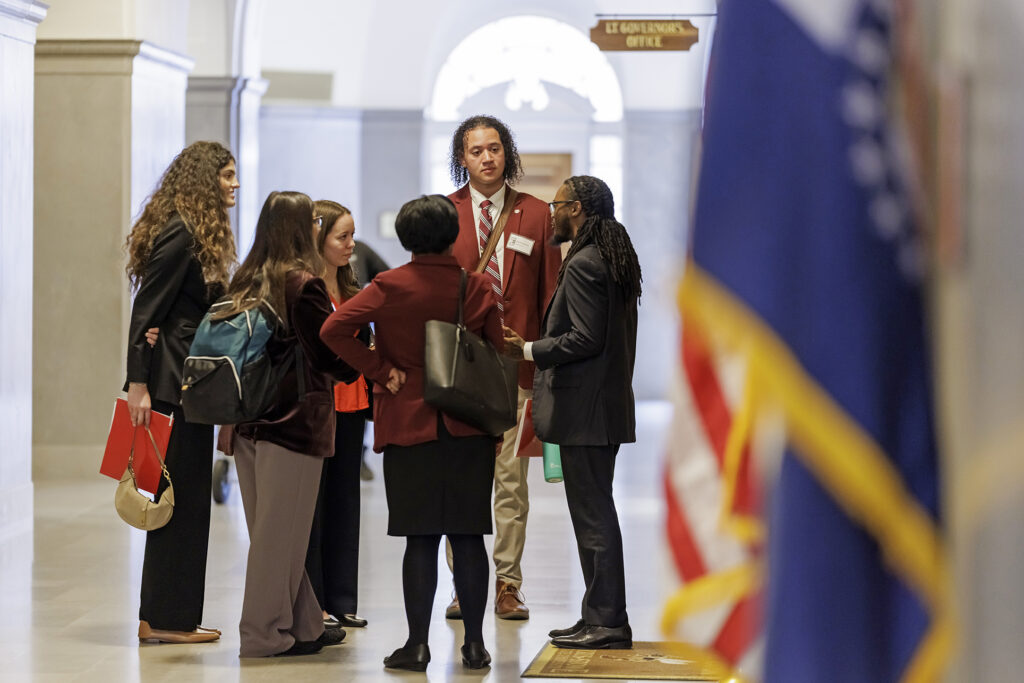
The Gephardt Institute for Civic and Community Engagement has been doing all of the above for more than two decades. Its programs, fellowships and growing catalog of courses dive deep into theory while offering students the unique opportunity to do the work — whether it be traveling to Jefferson City, Missouri, to advocate for research funding or awarding grants to local nonprofits working to improve the region.
“Like a lot of the new civic centers, we provide students with a rigorous academic experience that explores theory, history and ethics. We also teach the importance of civic dialogue and free expression, which are central tenets for many of these new initiatives,” says Stephanie Kurtzman, the Peter G. Sortino Executive Director of the Gephardt Institute. “But what sets us apart is that we offer our students the opportunity to build civic engagement skills and put them into practice.”
Founded in 2005, the Gephardt Institute is part of the Division of Student Success and leads a variety of campus initiatives, including WashU Votes, which provides students with voting information; the Longest Table, which brings together students at the beginning of each academic year for conversation and a meal; and the Civic Fellows and St. Louis Fellows programs, which combine intensive course work with a funded civic project or internship. These programs and others have experienced skyrocketing participation in recent years and, in the case of the fellowship programs, applications. The reasons are many: The institute provides fellows a generous stipend, throws a great Election Day party and understands the correlation between student turnout and free snacks.
But the real draw, Kurtzman says, is that students want to learn how to make a difference in an ever-polarized world. In response, the Gephardt Institute has launched the Civic Action Lab, a suite of undergraduate courses that integrate academic, civic and experiential learning. Last spring, the program offered three courses (more on those below). This fall, the program is running the popular “Running for Political Office” again and launching the new “Foundations of Civic Engagement” course.
“Students are really hungry for civic learning opportunities,” Kurtzman says. “At the same time, higher education is asking how we can produce graduates who understand the rights and responsibilities that come with being part of our American society. This is not new. American higher education was founded on the idea that our education is not just for our own personal advancement, but to serve the public good.”
Of course, what constitutes the public good is fiercely contested today, acknowledges Alannah Glickman, who serves as Gephardt’s associate director for civic engagement and has developed — and teaches — many of its Civic Action Lab courses. As a nonpartisan organization, the Gephardt Institute does not advocate for a particular party, politician or point of view except for one:
“Our stance is clear,” Glickman says. “Democracy is good.”
This spring, WashU Magazine visited the Civic Action Lab courses for a firsthand look at how students learn what it means to live in a democracy — discovering the knowledge, skills and responsibilities behind real-life civic action.
Date: February 24, 2026
Course: “Civic Action Lab: State and Local Government”
Action: A visit with the county executive
Beckett Grabner, a senior studying political science and history in Arts & Sciences, is well informed on any number of the debates before the U.S. Congress. But issues closer to home?
“Not so much,” says Grabner, who grew up in Maryland Heights in northwest St. Louis County.
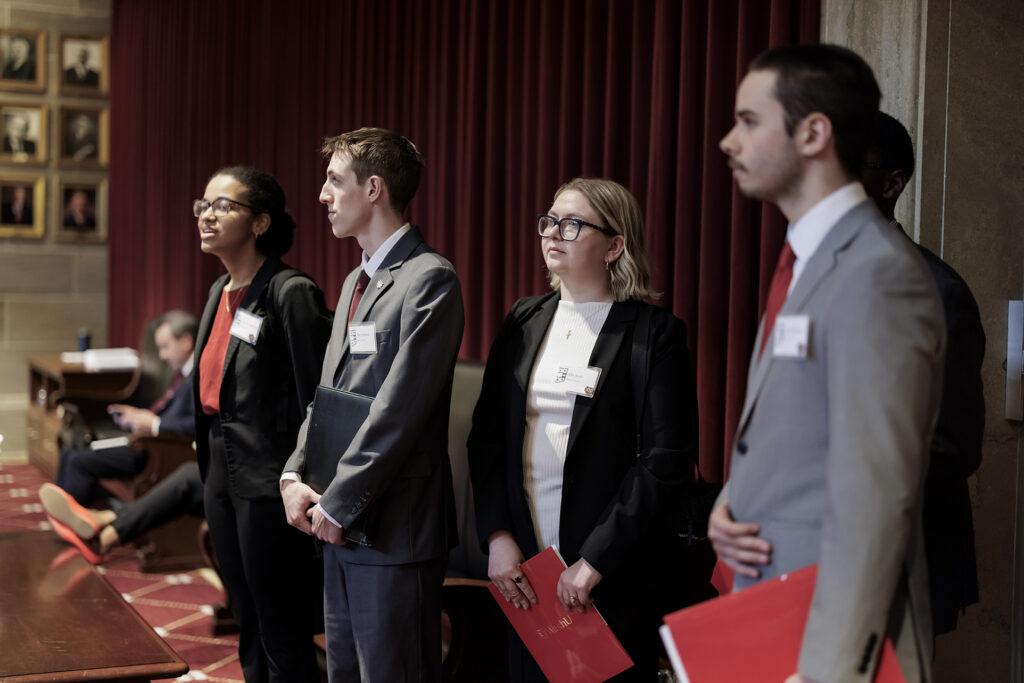
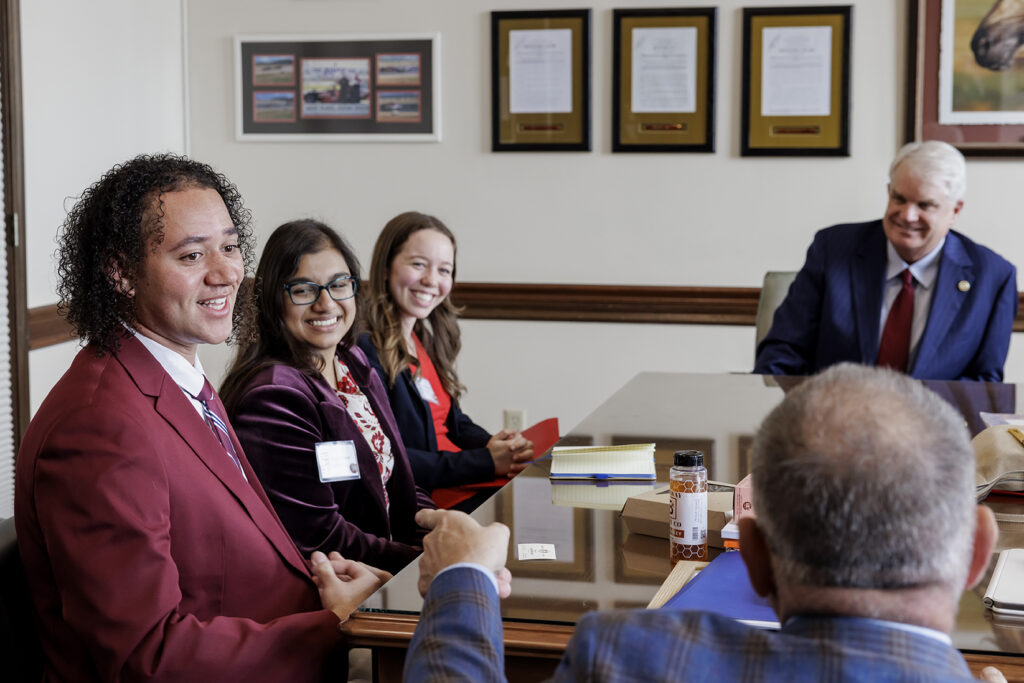
That’s why he enrolled in “Civic Action Lab: State and Local Government” as a junior. The course explored the roots of federalism and different models of state and local policymaking and governance. The course also offered Grabner the opportunity to meet the leaders making the big decisions as well as a number of government staffers, lobbyists and activists at the local and state levels.
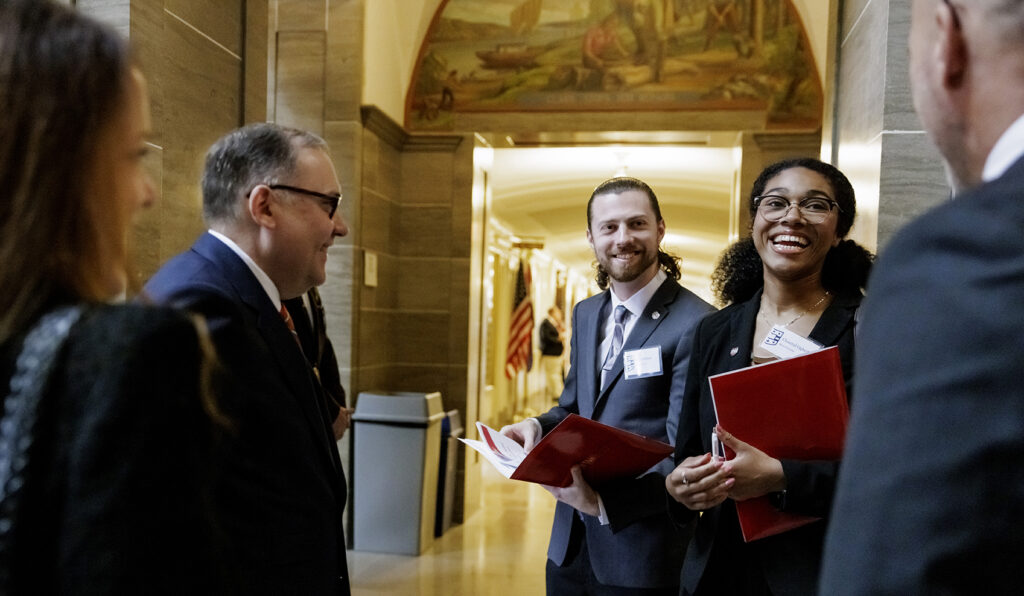
The participating lawmakers included Comptroller Donna Baringer and Board of Aldermen President Megan Green at St. Louis City Hall; Sen. Tracy McCreery and Reps. Ian Mackey, Travis Wilson, Doyle Justus and Bishop Davidson at the Missouri State Capitol in Jefferson City, Missouri; and Sen. Erica Harriss and Reps. Kimberly Neely du Buclet, Katie Stuart and Amy Elik at the Illinois State Capitol in Springfield, Illinois. And, on this day, County Executive Sam Page, MD, who shared with the students how he went from the operating rooms of a hospital to the top elected official of St. Louis County.
“I went to medical school, did an anesthesiology residency fellowship in interventional pain management at WashU, had a busy pain management practice and then focused entirely on anesthesia in the operating rooms at Mercy Hospital,” Page said to the gathering of Civic Action Lab students. “It’s probably an atypical trajectory for someone in elective office, but it certainly prepared me for making quick decisions with limited information.
“Now, what would you like to know?”
One student asked Page how he works with the 87 municipalities within St. Louis County. “Governments are designed in our country to preserve the status quo,” he said. “So you can imagine, with the multiple layers of jurisdiction decision-making we have here, how hard it is to accomplish something.”
Another asked about his experience as a Democratic representative in the Republican-dominated Missouri House. “I learned how to work the process and found majority members to sponsor my legislation and helped them get it done without worrying about getting the credit for it,” Page replied.
“Sitting down at the same table with these leaders gave me a clearer understanding of the work and its challenges.”
Beckett Grabner
Grabner then asked Page what he thought about “Better Together,” the failed 2019 effort to unite the City of St. Louis with St. Louis County.
“I think we would be stronger and more efficient if we had fewer political subdivisions,” Page told the students. “But any sort of structural change needs to have community support, and that’s where they fell short. There are a lot of people who come together in groups and associations, who make big decisions, and they’re used to giving directives and having them happen. My perspective is that they didn’t recognize an important stakeholder, the municipalities, and misunderstood their political force.”
Afterwards, Grabner recalls being surprised that Page and his staff were so accessible — and candid.
“Everybody is so focused on national politics, but local government is really where people can have an impact and make their voices heard,” Grabner says. “I think we all instinctively knew that, but sitting down at the same table with these leaders gave me a clearer understanding of the work and its challenges.”
Kurtzman says leaders are eager to speak to WashU students. Over the years, a number of mayors, lawmakers and high-ranking government officials have spoken at Gephardt events and classes.
“I’m grateful for all of the people who dedicate time and open their doors to students,” Kurtzman says. “I think there’s a real willingness to support young people by teaching, mentoring and sharing the unspoken rules of the road about how you actually get things done.”
Date: April 16, 2026
Course: “Philanthropy Lab”
Action: Gifts with purpose
It’s decision day in “Philanthropy Lab,” an innovative course where students learn about giving by awarding real money — $120,000 last semester — to local nonprofits. The class comprises 30 students who are divided into six “foundations.” Each one is about to reveal the recipient of their grant, but not before sharing their foundation’s philosophy and what type of charity they sought to support among the range of nonprofits serving St. Louis that matched their intentions.
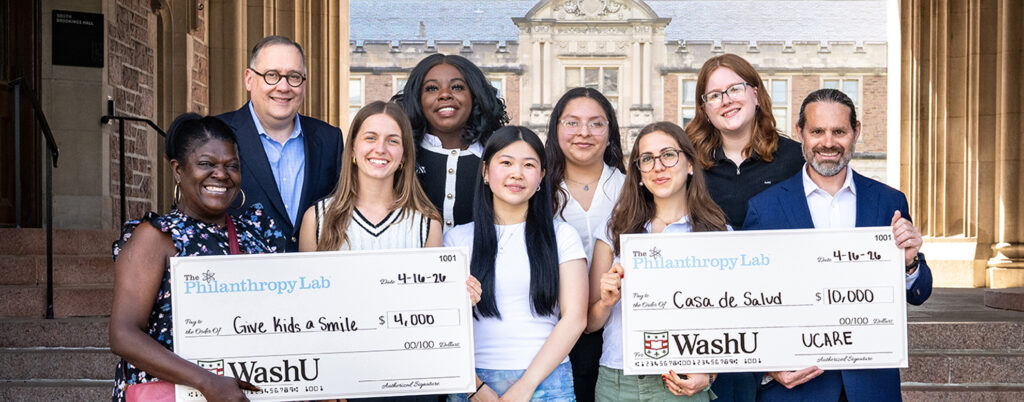
The results followed a semester of rigorous course work in and outside the classroom, conducting site visits at nonprofits large and small, soliciting and critically reviewing funding proposals, studying the sector’s history and best practices, and meeting leaders in the field. The students also learned about themselves — which issues matter most to them and what sort of impact they want to make.
“It was a huge responsibility to give away so much money. When you meet these leaders, you can see how much the money means to them and how important their work is. The class taught us how to set priorities, ask questions of these nonprofits and evaluate impact.”
Leah Hayem
The first question was easy for the six members of the foundation that called itself UCARE. With some of them pre-med students, the group sought to help vulnerable St. Louisans by supporting organizations that provide affordable and accessible healthcare. After identifying 10 healthcare nonprofits, the students visited five organizations: Give Kids a Smile, which hosts two no-cost dental clinics; iFM Community Medicine, which provides healthcare at partner clinics; Nurses for Newborns, which supports families through counseling, education and resources; Jamaa Birth Village, which focuses on Black maternal health; and Casa de Salud, which offers medical and mental health services to immigrants, refugees and other uninsured patients.
“Each one of these organization’s great work is aligned with our overall mission, but our dollars would mean different things to each of them,” says Chloe Rado, AB ’26, a senior at the time who earned her degree in political science in Arts & Sciences a few weeks later. “So it was up to us to decide whether to spend the money to help fix a need right now or a need in the future.”
The team ultimately decided to award a $10,000 grant to Casa de Salud. “We recognize that there is this incredible need right now for immigrant populations,” Leah Hayem, a then-junior studying biology in Arts & Sciences, explained to the class. “We also really appreciated that they provide specialized care and that all of their services are available in one location.”
UCARE also allocated $4,000 for Give Kids a Smile and $1,000 to each of the remaining three nonprofits. Hayem said giving away the money was both harder and easier than she thought it would be.
“I honestly didn’t believe it when I signed up for the class that we were getting real money to give to local nonprofits,” Hayem says. “It was a huge responsibility to give away so much money. When you meet these leaders, you can see how much the money means to them and how important their work is. The class taught us how to set priorities, ask questions of these nonprofits and evaluate impact.”
So far, WashU’s six “Philanthropy Lab” groups have contributed $610,000 to local charities. The class is funded in part by the national Philanthropy Lab program, which has distributed some $19 million through 34 partner universities.
“A lot of students come into this class thinking that only rich, old people can be philanthropists,” says instructor Barbara Levin, a retired teaching professor at the Brown School and founder of the Alliance for Building Capacity, an initiative that helps nonprofit organizations further their missions. “But they come to understand, through their readings and their conversations with people who do this work, that giving at different levels is still giving.”

A conversation between student and mentor
Brian Duckett is a member of the newly formed Bears Caucus, a group of student advocates dedicated to promoting the positive impact of WashU to local, state and federal officials.
Tonya Rice, assistant vice chancellor for advocacy and engagement, helped prepare the students for visits to Jefferson City, Missouri, and Washington, D.C., last spring. In this related story, Duckett talks with Rice about the Bears Caucus and why an opportunity like this is so important for students.
Philanthropy also is a form of civic engagement, Levin says. “What I hear from many of our students is that this is one of the most meaningful classes they experience in college,” Levin says. “Some continue giving or volunteering for the organizations they supported. Others express interest in serving on a nonprofit board or pursuing a career with a nonprofit. All of them leave with a deeper understanding of the vital role philanthropy and nonprofits play in our community.”
Date: March 16, 2026
Course: “Civic Action Lab: Skills That Turn Passion Into Policy”
Action: Informed SWOT analysis
As a WashU political science major, David Leipholtz, AB ’02, completed course work in American politics, political theory and data science. But he never had a class like the one he teaches today called “Just Do It! Skills That Turn Passion Into Policy.” For more than a decade, the course and its companion, a class on running for political office that’s being offered this fall, have provided students essential tools for engaging in the democratic process.
“I had a great experience as a political science student here, but there was not an opportunity to have this sort of immersive experience. This class takes political science out of the philosophical and grounds it in the real world,” says Leipholtz, who serves as senior lecturer for the Gephardt Institute in addition to his role as co-founder and CEO of Civic Insight, a research and data strategy firm.
The course introduces students from a wide variety of backgrounds and interests to lobbyists, communicators and other players in the political process and teaches them how to build coalitions, leverage data and research and develop an effective communications strategy. For their final assignment, students participate in a mock hearing, supporting or opposing an actual bill before the Missouri General Assembly. But today, they are conducting an assessment of their bills’ strengths and weaknesses, otherwise known as a SWOT analysis.
“This will help you understand your audience because you’re not trying to convince people who agree with you,” Leipholtz tells the students. “You’re trying to reach people who may not be familiar with your issue, which, don’t be shocked, can be legislators. They’re not experts on everything; they just got more votes than the other person. Maybe they are a teacher who knows a lot about education. That doesn’t mean they know everything about agriculture. There are all kinds of expertise.”
Sophie Lyman, AB ’26, then a senior studying anthropology in Arts & Sciences, was on a class team that selected House Bill 1613, a bill that would move local elections to the November general election.
“Strengths are reduced operational costs by consolidating to the same date and increasing voter turnout,” Lyman tells the class. “The weakness is that it decreases an emphasis on local issues by diffusing voter attention.”
“Is this a Republican or a Democratic sponsored bill?” asks Portia Francois, a then-first-year student studying public health in Arts & Sciences.
“I’m just starting to realize the incredible complexity of the legislative process and what it takes to influence its outcomes.”
Portia Francois
“Republican, but a past iteration of this bill had bipartisan support, so that is a potential opportunity,” Lyman says. “On the other hand, there is not a lot of grassroots support.”
During the break, Francois says the class has given her the tools to pursue her passion: advancing public health.
“I’m just starting to realize the incredible complexity of the legislative process and what it takes to influence its outcomes,” Francois says. “But as someone who wants to lift health burdens for specific populations, it’s important for me to know more than just the science. I think that taking this class, especially so early in my college career, will prepare me to use data and effectively argue for policies that will push public health policies forward.”
Back in class, Leipholtz helps the teams create a communications map. Keep it simple and be honest, he emphasizes.
“You can tailor your vocabulary, analogies and data points to address the questions and concerns of different audiences, but never your core message,” he says to the class.
Afterward, Leipholtz marvels at the quality and tenor of the day’s discourse. Despite the headlines about America’s civil discourse crisis, he finds his students curious and respectful.
“I always tell the students this is the best two hours of political conversation I’ll have during the week,” he says. “I find that even in these highly partisan times, these students are seeking understanding.”