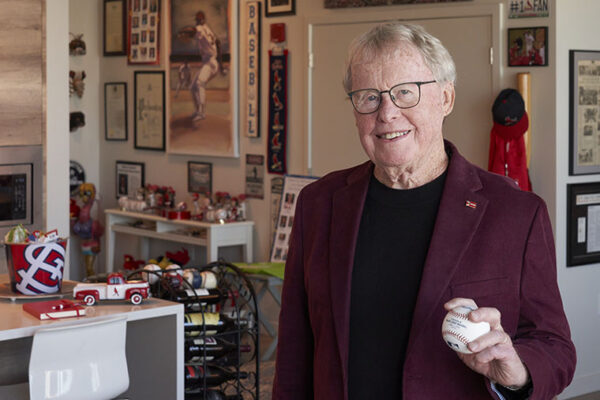
Carlo Bruno, BS ’65, turned 100 January 28, making him one of the oldest alumni in the Washington University domain. The milestone was marked with a party at the Bethesda Hawthorn Place assisted living community in suburban St. Louis, attended by a few dozen family members and friends.
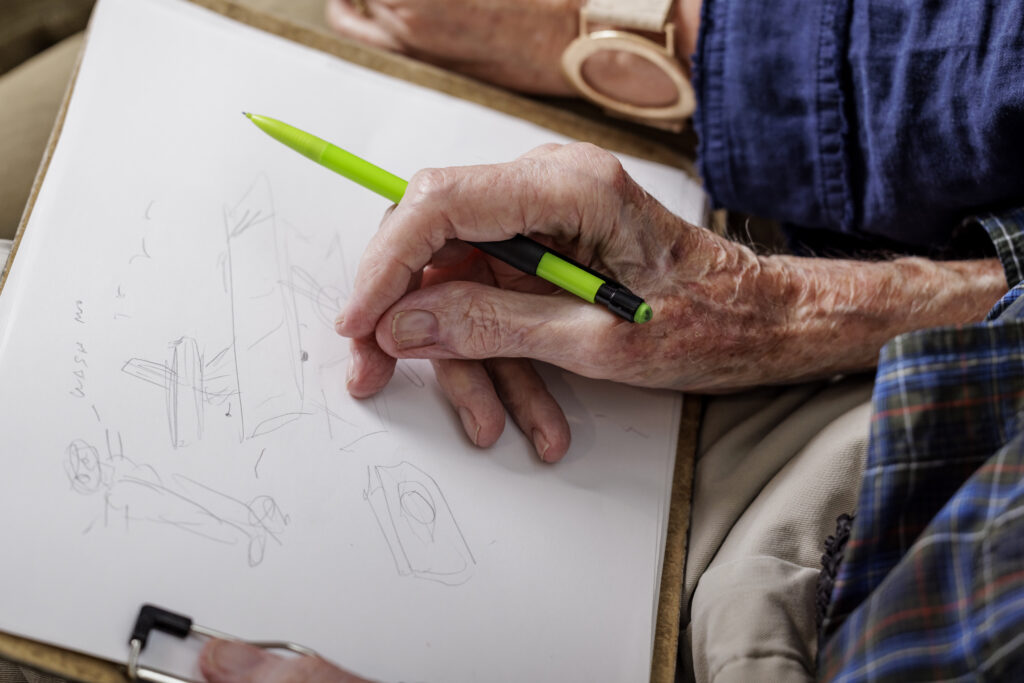
He took it all in, as he typically does, with a clipboard of white paper and a couple of No. 2 pencils, ready to sketch whatever caught his eye. Quiet and softspoken, Bruno lights up the moment his hand moves across a blank piece of paper. “I talk best with a pencil in my hand,” says Bruno, a first-generation American and the son of Italian immigrants.
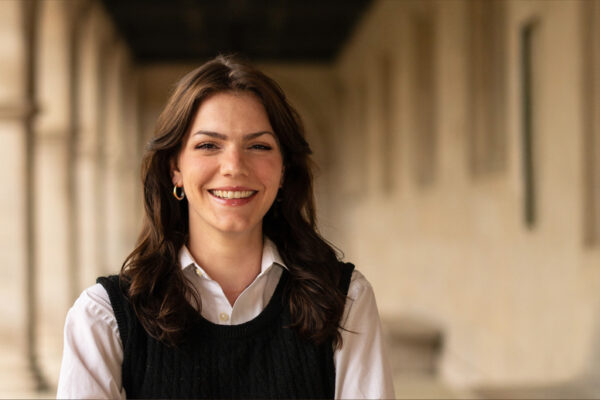
“He always has a pencil or two ready to go,” says his daughter Teresa Bruno, MA ’94. “But he is very particular about them. He loves a good number 2 — the sharper the better.”
Continuous education
Who: Carlo Bruno, BS ’65
Jobs he’s had in his career: Radio and radar technician on a B-17 bomber; draftsman; automative assembly line engineer; mechanical engineer; artist.
Decades in the making: Bruno enrolled at what was then known as University College in 1946 on the G.I. Bill and took night classes for 19 years until 1965, earning an undergraduate degree and two certificates all while working full-time. He still wasn’t finished. He went on to earn a master’s degree in construction management from Webster University.
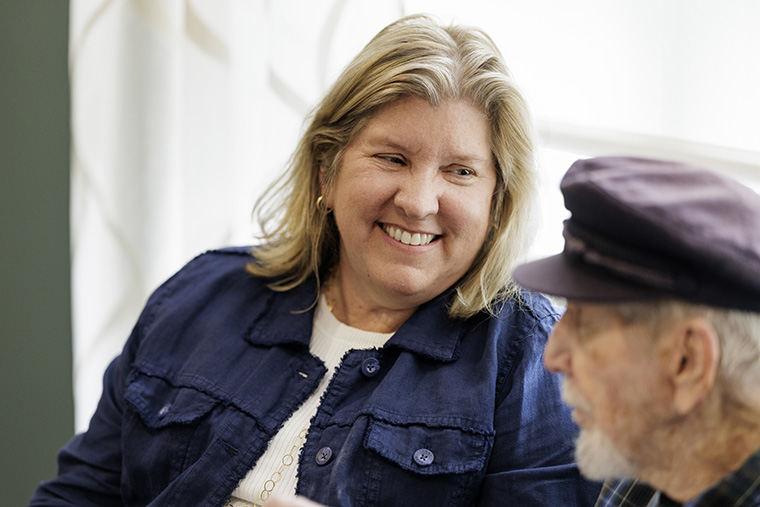
WashU family ties: His youngest daughter, Teresa Bruno, MA ’94, earned her degree in international studies through University College, also while working fulltime. “He made me start my master’s program right away,” she says, “but said ‘Don’t take so long — get it done while you can.’”
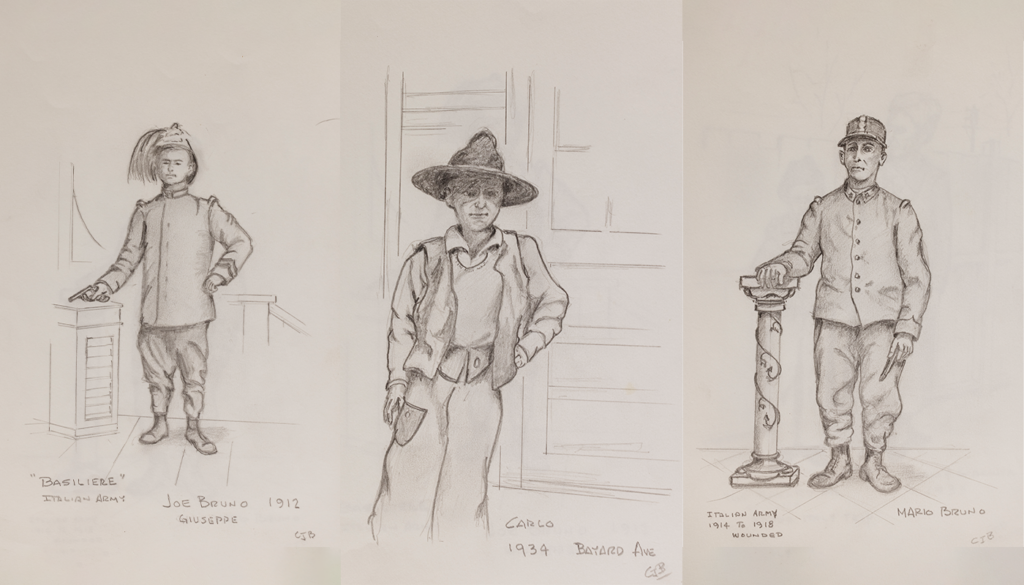
Having reached centenarian status, Bruno remains pretty sharp himself. He has hundreds of stories to match the drawings he keeps in notebooks and file folders in his apartment, from escaping Mussolini’s secret police in Fascist Italy in 1935, to dropping out of Clayton High School in 1944 so he could enlist in in the Army Air Force.
There are his stories about how he used his experience as a radio and radar technician on a B-17 bomber in World War II to get work as a machinist in the post-war automotive industry in St. Louis. Or how he enrolled at night school at WashU on the G.I. Bill, first earning certificates from the university’s Sever Institute in drafting and mechanical design in 1951 and ’53, then sticking around for another 12 years to earn his degree in mechanical engineering.
He’d get married and begin raising a family in between, working his way through the Big Three automakers — Ford, Chrysler and General Motors — all of which had, at one time, factories in St. Louis.
He also managed to take a couple of WashU art classes in that time frame. Among the professors he studied under was the late Siegfried Reinhardt, AB ’50, an internationally known artist and a pioneer in combining realism and surrealism. “One day in class, Reinhardt asked for a volunteer to be a model in one of his lessons,” Bruno says. “I always wished I had raised my hand faster.”
War stories
Among the drawings Bruno keeps in a portfolio are memories of his childhood. In one of them, he and his brother stand with his mother and grandmother in front of the family home in the village of Refrancore, in the Piedmont region of northwest Italy. The boys wear shorts and long-sleeved shirts, uniforms of the youth organization sponsored by the Fascist government of Benito Mussolini, the “Opera Nazionale Balilla.” Carlo wears a fez, the official hat of the uniform.
His parents had emigrated from Italy in 1919, and Bruno’s mother made sure the family returned every few years during the summer months, so her boys would get to know their Italian family. With each visit, Bruno recalls Mussolini’s secret police presence becoming more prominent and more dangerous. “All of the boys in the village were in the Balilla,” he recalls. “So we were, too. It was like scouts for us, something to do with other kids, and we wore the uniform.”
By 1935, during a visit in which his father stayed in the U.S., politics in Italy had become so tense his mother feared the family might not be allowed to leave. The boys were American citizens, but she had remained an Italian national. The mother and her two young sons left Refrancore under the cover of night “so there would be no suspicion,” Bruno says. They left on a horse and buggy and then caught a train to the port of Genoa, where they boarded a ship for America. He’s got a sketch for that journey, too.
Once on board and at sea – well out of the harbor – Bruno’s mother threw the brown uniforms overboard because she wanted no part of them. All except the fez, which Bruno begged his mother to keep. The fez survived the journey but somehow got lost over the years. His brother, now deceased, was allowed to keep a hand-carved wooden box that he had made in the youth program.
A different memento from Bruno’s younger years, a headset from his time on the B-17 during the war, leads to another story. When one of his Clayton High School classmates was killed in the war, Bruno enlisted at 17 without telling his parents first. “That didn’t go over well,” he says. He served two years on an a variety of Army aircraft, including the B-17, and rose to the rank of corporal. Some 73 years after he dropped out, Clayton honored him with a diploma. At 93, Bruno donned a cap and gown and collected it alongside other members of the Class of 2019.
Another war story: Bruno had just enlisted when he was among service members who were offered an immediate promotion in rank and a pay raise for a top-secret detail in Los Alamos, New Mexico. The army needed volunteers to support the Manhattan Project, from digging trenches to working on maintenance and explosives. Bruno says he would have witnessed the first testing of the atomic bomb.
“Everyone I knew who went on that detail either didn’t make it out of the Army alive, or died within a few years,” Bruno says. “If I had accepted that promotion, I don’t believe I would be here today.”
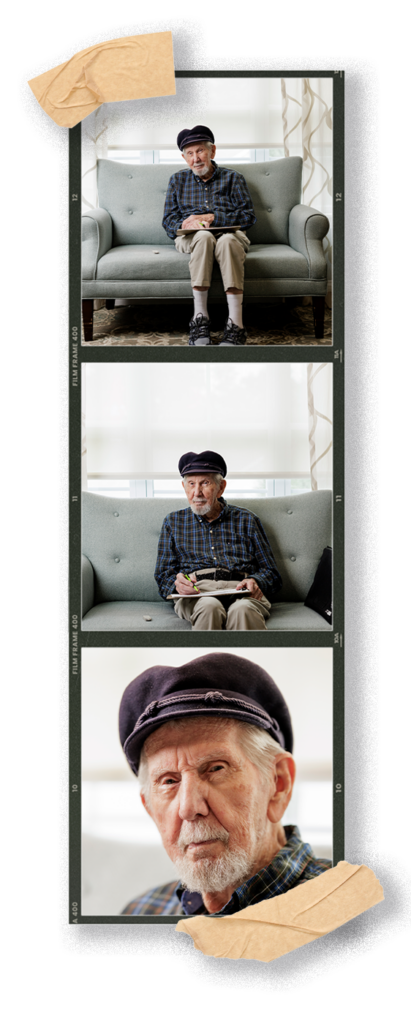
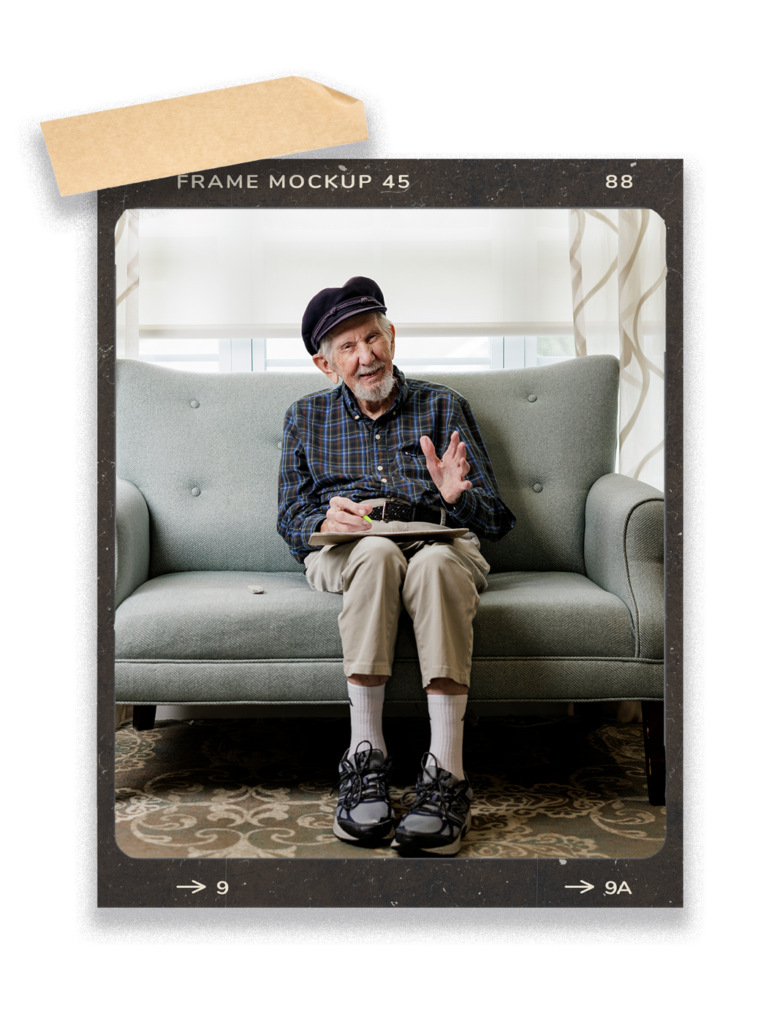
It would be nearly two decades before he’d meet his wife, Betty Schulze, a chemist, on a golf-course driving range. They married in 1964, had two daughters and built a life together for 59 years — traveling extensively in their 70s and 80s — before Betty’s death in 2023 at age 97.
At 100, Bruno has more good days than bad. He gets around with a walker and has hearing issues from a lifetime of working with machines, but he is one of Bethesda Hawthorne’s most charming residents.
Just ask him to tell you a story.
With every one of them, his hand moves across a blank sheet of paper with a pencil that creates lines and shadows until they start to reveal an image. As the drawing comes into fulfillment, it’s clear you’re witnessing more than just a sketch. You’re seeing memory reveal itself in real-time, a memory that will outlive him as long as the particles of medium-hard graphite cling to paper.
“He has profound hearing loss and doesn’t get around as well anymore,” Teresa Bruno says, “but drawing enables him to still connect with people. That’s everything for him.”