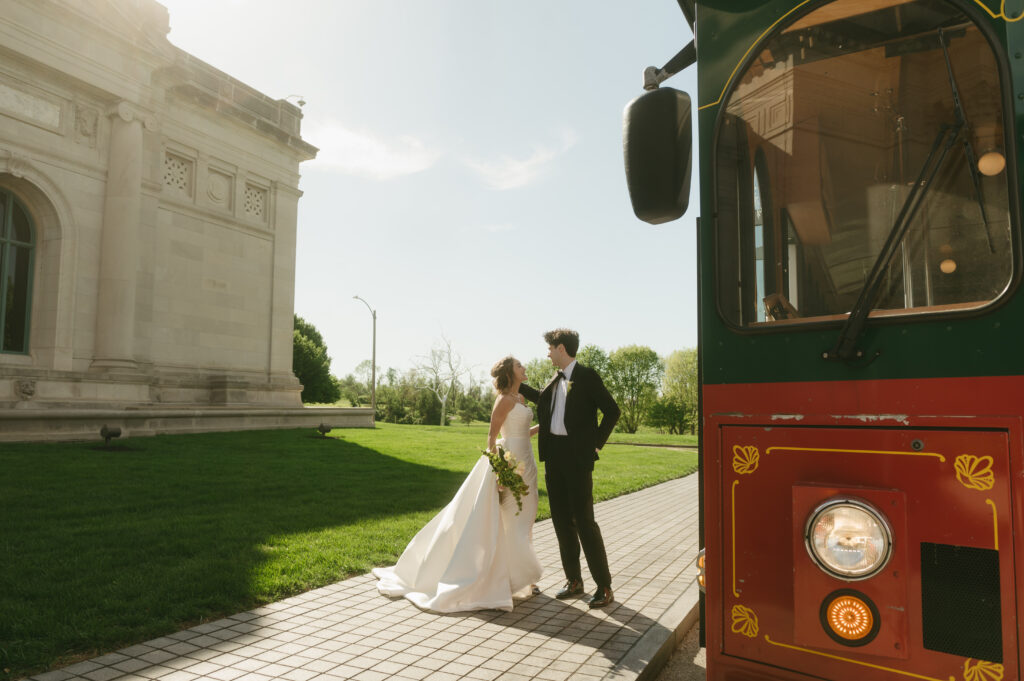
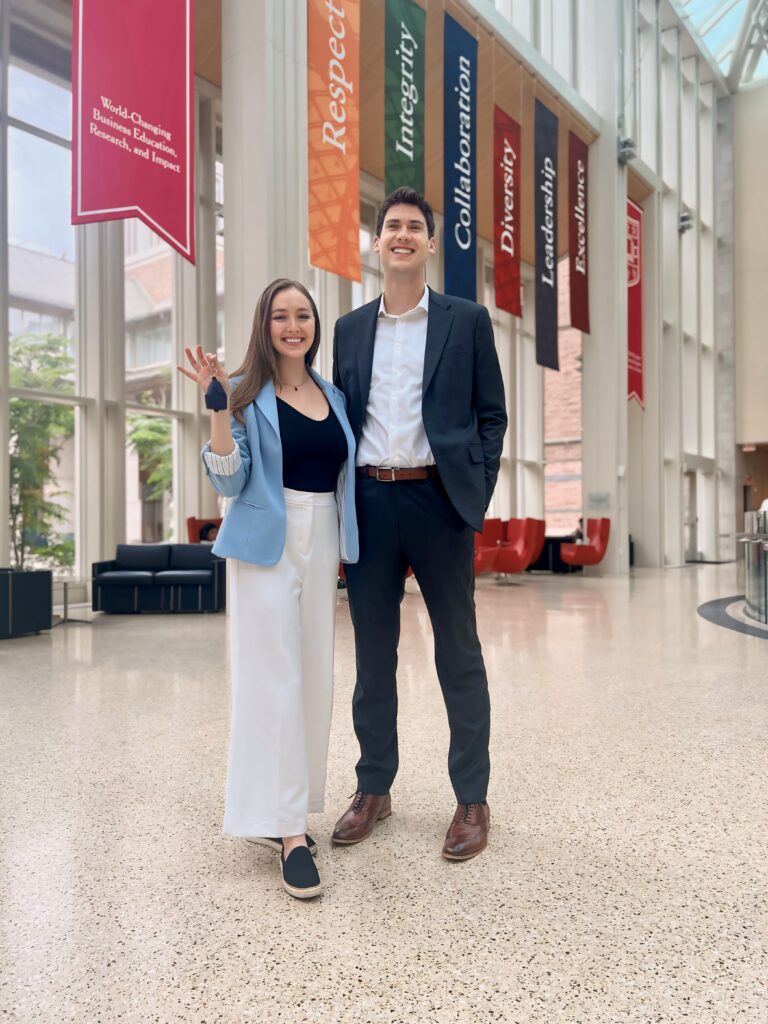
As members of the Class of 2021 packed their suitcases this April for their five-year WashU Reunion, more than 50 attendees tucked in an extra outfit for a special event at the St. Louis Art Museum: the wedding of Dani Wilder, AB ’21, MD ’26, and Matt Bitner-Glindzicz, BS ’21, MS ’22.
Wanting to ensure that former classmates (including their photographer, Marie Foss, BFA ’21) could attend both celebrations, the couple intentionally planned their ceremony to coincide with reunion weekend.
The wedding was a high point for Wilder and Bitner-Glindzicz in a year full of professional and personal milestones. Word is spreading in public health communities about their company, nCase Technologies, and its flagship product, NALOX-1. An updated version, nCase Light, launches this month — just weeks after Wilder’s graduation from WashU Medicine.
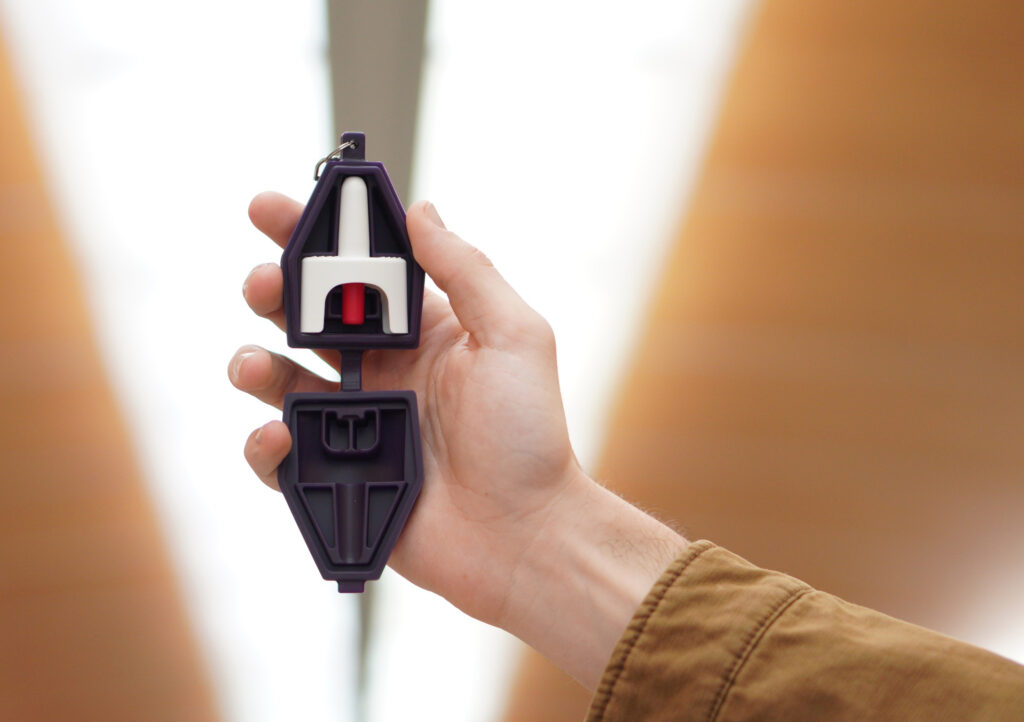
A St. Louis-based startup, nCase Technologies creates cases that securely and discreetly hold naloxone nasal spray, the life-saving drug that can reverse the effects of an opioid overdose. The idea arose from the sobering realization that even among those who already know the importance of naloxone, most frequently sold as Narcan, the vast majority don’t carry it regularly.
Wilder sees this pattern regularly in her work in emergency medicine. Tragically, as a teenager it affected her innermost circle.
“Back in 2018, I lost a close friend to an opioid overdose,” Wilder says. “He owned Narcan, and those he was with also owned Narcan, but none of them had it on them when his life depended on it.
And fast forward, when I got training in medical school, people received Narcan and then didn’t have it when they needed it most. That’s when we started realizing there was a problem. I wondered, ‘how do I get myself to carry Narcan? How do I get people to build it into their everyday lives?’”
“Back in 2018, I lost a close friend to an opioid overdose,” Wilder says. “He owned Narcan, and those he was with also owned Narcan, but none of them had it on them when his life depended on it.
Through research, the couple discovered a set of simple but persistent barriers to carrying naloxone: bulkiness, inconvenience, stigma. Bitner-Glindzicz, who as a WashU McKelvey Engineering student studied space technology, saw an engineering problem. Wilder, who had already conceived of and pitched a different medical device as an undergraduate in Arts & Sciences’ Biotech Explorers Pathway, saw an entrepreneurial opportunity.
Or as Wilder puts it: “We saw a very easy solution to a big problem and decided it was time to act on it.”
The tech behind 40+ lives saved
Another type of match
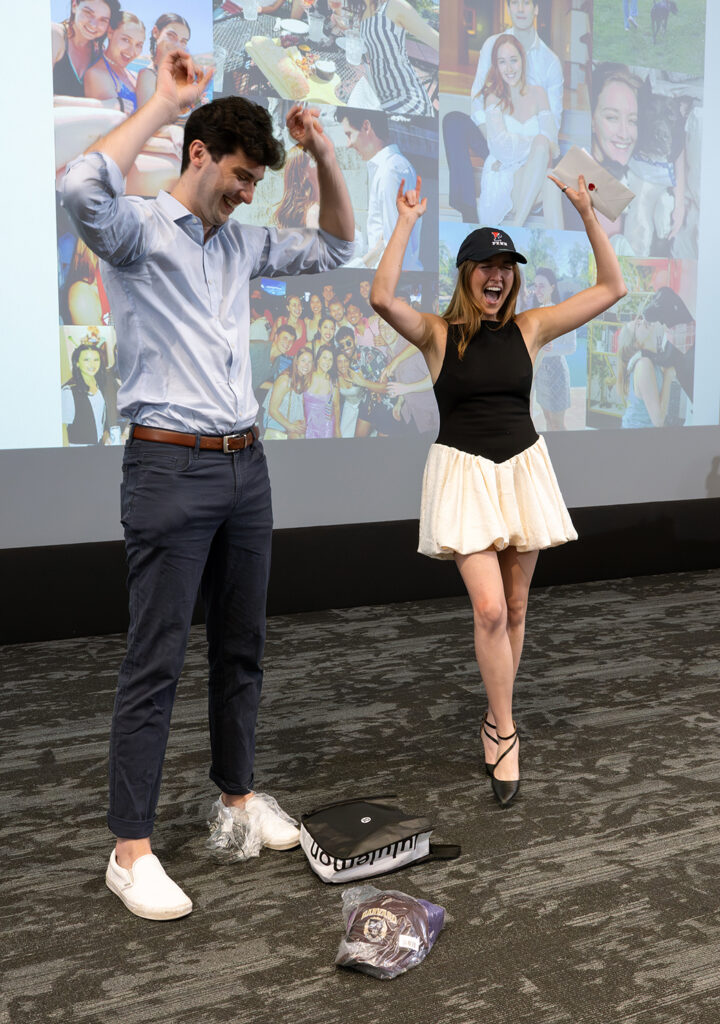
Just weeks before her wedding, at the WashU Medicine Match Day Ceremony, Wilder learned she will pursue her residency in emergency medicine at the Hospital of the University of Pennsylvania in Philadelphia. She and Bitner-Glindzicz plan to keep nCase Technologies based in St. Louis.
The unassuming, keychain-sized NALOX-1 case required a substantial amount of engineering knowledge to envision and manufacture. Bitner-Glindzicz designed the case to be waterproof, UV- and temperature-resistant, comfortable to hold and almost comically durable. In prototype testing, it survived being run over by a car and dropped off a building without damaging the nasal spray inside. (A kitchen blender bested it, the team admits.)
Most crucially, it’s built to be completely fail-safe when needed most.
“From an engineering perspective, having a soft case instead of a hard one allowed me to make this into a single-body design, which is really important,” Bitner-Glindzicz says. “If you come across somebody experiencing an overdose, literally every second counts. All you have to do is just pop it open, and you can immediately take the medication out and administer as quickly as possible.”
Appearance-wise, the case intentionally looks more like “a cute accessory” than a medical device, he says. “We wanted this to be something that was soft to the touch, something people actually want to carry with them.”
Customers are “obsessed,” Bitner-Glindzicz says. In August 2025, thanks to a large order from St. Louis County Public Health, nCase sold all their existing inventory within two weeks. The fledgling company then won an Arch Grant for $75,000, followed by an additional infusion of $100,000 in investments.
The influx of capital meant Bitner-Glindzicz could give up his bartending job, which had supported the couple as they launched the company while Wilder worked through her third year of medical school. Sales have quadrupled since then, growing nearly 100% each quarter, with new clients coming on board throughout the country.
“We’ve had a lot of rural and Native American reservation customers,” Wilder says. “Specifically targeting areas where there aren’t a lot of resources, that seems to be point of impact for us right now.”
Among the many significant figures and milestones from the past year, for Wilder and Bitner-Glindzicz, the most gratifying is 40 — the number of confirmed lives saved from the technology they created. Since so many overdose incidents go unreported, they suspect that number is even higher. And they’re determined to save even more.
The WashU start
StL love
In addition to WashU resources and mentors, the nCase founders credit the city of St. Louis for their early success.
Wilder: “For us, growing our company in St. Louis was our way to give back to the community, because it’s given us so much.”
Bitner-Glindzicz: “The people that choose to be here love this city and are proud to be here. That creates a really interesting incubator as a culture for startups and ventures.”
The couple credits much of their company’s success to WashU, especially the university’s Skandalaris Center for Interdisciplinary Innovation and Entrepreneurship.
“I just have to say, flat out: we definitely would not have gotten this off the ground without the support of WashU and the innovation resources that it has,” Bitner-Glindzicz says.
The couple won the top prize at the Skandalaris Spring Venture Competition in 2024. That early $10,000 award made it possible to move from ideation to creation in less than a year. And Skandalaris mentors, including Cyril Loum, venture development manager, have been by their side ever since.
“Cyril has been such a massive and consistent supporter for us from the very beginning, and continues to be even now,” Bitner-Glindzicz says.
“I think he was just as excited as we were when Matt proposed,” Wilder adds. “The ecosystem is so friendly and personal. It makes it so much easier to approach these problems with people who really seem to care about you.”
The nCase founders credit the Skandalaris Center with helping them build crucial connections in the public health, innovation and medical industries, and they’re expanding that circle of connection by bringing on current WashU students as interns.
“If it wasn’t for those resources, there’s no way we end up even saving a single life,” Bitner-Glindzicz says.
Growing (and shrinking) with purpose
Origin stories
Legacy love: The couple met during their first week of WashU classes — as did Dani’s parents, Susan Shern Wilder, AB ’84, and Robert Wilder, BSBA ’83.
That first business pitch: As an undergraduate, Wilder created a patch to test for skin sensitivities.
An open door: WashU “was not originally on my radar,” Bitner-Glindicz says, but he enthusiastically enrolled after earning a full-tuition engineering scholarship as a Langsdorf Scholar.
While bringing their first case to market, the nCase co-founders had already set their sights on ways to improve the case and make it useful for even more people.
“The early beta testing we did showed the number one thing that keeps people from carrying Narcan is just inconvenience and size and bulkiness,” Bitner-Glindzicz says. “We knew long term that we needed to develop something that was even smaller and lighter.”
Their upcoming product launch, nCase Light, checks both boxes. It’s 37% lighter and 30% smaller than NALOX-1, while still being fully protective. The new version may not survive being run over by a car, Bitner-Glindzicz says, “but you can still drop it off a fifth-story balcony.”
The launch also marks a move beyond opioid harm reduction. In recent years, pharmaceutical companies have begun to turn other emergency medications, including the widely used epinephrine for allergic reactions, into nasal sprays.
“That opens up an entire global market of people that have a serious need for carrying their meds, and we can provide them a better way of doing so — and continue to save even more lives that way,” Bitner-Glindzicz says.
While keeping an eye toward growth, the couple continues to prioritize public health over profits. An individual case costs less than $9, with bulk orders decreasing the price per unit to as low as $5.
“Ultimately, our goal is to sell this at the cheapest price possible,” Bitner-Glindicz says. “I would never be willing to take on an investor who isn’t OK with us selling these at a lower price, even maybe an unprofitable one, to a group that can truly make a difference and help save lives, because that’s what matters most.
“Ultimately, our goal is to sell this at the cheapest price possible,” Bitner-Glindicz says.
It’s high and lofty, and I don’t regret it for a single moment,” he adds. “Admittedly, it made getting this off the ground a lot harder, but our goal will always be public health first. We want to keep saving lives one day at a time — while exploring married life at the same time.”