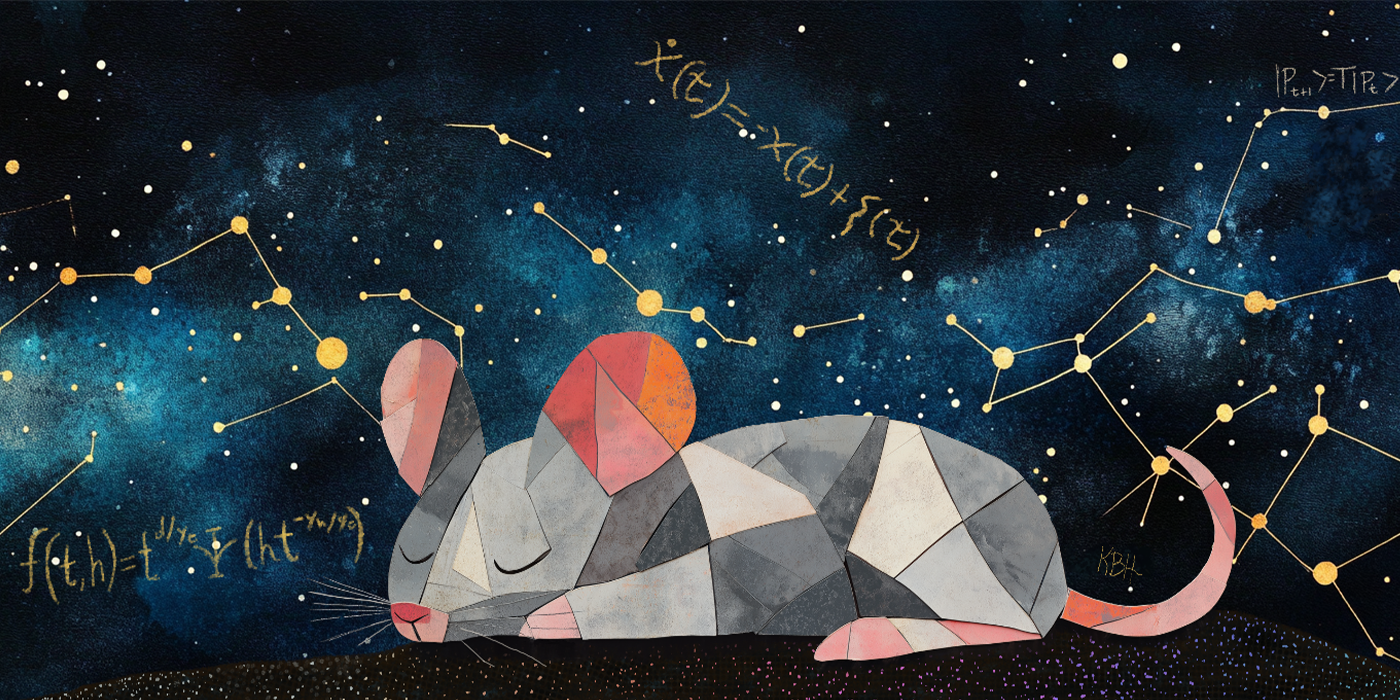
When you’re awake, all your brain’s functions gradually deteriorate. Sleep somehow restores them and may hold the key to understanding how brains operate.
“Sleep is one of the great mysteries in biology,” says Keith Hengen, associate professor of biology in Arts & Sciences. “We all need it, but we don’t know why.”
Hengen’s research focuses on understanding how sleep contributes to healthy cognition and how disrupted sleep worsens neurodegenerative and mental health disorders, like Alzheimer’s disease and depression.
In 2024, Hengen and Ralf Wessel, professor of physics in Arts & Sciences, published a significant paper that reported the first direct evidence that sleep restores the computational power of the brain. They discovered that sleep has a fundamental purpose: resetting neural networks by restoring criticality, a state of mind that promotes optimal thinking and learning.
Understanding this tipping point helps explain the incredible power of the brain. Up until recently, most people assumed that sleep must replenish some sort of crucial molecules that are depleted during waking hours. But what Hengen and Wessel found is that learning, thinking and being awake pushes the brain away from criticality — and that sleep is perfectly positioned to reboot the system.
Now, Hengen is exploring new questions about the connections between sleep and disease. “Sleep is worth studying not only because of its innumerable health benefits but precisely because a brain without sleep falls utterly and completely apart,” he says.
To tackle this research, Hengen and his team have developed a flexible brain-electrode interface that can record the activity of individual neurons in the living brain over extended periods of time.
It’s an intensive process that delivers a staggering amount of data. “We’ve engineered systems that allow us to record for months at a time,” he says, “so we can observe how the same neurons behave over thousands of iterations of sleeping and waking cycles, through light and dark and across conditions that can’t be captured quickly, like aging or disease progression.”
“If the brain is a computer, my lab is trying to figure out the operating system. I’m convinced sleep is the key to how the brain works.”
Keith Hengen
This spring, Hengen and Luis de Lecea of Stanford University were awarded $2.7 million from the National Institutes of Health (NIH) for a five-year investigation into the power of sleep to prevent, delay and diminish Alzheimer’s and related diseases. They will examine the relationship between sleep patterns, criticality and brain function in mice engineered to be at high risk for an Alzheimer’s-like neurodegenerative disease.
The scientists hope to develop targeted sleep interventions that could slow or prevent disease-related cognitive decline. This research could lead to new therapeutic strategies for neurodegenerative diseases that affect millions. “Breakdown in criticality seems to unify at least four molecularly distinct forms of neurodegenerative diseases,” Hengen says. “It’s almost like driving a car in the wrong gear for years; eventually, you start to destroy the engine. But by looking at subtle shifts, you can predict who’s vulnerable long before you start to see symptoms.”
Hengen has also just begun to work with Aya Takeoka at the Japan-based RIKEN Center for Brain Science, investigating a sleeplike process in the spinal cord with funding from the Human Frontier Science Program.
Sleep is traditionally considered a brain-centric phenomenon. But whether neural structures beyond the brain experience sleep remains an unexplored frontier — one with potentially profound implications. If the spinal cord exhibits autonomous sleeplike states contributing to motor memory consolidation, this would challenge and expand our understanding of sleep’s role in learning and neural plasticity.
These new questions strike at the heart of what sleep is, why it is necessary and where in the nervous system it operates. “If the brain is a computer, my lab is trying to figure out the operating system,” Hengen says. “I’m convinced sleep is the key to how the brain works.”