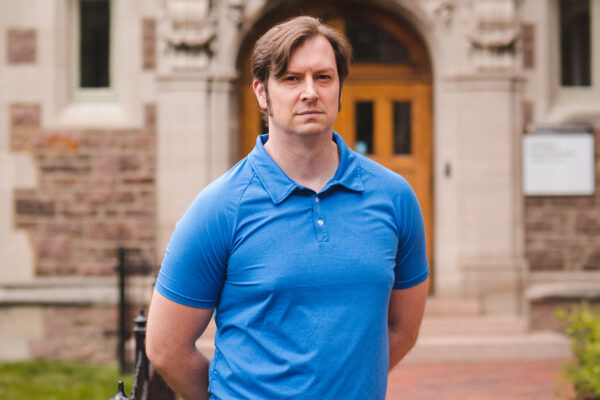
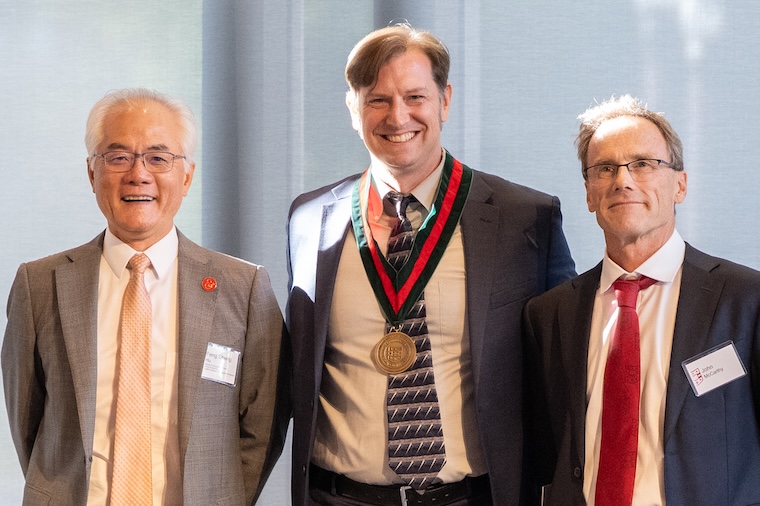
Brett D. Wick, chair of the Department of Mathematics in Arts & Sciences, has been installed as the inaugural Robert G. and Maxine W. Scheibe Professor of Mathematics at Washington University in St. Louis.
The newly endowed position was established through a planned commitment by the late Scheibes, who were loyal, generous and engaged alumni.
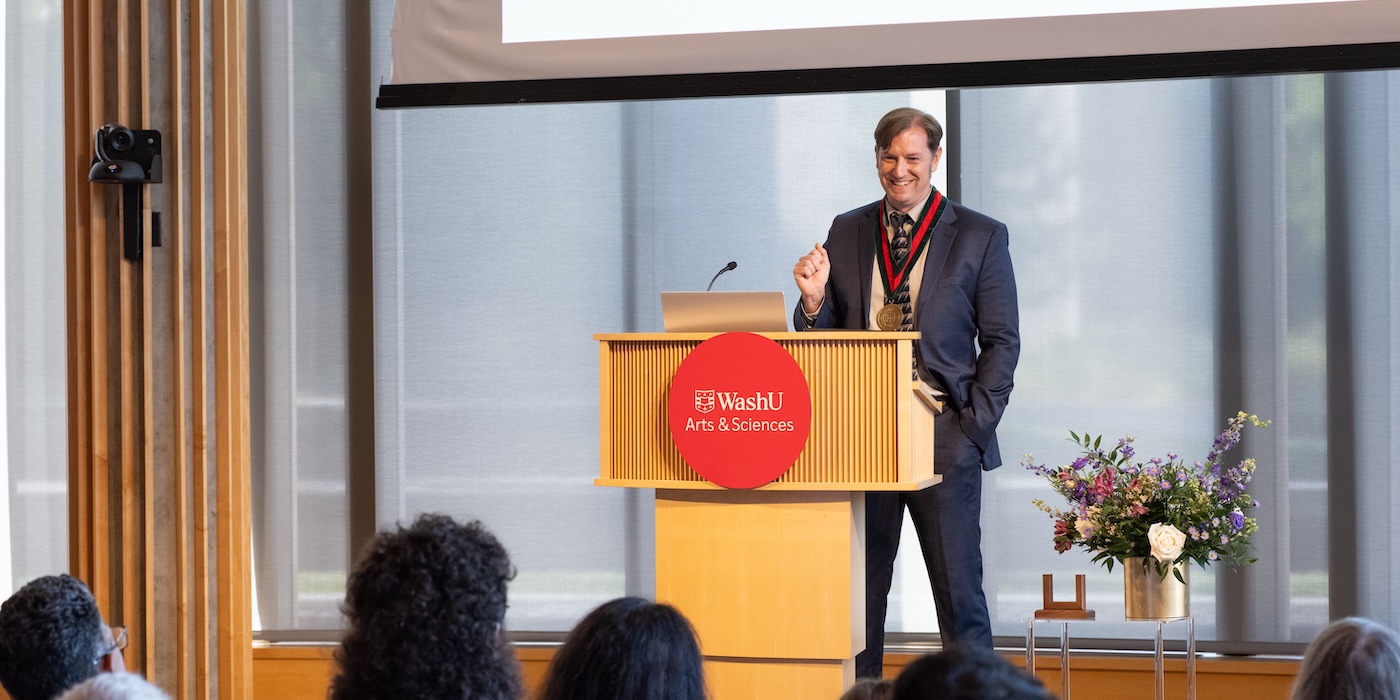
Wick delivered an address, titled “The Human Side of Mathematics,” at a well-attended installation ceremony held Sept. 15 at Hillman Hall.
Every theorem begins with people, Wick said. That is the deep truth that underpins Wick’s decades of research and scholarly contributions — and continues to motivate his work as an educator and mentor.
“It’s the teachers, the collaborators, the advisers, our students and our families who help us take advantage of opportunities and give us encouragement,” Wick said. “I’m grateful to those who helped me get here, and I hope to honor that gift by helping the next generation get where they are going.”
Over the course of his career, Wick has built an international reputation for his research in harmonic analysis, complex analysis, function theory and operator theory. His wide-ranging installation talk included a layperson-friendly description of the corona problem in mathematics.
Since he joined WashU in 2015, Wick also has contributed significantly to advancing certain university priorities.
“What strikes me about Brett is not only his impressive body of scholarly work, but his commitment to service and mentorship,” said Feng Sheng Hu, the Richard G. Engelsmann Dean and the Lucille P. Markey Distinguished Professor of Arts & Sciences.
Hu noted that Wick also helped in the creation of Arts & Sciences’ Department of Statistics and Data Science. This new department, formed under the Arts & Sciences and WashU strategic plans, provides a foundation for ambitious and innovative research across a range of disciplinary areas, leveraging emerging opportunities in computational and data science and providing foundational data science support to schools and programs across the university.
“Mathematics is a global conversation,” Wick told the crowd at the ceremony. “It may seem like we work by ourselves in our offices, thinking about these abstract things. But I find that not to be true at all.” He shared photos of his students and mentees and described how mathematics brought him opportunities to interact with people around the world, from Australia to Sweden to Taiwan and beyond.
“Ideas in math come from conversations — at conferences, dinners, walks, over coffee or over the blackboard,” he said. “The key thing I want to point out is that the ideas move through people.”
About Brett D. Wick
Wick earned his bachelor’s degree in mathematics, with a minor in physics, from the University of Houston in 2001. He then earned a master’s in 2003 and a doctorate in mathematics from Brown University in 2005, under the direction of Sergei Treil. His early career included postdoctoral and visiting positions, including appointments at Vanderbilt University, the Fields Institute and the Royal Institute of Technology (KTH) in Sweden. He later held faculty positions at the University of South Carolina and Georgia Institute of Technology before coming to WashU.
Wick’s research centers on questions in modern analysis. His work addresses problems involving singular integral operators, weighted inequalities, commutators, function spaces, interpolation and the corona problem.
A recurring theme in his research is the use of harmonic-analytic methods to uncover structure in settings that arise in complex analysis and operator theory. His scholarship has led to a large body of work with researchers across the United States and internationally, including more than 140 published or accepted papers and a monograph on the Dirichlet space and related function spaces.
His research accomplishments have been recognized with several major honors. Wick is a fellow of the American Mathematical Society and has received a National Science Foundation CAREER Award and an Alexander von Humboldt Research Fellowship. He also has received numerous grants from the National Science Foundation and the Australian Research Council.
Alongside his research, Wick has held significant leadership roles in academic administration and graduate education. At WashU, he served as director of graduate studies in mathematics from 2017-2022 and as a Dean’s Fellow for Digital Transformation in Arts & Sciences from 2022-24. He became chair of the Department of Mathematics in 2025. Wick has advised numerous doctoral students and postdoctoral fellows. Wick also has provided editorial leadership for journals in analysis, complex analysis and operator theory.
About Robert G. and Maxine W. Scheibe
Robert Scheibe earned a bachelor’s degree in mathematics in 1960 and a medical doctor degree in 1964, both from WashU. He then completed his residency in urology at Barnes Hospital and entered private practice in St. Louis as an attending urologist at the Missouri Baptist Medical Center. He served in the military during the Vietnam War, working in field hospitals in the mid-1960s.
An engaged volunteer at WashU, Scheibe served on the Medicine Eliot Society Committee, the Medical School Annual Giving Committee and was a life member in the William Greenleaf Eliot Society. He was also a board member of the WashU Medicine Alumni Association and Washington University Medical Center Alumni Association Executive Council for many years.
He enjoyed his work and keeping up with all the technological changes in medicine. Scheibe enjoyed reading and was interested in art, artifacts and ancient Middle Eastern archaeology. He died in 2024 at age 85.
Maxine Scheibe earned a bachelor’s degree in nursing in 1966 from WashU, followed by a master’s in 1972 from the University of Missouri-St. Louis. She worked as a nurse and a psychotherapist, helping low-income clients. Maxine died in 2015 at 77. The couple have a daughter, Elizabeth (Liz) Caroline Scheibe Samrick.
In addition to support for Arts & Sciences, the Scheibes supported WashU Medicine and the Mildred Lane Kemper Art Museum, among several other university funds and scholarships. In 2002, Robert Scheibe told WashU Magazine, “We both value education. We’re very proud of our education at Washington University. And we want to help ensure that it continues to get the best people and to help ensure that very qualified, bright people who have dreams are able to realize them.”