AI and Creativity
What does AI mean for the future of human creativity? Janet Rafner of the University of Southern Denmark in Odense, an expert in hybrid intelligence and human–AI co-creativity, joins Sandro Galea to discuss AI’s role in the creative space.
Janet Rafner
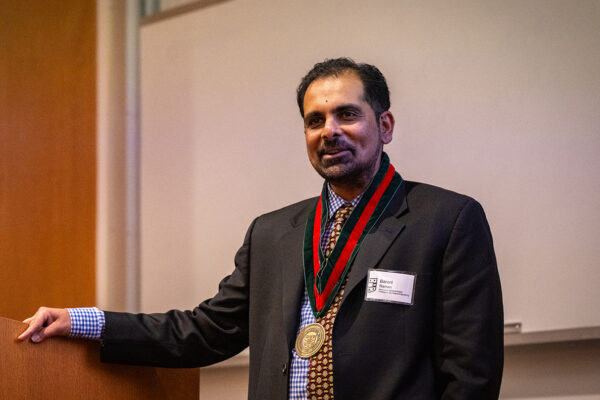
Raman named Dennis and Barbara Kessler Professor
Barani Raman, a renowned expert in systems neuroscience, machine olfaction and bio-inspired computing, has been named the Dennis and Barbara Kessler Professor of Biomedical Engineering at WashU.

New software safeguards research participants’ privacy
WashU Medicine researchers have developed a software, De-ID, that flags sensitive information in data collected through focus groups, surveys and interviews. It allows for easy removal of such details to enable safe sharing.
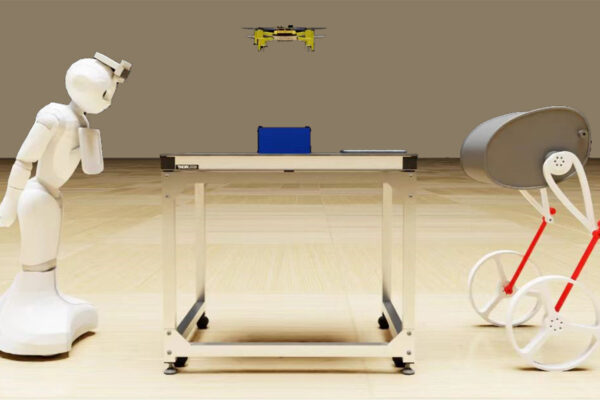
Robots learn by imitating other robots
A multi-institutional team, including Chongjie Zhang at WashU McKelvey Engineering, developed a new method that enables robots to achieve intentions shown by their peers.
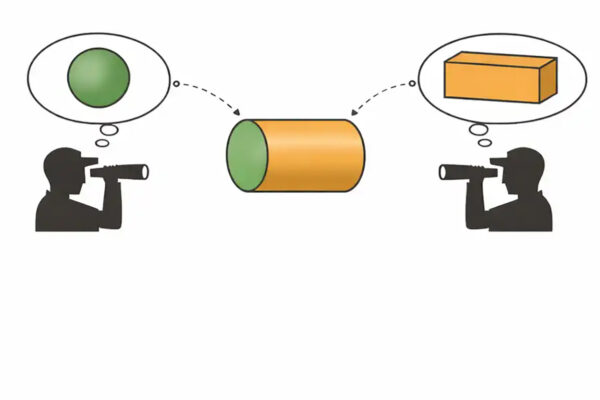
An inside look at drone swarm behavior
Researchers in the McKelvey School of Engineering at WashU have developed a new method to understand information in complex systems, which can be applied toward development of unmanned aerial vehicles.
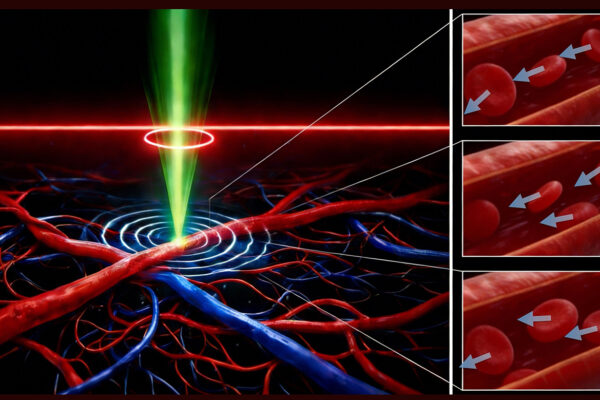
Tracking single red blood cells as they move through the brain
Super-resolution functional photoacoustic microscopy, a new technique developed at WashU, allows researchers to image blood flow and oxygenation at single-cell resolution. The research could provide insight into microvascular health and disease, such as stroke, vascular dementia and Alzheimer’s disease.

Index provides flu risk for each state
Researchers at WashU have developed vulnerability maps highlighting regions across the United States with varying levels of socioeconomic vulnerability to influenza-like illness.

Sun sets on the Sunlight glacier
Researchers at WashU are documenting the loss of the Sunlight glacier system near Sunlight Peak, Wyo.
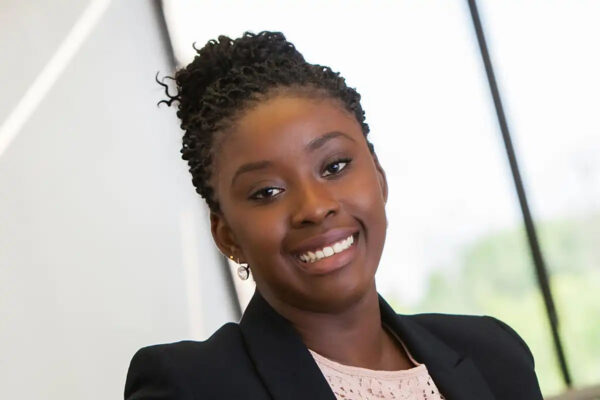
Ottley appointed to UN panel on artificial intelligence
Alvitta Ottley, a computer science researcher at WashU, was appointed to a United Nations panel on artificial intelligence.
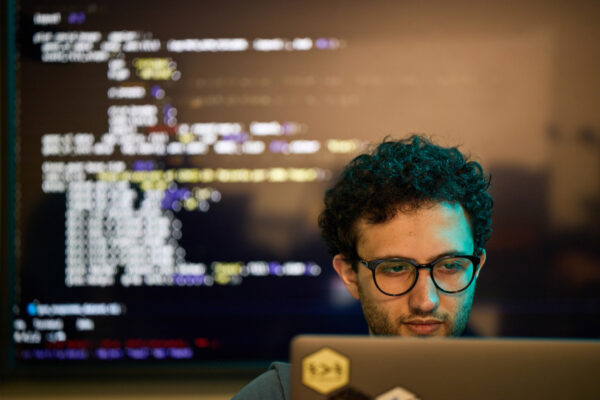
New WashU Medicine program to train data specialists
The master’s program in biomedical data science and artificial intelligence is one of few such programs in the U.S. It offers a flexible curriculum, part-time enrollment and evening classes to accommodate working students.
Older Stories