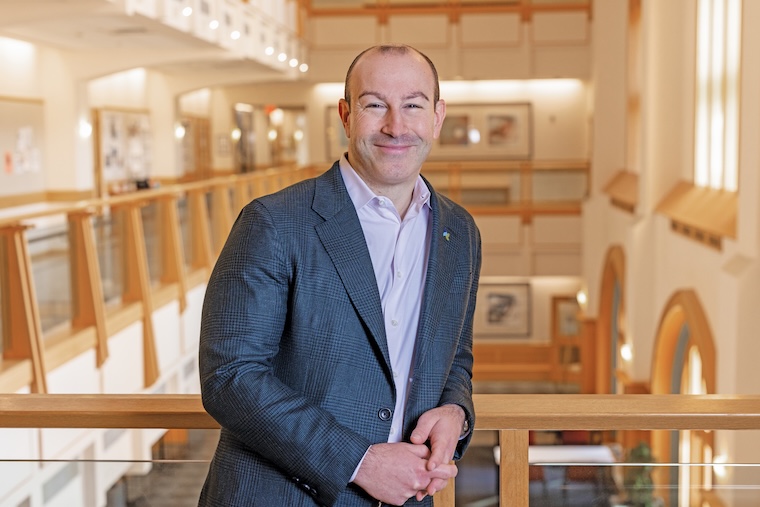
As a student at Syosset High School on New York’s Long Island in the ’90s, Michael Lefenfeld, BS ’02, undertook several extreme science projects, including one that replicated the groundbreaking Miller-Urey origins of life experiment from the 1950s. “They made me do it in the school’s basement because the chemical components could literally blow up,” he says.
Lefenfeld’s curiosity and penchant for taking risks helped him pave an entrepreneurial path at WashU. As a chemical engineering student, he launched a startup to improve the design of sensors that measure blood oxygen saturation. The technology was eventually licensed and is now used in modern pulse oximetry devices.
After graduation, Lefenfeld and a collaborator discovered a way to convert highly reactive alkali metals into stable powders. He co-founded SiGNa Chemistry to develop and market the innovative materials for oil and gas refining, pharmaceutical manufacturing, environmental remediation and more. After earning two master’s degrees from Columbia University, he led SiGNa for more than a decade, growing top-line sales to more than $1 billion.
“WashU has been critical to my success. I didn’t know what an engineer was when I arrived on campus. The environment and support I received accelerated my growth. If I can help make it even better, I want to.”
Michael Lefenfeld, BS ’02
Since 2018, he has flexed his strategic and operational leadership skills as a turnaround growth expert for private equity-backed chemical companies. Currently president and CEO of Hexion in Columbus, Ohio, he is transforming the adhesive manufacturer into an AI-based performance material provider that helps customers around the globe digitize wood panel manufacturing.
Lefenfeld holds more than 100 issued and pending patents. Among his many honors, he received an Alumni Achievement Award from WashU McKelvey Engineering in April. He maintains close ties with the school, serving on its national council since 2019 and the executive advisory board for the Department of Energy, Environmental & Chemical Engineering since 2009. In July, he joined the university’s Board of Trustees. Through his philanthropy, he has supported engineering scholarships and facilities. He also has made an estate commitment to the university.
How did WashU nurture your growth as an entrepreneur?
My first company started as an extra-credit project for one of my classes. I was very lucky to connect with professors who made themselves available. They were doing top-level research, but their doors were always open for students to ask questions or discuss their interests. I’ve been involved with a lot of universities, and I can say WashU is exceptional in this regard.
Which faculty members were particularly influential?
Ron Cytron in the computer science department was fantastic, as was the late Curt Thies in chemical engineering. Curt had a consulting company that I worked for. I learned a lot about how to start a business from him. And then there’s Mike Duduković [the Laura & William Jens Emeritus Professor]. He’s a phenomenal chemical engineer. There’s not a refinery you can visit that hasn’t been affected by his work. We became close after I graduated.
Describe your work as a private equity CEO.
It’s like sprinting a marathon. Typical private equity holding periods are about five years, so you have to get in and transform a company in a short time frame. A lot of books say you should wait 90 days before doing anything when you take over a company. But I believe in making reversible changes quickly. You have to get lots of ideas out there.
I’m a big believer in taking chances and failing fast. But you never fail and walk away. You have to learn and apply the learning to other problems. In some of my companies, I’ve held funerals for projects that have “failed” in order to celebrate the ideation process — and to make sure bad ideas don’t come back.
Why did you choose to attend WashU?
I grew up in Queens and had never left New York. My family didn’t have a lot of money. I was going to a community college if I didn’t get a scholarship, and WashU offered me one. It was a wonderful opportunity, and I took it. Though as I recall, the summers in St. Louis were brutal
Is that why you support scholarships?
People sometimes forget how college transforms a person. I don’t think anybody who knew me as a child thought I would end up where I am now. I like helping others become the greatest version of themselves. I’ve stayed in touch with one of my scholarship students who is now getting a PhD in the United Kingdom. She still reaches out for advice.
Why have you stayed engaged with the university?
WashU has been critical to my success. I didn’t know what an engineer was when I arrived on campus. The environment and support I received accelerated my growth. If I can help make it even better, I want to. Even today, the relationships I build through the university are impactful. I meet with professors and serve as a sounding board for other national council members. WashU has provided a steadfast community for me.