In Brief
- WashU engineers developed tiny optical sensors that can collect information about multiple simultaneous changes as they occur.
- The approach uses AI to decode hidden patterns in light.
- This research paves the way for smaller, smarter sensors for robotics, human health monitoring and cybersecurity.
Picture a keyboard that knows not only which key you pressed, but also how hard you pressed it, using just one tiny sensor.
Research from Washington University in St. Louis is paving the way for smaller, smarter sensors that bring this idea closer to reality. The new work has potential applications for robotics, human health monitoring and cybersecurity.

By combining the physics of light with artificial intelligence (AI) tools, WashU engineers have figured out how to extract multiple pieces of information from a single optical sensor. The research, published in Laser & Photonics Reviews, was led by Lan Yang, the Edwin H. & Florence G. Skinner Professor of Electrical & Systems Engineering, in collaboration with the group of Chenyang Lu, the Fullgraf Professor of Computer Science & Engineering, both at the WashU McKelvey School of Engineering.
“What excites us most is that a single, tiny optical sensor can perform functions that typically require multiple sensors,” Yang said. “By using multiple sensing channels and analyzing how different optical modes respond to changes, we can extract much richer information from one device. This opens up new possibilities for developing smaller, smarter sensing technologies.”
“The sensor captures a wealth of information, but the challenge is making sense of it,” Lu said. “Machine learning helps us decode these complex light patterns and turn them into useful measurements, enabling a single sensor to detect and distinguish multiple physical changes.”
Beyond detecting touch, the underlying principle offers a new way to design sensors, Yang and Lu said. Instead of adding more physical sensing elements, researchers can use AI tools to extract more information from different optical modes within the same device.
Hidden in the light
Most of today’s conventional sensors are designed to measure one type of change. To measure several things at once, engineers must often combine multiple sensing elements. Although effective, this approach can make devices larger, more complicated and harder to calibrate.
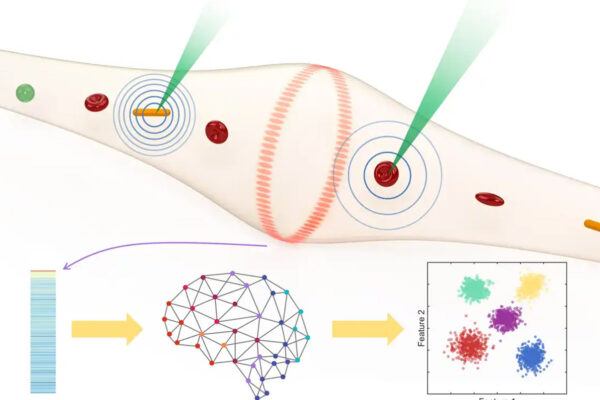
The WashU team took a different approach. They built a tiny optical device that traps light inside, where it travels in many different paths. When something changes around the device, each light pattern responds in its own way. Taken together, these responses create unique optical “barcodes” that carry information about the changes. By analyzing how these barcodes change, researchers can learn several things at once, such as where the device was touched and how much pressure was applied.
AI can help fill in the final piece of the puzzle, the WashU researchers said. By learning from examples of known changes, machine-learning algorithms can recognize hidden relationships within these complex light patterns and translate them into useful measurements.
“The research points toward an exciting possibility,” Lu said. “A new generation of intelligent sensors can understand multiple elements of a changing world through the rich information carried by light.”
Many potential applications
To demonstrate their approach, the WashU engineers tested a miniature keyboard-like platform with nine touch locations.
Instead of using an array of nine sensors, the researchers used a single, tiny light-trapping device — called an optical microresonator — to determine both where the surface was pressed and how far it moved. Their tests also showed that this approach was effective when the optical measurements became noisier or contained fewer data points — important considerations for practical sensing systems.
“With further development, this strategy could support compact, intelligent devices for robotic touch, environmental monitoring and biomedical sensing,” said first author Jie Liao, a postdoctoral research associate in Yang’s group. “For example, future health-monitoring technologies could benefit from measuring several related physiological changes together and provide a more complete picture than any single measurement alone.”
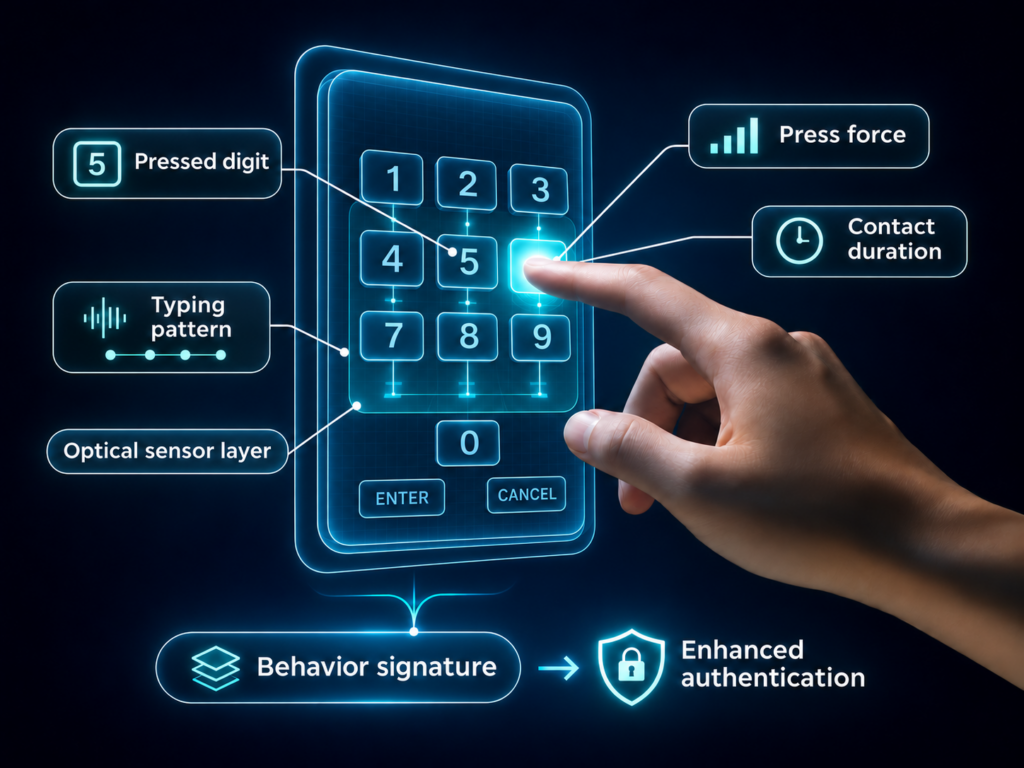
Cybersecurity is another area where new kinds of photonic sensors could help, suggested co-author Hangyue Li, a doctoral student in Lu’s group. As an example, Li offered: What if your smartphone recognized not only the access code that you are entering, but also something unique about the way that you enter it?
“People are interested in adding another degree of authentication,” Li said. “The pattern you type in — including how much pressure you apply on different numbers — that could increase the safety.”
Liao, Jie, Hangyue Li, Chenyang Lu, and Lan Yang. “AI‐Empowered Hyper‐Information Barcodes for Multiparameter Sensing With a Single Multimode Microresonator.” Laser & Photonics Reviews (2026): e71643. https://doi.org/10.1002/lpor.71643
Funding: This work was supported in part by the AI for Health Institute at WashU.