Early voting has started in Missouri, and the general election is Nov. 3. Until then, members of the Voter Champions Network and WashU Votes, both initiatives of the WashU Gephardt Institute for Civic and Community Engagement in the Division of Student Success, are hard at work connecting students, faculty and staff to important information about their ballots, voter identification requirements and polling places.
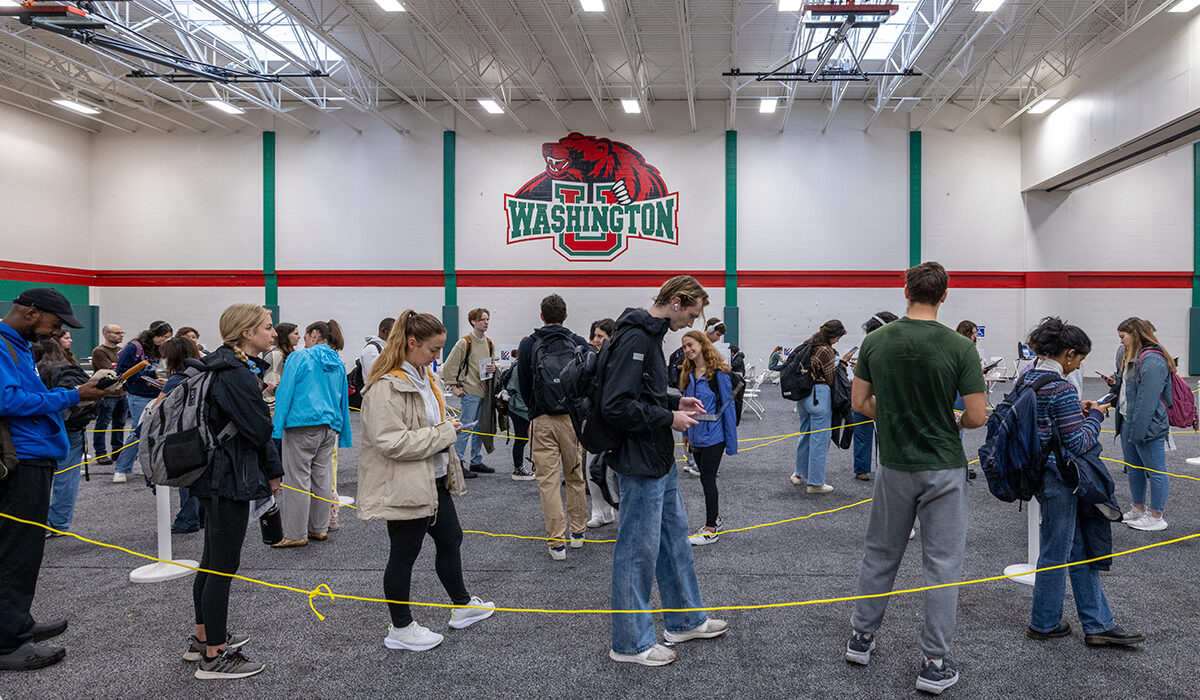
Gephardt Institute staff and volunteers also are preparing to host two campus polling locations Nov. 3 — one in the Athletic Complex, on the Danforth Campus, for St. Louis County voters and one in the McDonnell Medical Sciences Building, on the Medical Campus, for St. Louis city voters. Polls open at 6 a.m Nov. 3 and will remain open until all voters in line by 7 p.m. have voted. Voters must bring a photo ID issued by the state of Missouri (e.g., a driver’s license or state ID) or by the U.S. government (e.g. a passport).
Here, the Record highlights three members of the WashU community who have volunteered their time to support voters.
“This is truly a universitywide effort, and we’re grateful to our students and colleagues who are invested in fostering voter engagement and other forms of civic engagement throughout the WashU community,” said Stephanie Kurtzman, the Peter G. Sortino executive director of the Gephardt Institute.
Heather Hageman
Director, collaboration for interprofessional education and community engagement hub, WashU Medicine
Heather Hageman, of WashU Medicine, said there is a reason why healthcare professionals vote at a lower rate than the general population: access. That’s why she partnered with the Gephardt Institute to establish a polling place at WashU Medicine.
“It can be difficult to get the polls when you are working a 12-hour shift,” said Hageman, director of collaboration for interprofessional education and community engagement hub. “It was my dream for people who live in the city to come down from their shift and be able to vote. It took two solid years of hard work, but the Gephardt team made it happen.”
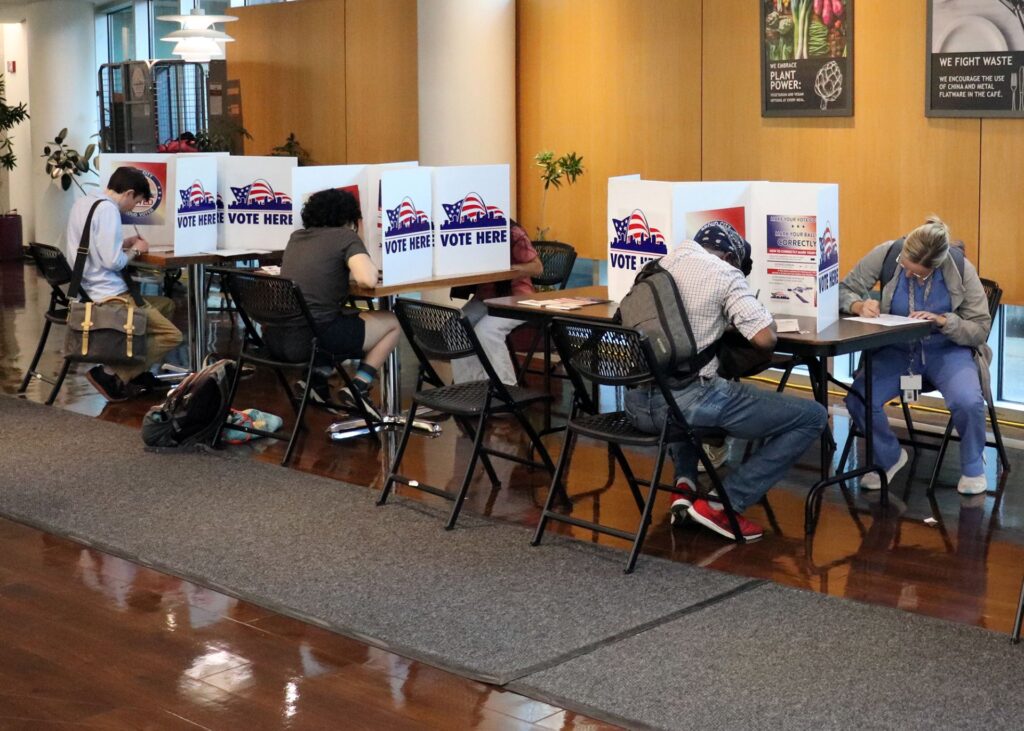
Hageman and some of her students are preparing to welcome hundreds of voters — WashU Medicine students and employees, patients, neighbors and any registered voter who lives in the city — to the Shell Cafe in the McDonnell Medical Sciences Building on Election Day. As one of the site’s official poll managers, Hageman checks in voters, answers questions and makes sure that everyone who is eligible has the opportunity to vote.
“Our first election was in November 2024, and there was torrential rain, so we didn’t have a ton of people. But the people who did come were so thankful,” Hageman recalled. Despite the rain, 496 voters cast their ballots on the WashU Medical Campus that day.
Hageman also serves as the adviser to the Health Professional Student Leadership Council and supports their partnership with Vot-ER, a nonprofit organization working to integrate civic engagement into medical training. The group recently held voter registration drives at Ellen S. Clark Hope Plaza on the Medical Campus and at the SPOT Youth Center. The students answer basic questions, such as who can vote where, and explain more complex phenomena, such as the correlation between voting rates and human health.
“Where there are lower voting rates, there are more hardships for people,” Hageman said. “The American Medical Association and other health organizations recognize voting as a critical social determinant of health. It can shape policies, resource allocation and community well-being.”
Ella McCauley
Co-chair, WashU Votes
When she’s not studying politics in the classroom, junior Ella McCauley is helping increase political engagement on campus and in the St. Louis community as co-chair of WashU Votes, a nonpartisan student committee of the Gephardt Institutue that promotes voter engagement and education for undergraduates.
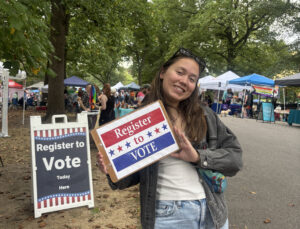
These days, she is busy answering questions about which forms of identification are acceptable in Missouri, how to vote absentee and where to find a notary. She is also planning Party at the Polls, an Election Day celebration with free food and fun activities, and speaking to students about the importance of making a plan for Election Day.
“What really brings me back to WashU Votes is knowing that there is always an election to vote in. There’s always a way to engage with elections,” McCauley said.
McCauley knows that navigating voter registration and the issues on the ballot is especially challenging for first-year students who are voting for the first time and for students who are busy with schoolwork and extracurriculars. As a result, voting isn’t always a top priority for students — something she’s trying to change.
“Even if students may not necessarily be as invested in the candidates themselves, I do think there’s a lot of nationally contentious issues that are happening right here in St. Louis,” McCauley said. “I think that students should really care about what’s going on politically and how that’s going to affect not only their lives, but their fields of study.”
McCauley works closely with St. Louis-based organizations including the League of Women Voters of Metro St. Louis and nationwide organizations such as All In To Vote.
“I honestly don’t think I realized how connected I would feel to St. Louis,” said McCauley, who is from southern Colorado. “I think that being able to actually engage with the St. Louis community has definitely been a very meaningful part of my college experience so far.”
– Sara Gelrud
Raven Lumpkins
Director of strategic initiatives and communications, University Services
Raven Lumpkins rarely has the opportunity to work directly with students in her role as director of strategic initiatives and communications at University Services. Still, she keeps students top of mind in her day-to-day work. So when leaders at the Gephardt Institute asked her to brainstorm ways to support new voters, she was quick to say yes.
“Helping students is near and dear to my heart, and this is one important way I can do that,” said Lumpkins, who previously worked in Undergraduate Admissions and the Office of Residential Life. “An important part of the WashU experience is learning about civic engagement and understanding your role in our American democracy.”
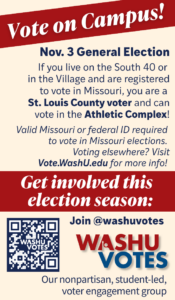
Lumpkins conceived of a sure-fire way to introduce voting resources to new students when they arrive on campus — slot their student IDs into a WashU Votes-branded cardholder, much like what hotel guests receive at check-in. The cardholder featured important dates, information about ID requirements and a QR code linked to Gephardt Institute resources.
“It’s hard to keep track of everything you get when you arrive on campus, but the one thing you are not going to lose is your WashU ID,” Lumpkins said. “A lot of campus partners would like that real estate, but we have decided to use the cardholder to inform students about voting resources.”
Lumpkins continues thinking of new ways to leverage University Services, such as Student Mail Services, to reach students. Her reasons are personal as well as professional.
“I want people to exercise their right to vote,” Lumpkins said. “The process can be hard to navigate, and the rules change. But I personally wouldn’t have this right if people before me didn’t fight for it. Everyone deserves the opportunity to use their voice.”