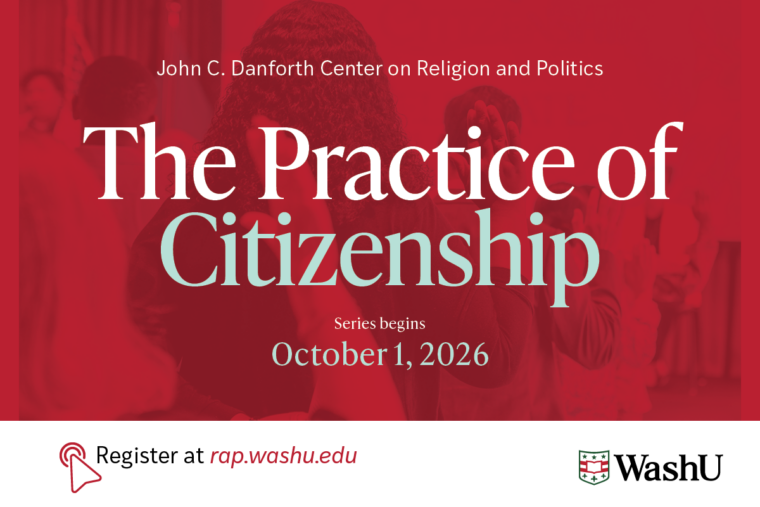
This fall, the WashU John C. Danforth Center on Religion and Politics will offer “The Practice of Citizenship,” a series of events that examines how people understand and inhabit citizenship, from daily interactions with neighbors to specific acts of political participation.
The series invites students, scholars and engaged citizens to consider what it means to practice citizenship. How do we imagine or reimagine citizenship through the individual behaviors and collective deeds that enact it? How do our shared history, culture and political activity shape the idea of citizenship and actions taken in its name?
Series events are free to attend, but tickets are required. Click on the event names to register.
‘Revisiting the American Indian Citizenship Act of 1924’
7:30-9 p.m. Thursday, Oct. 1
Knight Hall, Emerson Auditorium
The series opens with a presentation by Philip J. Deloria, the Leverett Saltonstall Professor of History at Harvard University. Deloria, who is of Dakota descent, will present his work on the social, cultural and political histories of relations among American Indian peoples and the United States. This lecture will invite participants to reflect on questions of Native “citizenship.”
‘Live Like a Citizen: 8 Ways to Change Your Mindset and Our Country’
7-8:30 p.m. Wednesday, Oct. 7
Hillman Hall, Clark-Fox Forum
The series continues with a public book discussion with Eric Liu, author of “Live Like A Citizen: 8 Ways to Change Your Mindset and Our Country” (Simon & Schuster, October 2026). This event is co-sponsored by the WashU Gephardt Institute for Civic and Community Engagement.
Democracy depends on active, informed and skilled participation. According to Liu, citizenship isn’t about legal paperwork or documentation status, it’s about a simple formula: Power + Character = Citizenship. It requires understanding how to make change happen while building the daily habits of a community-focused contributor. Individual civic actions might seem minor, but our collective, repeated efforts are exactly what build long-term resilience against national and global crises, Liu argues.
‘Christian Nationalism & Democratic Citizenship with Heath Carter’
7-8:30 p.m. Oct. 14
Knight Hall, Emerson Auditorium
Marie Griffith, the John C. Danforth Distinguished Professor in the Humanities, will moderate a panel discussion with WashU Danforth Center faculty J Kameron Carter, the Archer Alexander Distinguished Professor, Kambiz GhaneaBassiri, a professor of religion and politics, and Heath Carter, of Princeton Theological Seminary.
This timely conversation brings together leading voices in religion, history and politics to examine the rise of Christian nationalism and its profound impact on modern democratic citizenship. They will analyze how religious ideologies shape political belonging and the ongoing need for a pluralistic society.
‘Civil Resistance and the New Global Order’
7-8:30 p.m. Oct. 28
Hillman Hall, Clark-Fox Forum
Erica Chenoweth, the Frank Stanton Professor of the First Amendment at the Harvard Kennedy School and director of the Nonviolent Action Lab, will explore the profound evolution of global activism, sharing how civil resistance shaped the 20th century and how the geopolitical currents of the 21st century have shaped civil resistance in turn.
A leading expert on political violence and its alternatives, Chenoweth’s research focuses on how people effectively resist authoritarianism and push for systemic change. This event is co-sponsored by the Gephardt Institute.
Two other series events are already sold out: Doris Kearns Goodwin: Leadership for a More Perfect Union: Lessons from America at 250, presented in conjunction with WashU’s Leadership Week, and Nikole Hannah-Jones on “Citizenship,” convened by Department of African and African American Studies and the Center for the Humanities. A waitlist is being used for both events.