In Brief
- Painter Edward E. Boccia taught at WashU for 35 years.
- A new book takes an in-depth look at Boccia’s life and career.
- A new exhibition will feature dozens of paintings, some never-before exhibited.
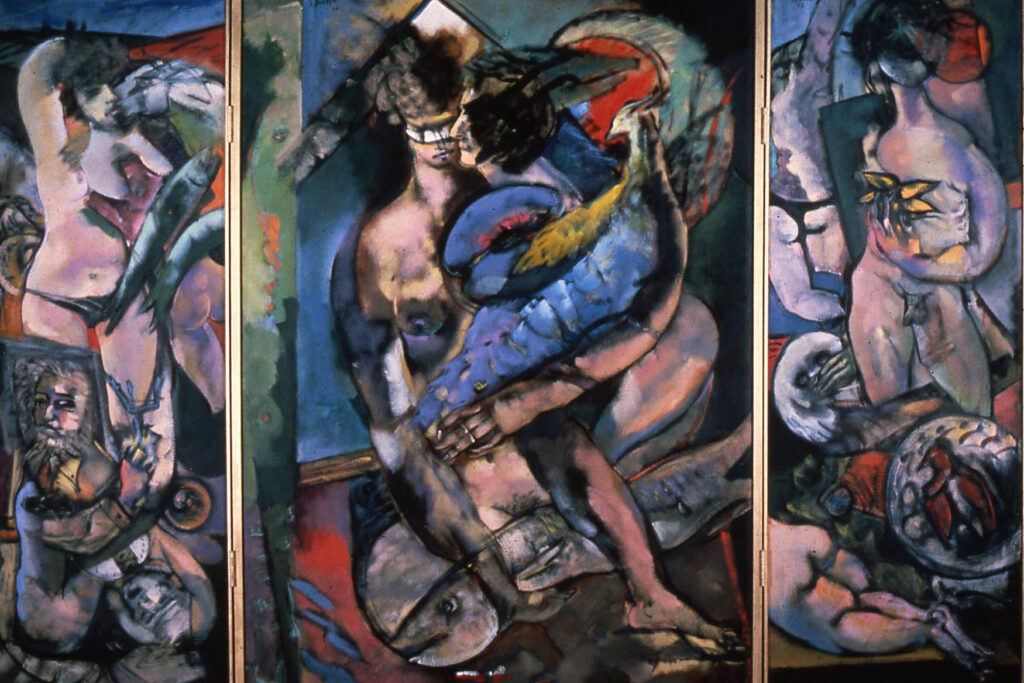
Edward E. Boccia (1921-2012) is known for large-scale, multi-panel epics. But Boccia also was a painter of exquisite detail.
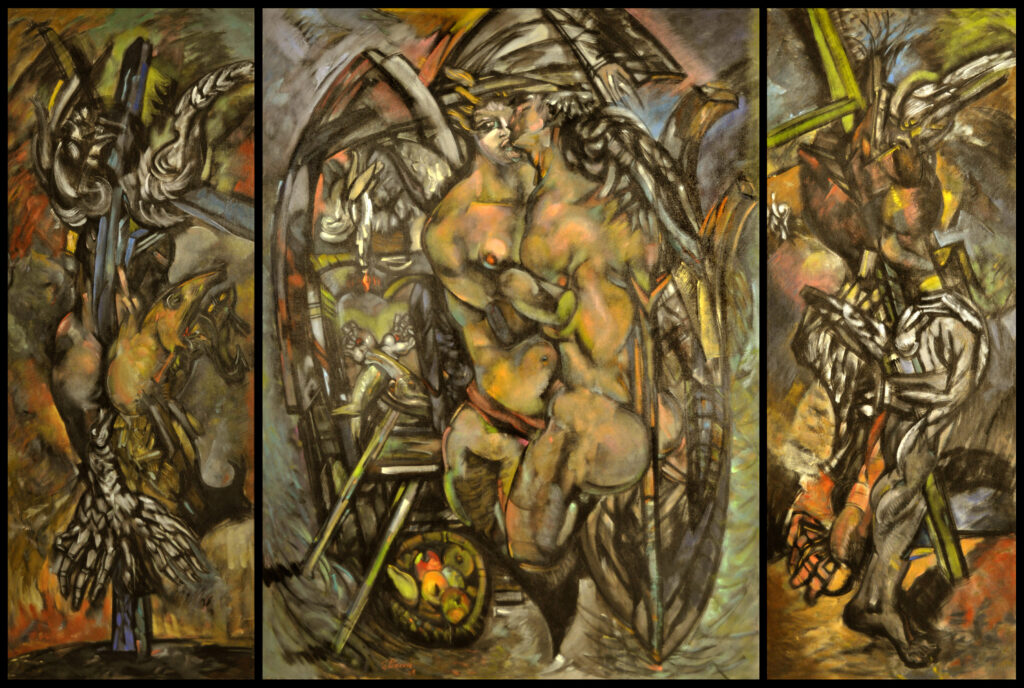
In the triptych “Mahler’s Symphony No. 3” (1966), Boccia sets the central figure, rendered in soft peaches and pale ochres, against bright passages of cerulean and peacock. Thick brushstrokes are layered atop translucent washes — an old master technique put to expressionist use.
As a faculty member in the WashU School of Art (now part of the WashU Sam Fox School) from 1951 to 1986, Boccia trained generations of artists while exhibiting across the United States and Europe. Nevertheless, Boccia “was keenly aware of his relative invisibility in the shadow of abstract expressionism and pop art,” writes curator and art historian Rosa J.H. Berland. “Yet he forged on to dedicate himself to making art, a task he saw as deeply significant.”
In recent years, Berland has helped renew scholarly interest in Boccia’s work. In 2024, she organized “Edward E. Boccia: Postwar American Expressionist” for the John D. Calandra Italian American Institute in New York. That exhibition won critical acclaim, with Artnet declaring: “Edward Boccia, the American expressionist who time forgot, is suddenly everywhere.”
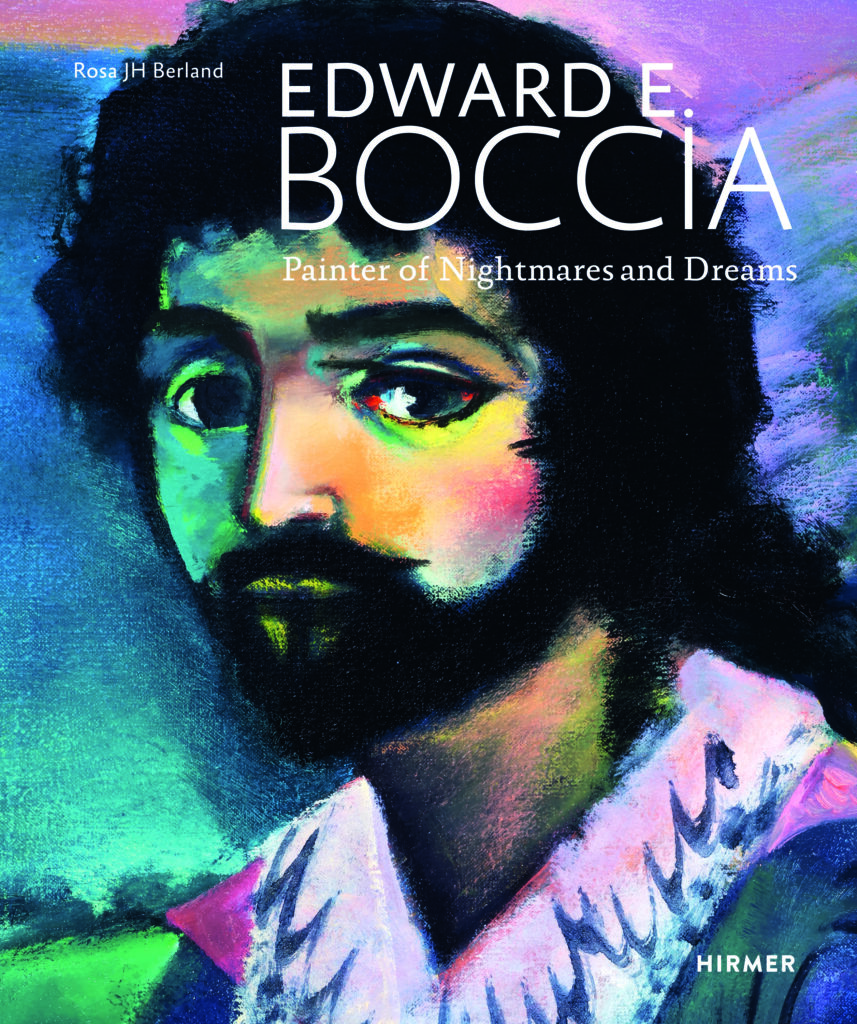
This month, Hirmer Publishers will release Berland’s “Edward E. Boccia: Painter of Nightmares and Dreams,” an in-depth exploration of his life and work. Distributed by the University of Chicago Press, the monograph features more than 50 illustrations, an extensive timeline, and chapters examining Boccia’s early years, his arrival in St. Louis and his use of narrative and symbolism, among other topics.
To mark the publication, on Oct. 23, St. Louis’ Philip Slein Gallery will debut “Edward E. Boccia: An American Modernist.” Drawn primarily from the Edward E. Boccia Artist Trust, the exhibition will include more than 30 paintings, many never-before exhibited, spanning five decades of Boccia’s career.
“Boccia’s dream-like oeuvre reflects on universal themes such as spirituality, creativity, love, desire, war and grief,” Berland writes. Futurist energy, cubist space, surrealist automatism and Italianate draftsmanship — in Boccia’s hands, all are translated into a “lyrical and kinetic neo-classical vocabulary.”
Mystery and heroism
Born in Newark, N.J., Boccia was raised in an artistic family. His grandfather’s brother was a painter. His grandmother’s uncle was a sculptor. He learned classical draftsmanship from an early age and won his first mural commission, for an Asbury Park hotel, while still in high school.
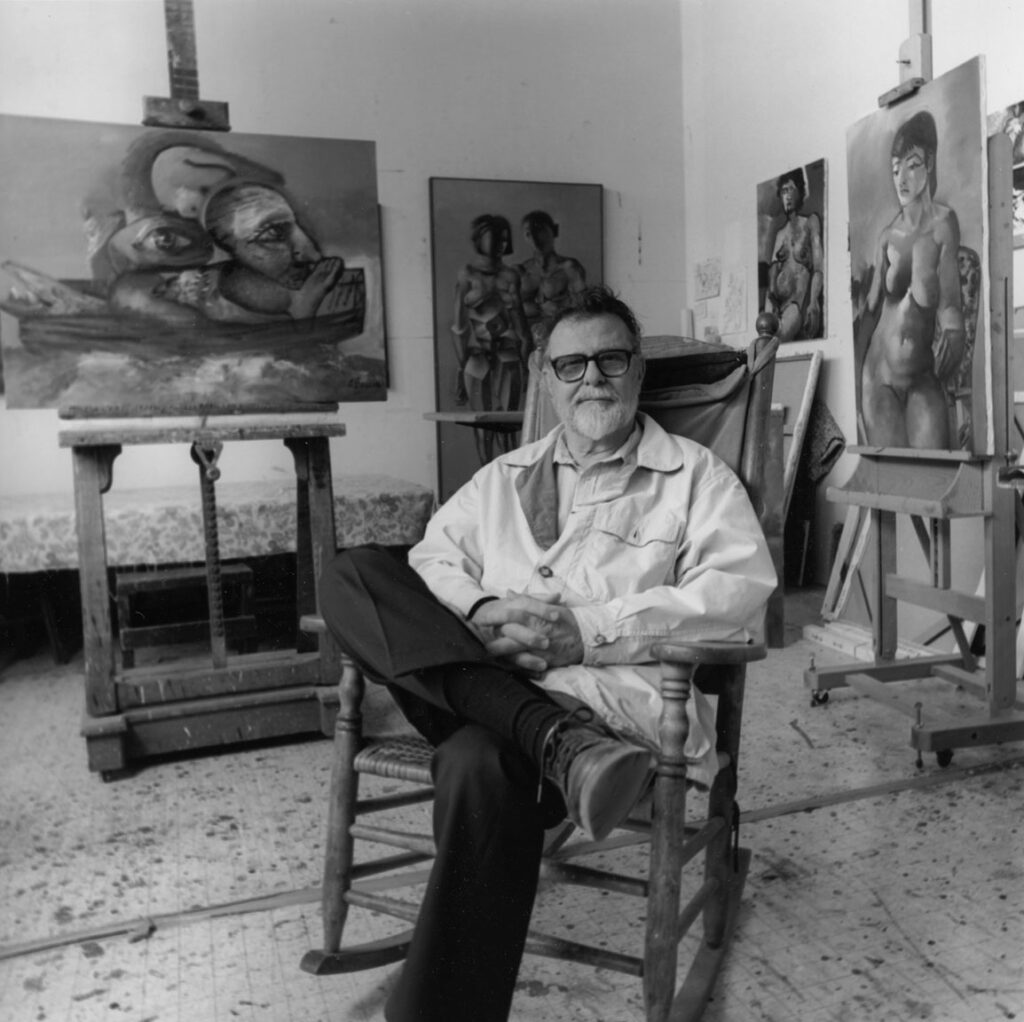
Boccia studied at New York’s famed Art Students League, where instructors included Missourian Thomas Hart Benton, before winning a scholarship to The Pratt Institute in New York. During World War II, he enlisted in the U.S. Army and joined the 603rd Engineer Camouflage Battalion.
“The Army wanted us,” Boccia recalled. “They needed us because we knew something about imagery and the mystery of imagery and how to make things look like things, how to make things disappear by a set of images that can fool the eye.”
As part of the so-called Ghost Army, the 603rd landed in Normandy a week after D-Day, staging battlefield deceptions across France, Luxembourg, Belgium, Germany and Italy. Shape and color, radio transmissions, inflatable tanks, jeeps and airplanes — all were used to confuse enemy forces.
“The work of the Ghost Army remained classified until the 1990s,” critic and art historian Natalie Prizel writes in her forward to the book. “But perhaps from his time in the Army, Boccia learned that art could be heroic.”
After his discharge, in 1945, Boccia returned to New York to complete his studies on the G.I. Bill, earning bachelor’s and master’s degrees from Columbia University. But in 1946, an encounter with “The Bridge (Brooklyn Bridge)” (1922), the iconic semi-abstract canvas by fellow Italian American Joseph Stella, prompted an epiphany. “The experience possessed me for months,” Bocca recalled. “Painting couldn’t be the same after that.”
Boccia too experimented with abstraction, and the sense of promise and discovery he found in Stella never faded. But by the time Boccia joined the WashU faculty, the figure had reemerged, as the artist increasingly grappled with religious and existential themes.
“Physical symbols of the spirit earth are the great work of art,” Boccia wrote. “Through painting I exercise the spirit. I hope I am making significant statements about the spirit. I am happiest when I paint — though it is a struggle and full of disappointments.”
Painting the subconscious
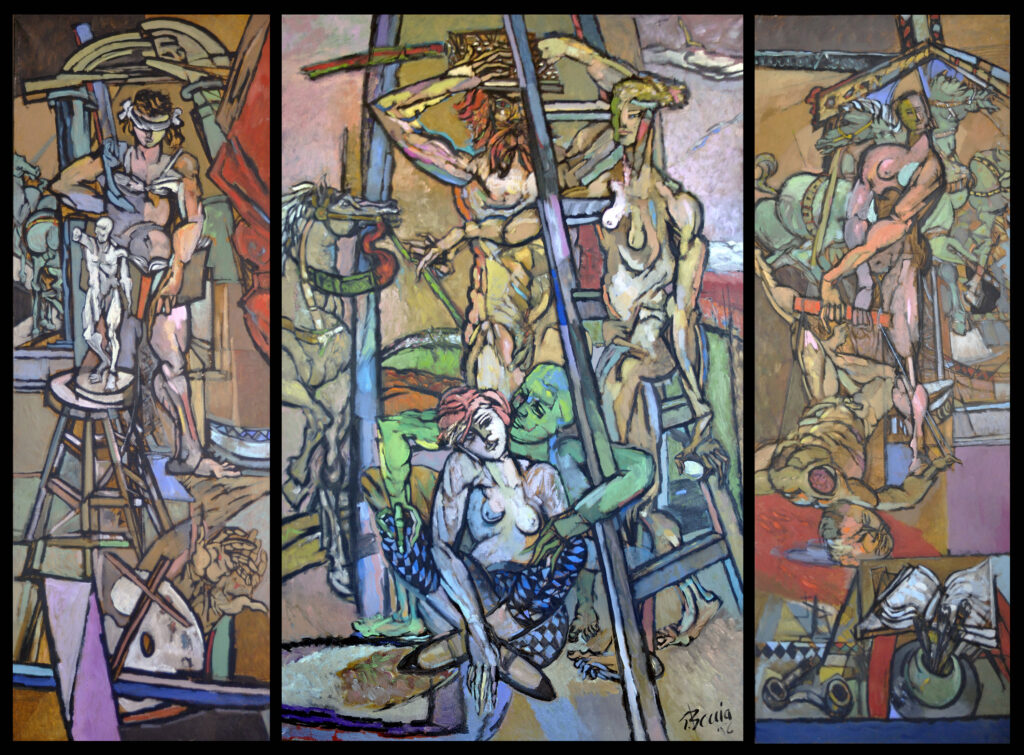
In St. Louis, collector Morton D. May became a regular visitor to Boccia’s studio and purchased more than 20 of his paintings. May also was a patron to the German exile Max Beckmann, who taught at WashU from 1947-49. Though the two painters never met, Boccia, like Beckmann, made frequent use of the triptych format.
“Allegorical Episode” (1956), Boccia’s first triptych, which May acquired, fills a carnival setting with biblical and classical allusions. Yet the cool palette, elongated forms and geometric brushwork are rooted in mid-century abstraction. “Rome Allegory” (1960), painted after Boccia’s sabbatical to Italy, is more fractured and apocalyptic but also more illusionistic. Bright, unsettling colors are framed and chopped by lines of slashing black.
Over the next decade, Boccia completed commissions for the Old Cathedral in downtown St. Louis (1961), the WashU Catholic Student Center chapel (1964) and the Brith Sholom Kneseth Israel Synagogue in Richmond Heights, Mo. (1970). He continued to create one-, two- and three-panel works but, especially in his later years, experimented with larger configurations. Both “Eugene’s Journey” (1996) and “A Poet’s Life: Scriabin, Symphony No. 3” (1998), for example, feature nine panel arrangements.
The five-panel “Il Penieroso” (1981), measuring more than 18 feet across, is among Boccia’s most ambitious works. The central tableau was inspired by Renaissance master Giorgione’s “Sleeping Venus” (1510). Densely woven imagery reflects the artist’s study of mythology, psychology and theology. One passage, a portrait of an artist, adorns the cover to Berland’s monograph.
That figure, with frilled collar, scruffy beard and soft, pensive eyes, resembles Giorgione more than Boccia. Still, Boccia mused, “I think that’s me. Every head we paint is in some respects our own head. I mean it, if the painter is a man and he paints the head of a female, there’s something about her characteristics that she looks something like him.
“It’s as simple as that.”
“Edward E. Boccia: Painter of Nightmares and Dreams” is released by Hirmer Publishers and distributed by the University of Chicago Press. Berland is the lead author and editor of the volume, with contributions by Natalie Prizel, Ben Street and Charles Grund. Victoria Barry (MA ’19) served as research assistant. For more information, visit the press’ website.
The Philip Slein Gallery is located at 4735 McPherson Ave. “Edward E. Boccia: An American Modernist” will open with a reception from 5-8 p.m. Friday, Oct. 23, and will remain on view through Dec. 19. For more information, visit the gallery website.