Aaron F. Bobick, dean of the McKelvey School of Engineering and the James M. McKelvey Professor at Washington University in St. Louis, will conclude his deanship on June 30, 2027, after successfully serving the university for 12 years in his role, Chancellor Andrew D. Martin announced.
“Aaron Bobick has been an outstanding leader for the McKelvey School of Engineering,” Martin said. “He has led one of WashU’s oldest schools through a time of extraordinary change in our world. As artificial intelligence (AI) has become integrated in numerous aspects of our society, Aaron has nimbly guided McKelvey to address new scientific and technological challenges. The research enterprise, graduate enrollment, degree programs and facilities have grown considerably during his deanship, and we are extremely grateful for his service.”
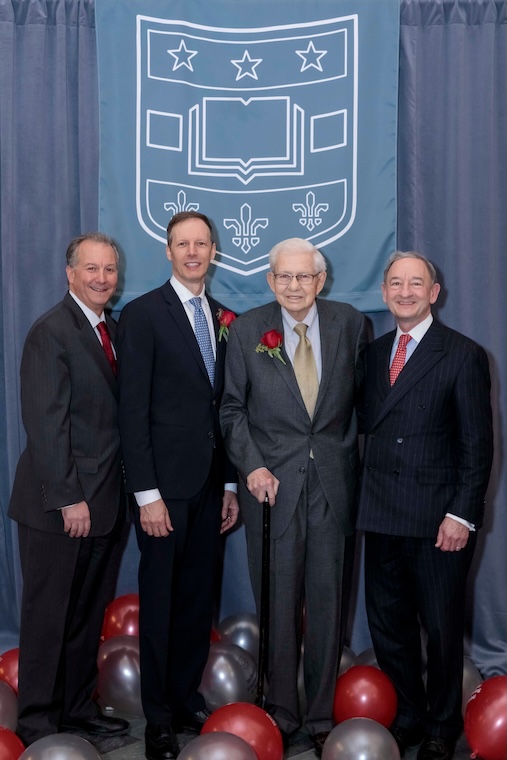
Bobick joined WashU as the dean of what was the School of Engineering & Applied Science in July 2015. The school was formally renamed the James McKelvey School of Engineering in 2019, in honor of trustee and distinguished alumnus Jim McKelvey Jr., AB ’87, BSCS ’87. Prior to WashU, Bobick was a professor and founding chair of the School of Interactive Computing at the Georgia Institute of Technology, where he had been a member of the faculty since 1999.
“The McKelvey School of Engineering is solving fundamental research challenges of the world today and preparing students for the rapidly changing world of tomorrow,” Bobick said. “It has been an honor and a privilege to lead the faculty as we have expanded McKelvey’s reach and impact, both in research and education.”
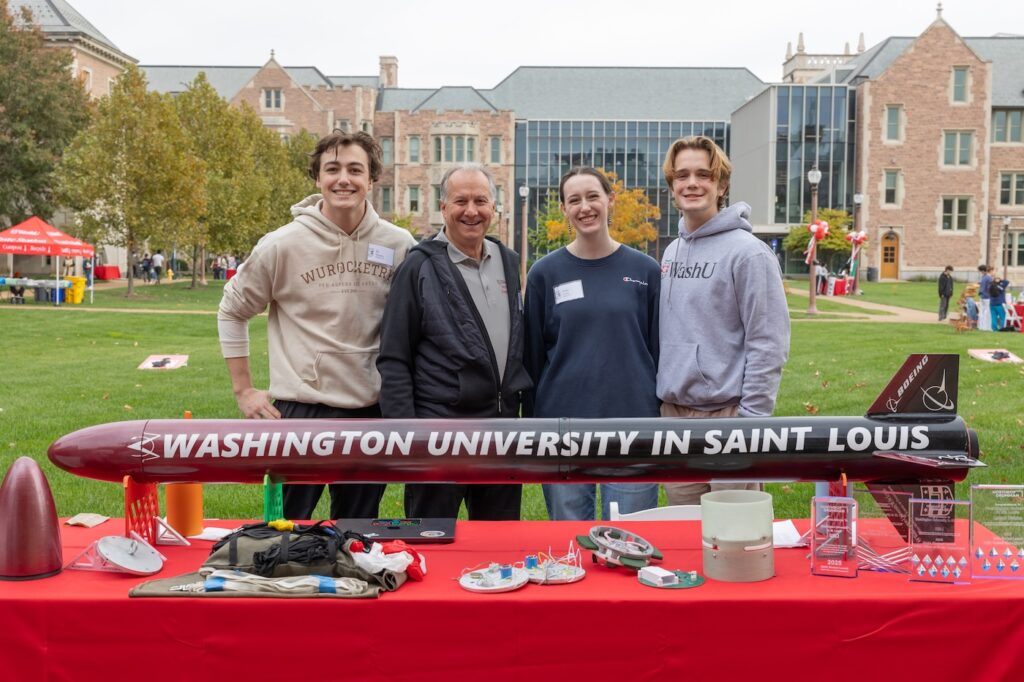
WashU’s engineering school grew in numbers and in research productivity under Bobick’s leadership. The number of tenured and tenure-track faculty has grown by 30% since 2015. Bobick helped recruit and retain faculty innovators, and his emphasis on research resulted in a more than doubling of annual research expenditures during his time as dean. In support of the research growth and sophistication, the number of PhD students increased 80% to about 650 students today. In the past decade, McKelvey Engineering also has launched several new research centers, including centers focused on clean water, synthetic biology, women’s health engineering, nanophotonics and AI for health.
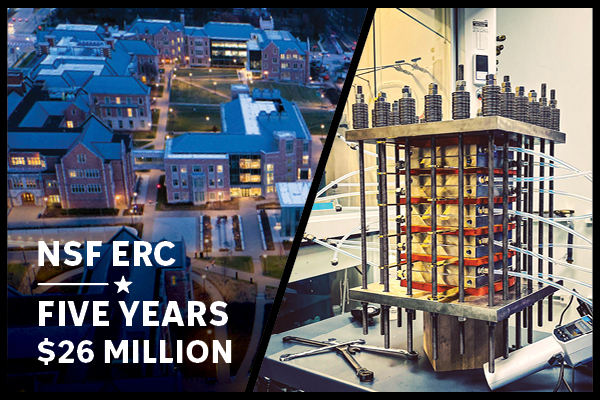
As an example of the school’s increased national prominence in key research areas, McKelvey Engineering was awarded a National Science Foundation Engineering Research Center in 2024, Carbon Utilization Redesign for Biomanufacturing (CURB), a $26 million initiative to create biomanufacturing systems that use carbon dioxide as a feedstock for a broad range of products much more efficiently than current state-of-the-art engineered and natural systems.
“For McKelvey Engineering to lead this research project represents the increased sophistication of the school’s research and its ability to support an activity of this scale and in alignment with our strategic priorities,” Bobick said in WashU’s announcement about the CURB award.
The school’s footprint also expanded during Bobick’s tenure, adding state-of-the art facilities including Henry A. and Elvira H. Jubel Hall, which houses the Department of Mechanical Engineering & Materials Science and the Spartan Light Metal Products Makerspace and opened in 2019, and James M. McKelvey Hall, which opened in 2021 and houses the Department of Computer Science & Engineering.
In executing on several of the initiatives that emerged from McKelvey Engineering’s 2017 and 2024 strategic plans, “From Leadership through Excellence” and “From Excellence to Impact,” respectively, Bobick also strengthened the school’s connections to WashU Medicine. The most visible efforts have been the creation of interdisciplinary PhD programs in imaging science — one of only two in the country at the time it launched — and in neuroengineering, a new program spanning multiple departments at McKelvey Engineering and WashU Medicine. He also increased inclusivity in computer science through developing new programs with other WashU schools, including new or expanded degree options in computer science and business, economics and mathematics and a minor in computer-human interaction with the Sam Fox School of Design & Visual Arts.
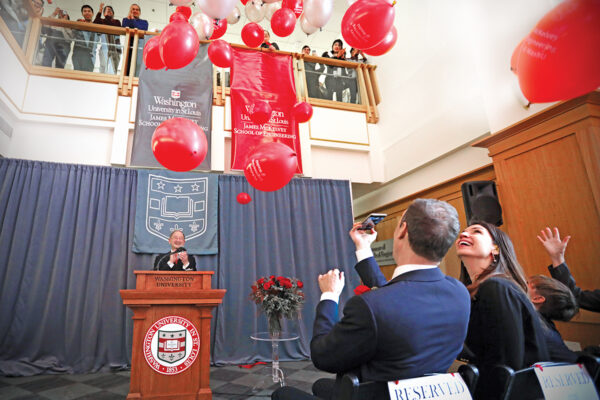
During Bobick’s time as dean, the engineering school has received nearly $279 million in gifts and commitments. Bobick was instrumental in securing the gift from Jim and Anna McKelvey that named the school in 2019. This gift — an unprecedented and transformative investment in the school — funds endowed scholarships and professorships and significantly advances the school and its impact on lives and communities in St. Louis and around the world. In his remarks at the naming ceremony, Bobick focused on the promise and potential of innovation.
“Innovation is about creating novel solutions to significant problems, about exploring solution spaces, with a necessary emphasis on design, experimentation, failure and iteration,” Bobick said. “We will still place great effort on elevating the significance, caliber and amount of research, because research strength is what attracts great faculty and drives reputation. But our next focus is: How do we fit within the innovation ecosystem within St. Louis?”
Bobick pushed engineering faculty to keep asking this question, even as he personally sought to help grow a stronger and more resilient St. Louis region. He joined the board of directors for the Cortex Innovation District, the nonprofit founded by WashU and four other anchor institutions to foster innovation, development and jobs in an underdeveloped 200-acre area along St. Louis’ central corridor. In addition to Cortex, Bobick also serves on the boards of Taylor Geospatial and GeoSTL, St. Louis-based nonprofits catalyzing development and commercialization of geospatial innovation and geospatial AI.
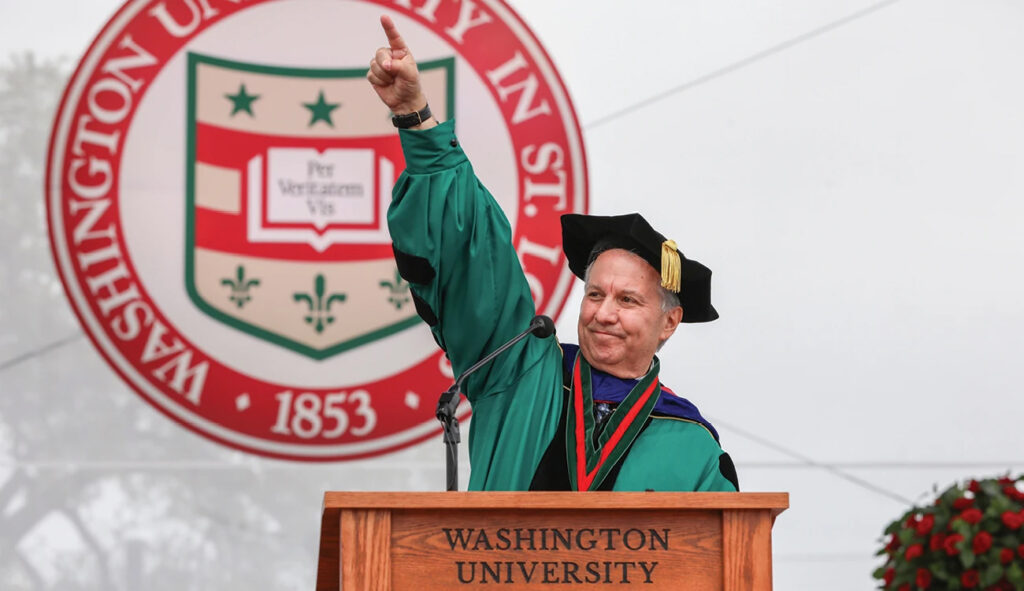
“Since 1857, WashU’s engineering school has promoted independent inquiry and education with emphases on excellence, innovation and collaboration,” Provost Mark West said. “We thank Aaron Bobick both for his passion for advancing innovation and entrepreneurship and for leading our faculty and students as they tackle the world’s great engineering challenges.”
Bobick is a graduate of the Massachusetts Institute of Technology (MIT), where he earned bachelor’s degrees in mathematics and computer science and a doctorate in cognitive science. Prior to joining the Georgia Tech faculty, he served as a member of the MIT Media Laboratory faculty. Bobick is a pioneer in his research area, which focuses on action recognition by computer vision. Bobick also studies robot perception for human-robot collaboration. He has founded a variety of successful startups and served as a senior area chair for numerous international computer vision conferences. Bobick is a distinguished scientist of the Association for Computing Machinery and a fellow of the Institute of Electrical and Electronics Engineers.
After concluding his tenure as dean, Bobick and his wife, Denise, have committed to remaining in St. Louis. Bobick will continue his work in local innovation ecosystems.
The university will launch a national search for Bobick’s successor in coming months. Details about the search process and how members of the WashU community can participate will be shared soon.