In Brief
- WashU Arts & Sciences will present its second annual Teaching Innovation Showcase Oct. 22.
- Twelve faculty from across a range of disciplines will be competing.
- Winners, selected by audience vote, will receive a $1,000 cash prize.
Teaching is a calling and a profession. It is also a skill. And like any skill, it can be sharpened and refined.
On Oct. 22, WashU Arts & Sciences will hold its second annual Teaching Innovation Showcase. A companion to the spring Research Innovation Showcase, the event will feature short, three-minute presentations, a dozen in all, highlighting creative classes and teaching projects. An audience vote chooses the winners, who receive a $1,000 cash prize.
In this Q&A, three participating faculty — Michael Olson, an associate professor of political science; B. Duygu Özpolat, an assistant professor of biology; and Zhiling (Zach) Zheng, an assistant professor of chemistry — discuss their projects and teaching philosophies. Joining the conversation is William Acree, Arts & Sciences’ vice dean of interdisciplinary initiatives and innovation.
Duygu, your presentation is called “Franken-worms.” Can you describe it for us?
Özpolat: I teach regeneration biology, which is about how some animals regrow body parts. But instead of listing example after example — all that textbook information — I give students a problem that’s real in my lab.
This is not a lab course, so we approach it as a thought experiment. I tell them: Old worms have a harder time regenerating than young worms. Come up with a hypothesis and an experiment to address this. But also, imagine you are amazing worm surgeons. You can take a piece from one worm and attach it to another. You can combine many worms. You can create Franken-worms.
How might this test your hypothesis?
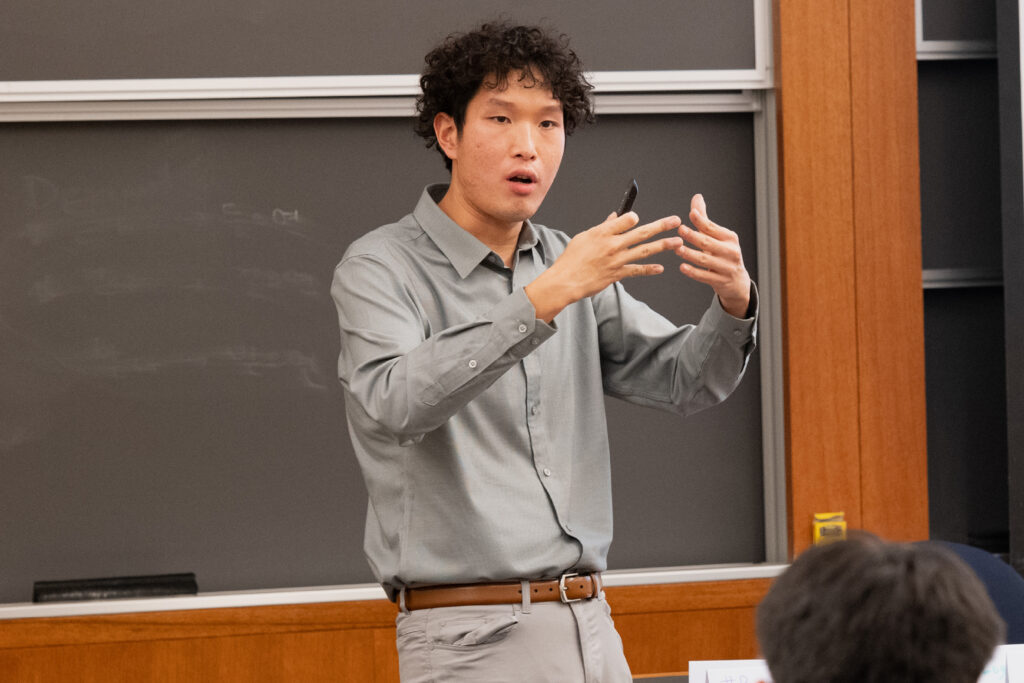
Zach, you’re presenting on AI and chemistry. What drew you to that topic?
Zheng: Right now, some people are embracing AI and some people remain skeptical about AI. My job is to show what’s actually going on. I’ve had students tell me that they signed up for the class because they want to see what AI can really do.
So what can AI do? What’s it good at, what’s it not so good at?
Zheng: AI is good at handling questions that involve large amounts of data. In material discovery, there are so many possible protein-folding combinations that it’s hard for a human to enumerate. On the other hand, scientific questions need good hypotheses. AI, at least for now, more or less takes an average of what people are already thinking. Those hypotheses might be valid, but they’re not very creative.
That’s something I teach my students. For those who are super enthusiastic about AI, I say, ‘Here are the limitations.’ And for those who are not confident about AI, I say, ‘Here are the opportunities.’
Mike, you teach “American Politics Over Space and Time.” Tell us about that class.
Olson: The hook is, we watch a movie roughly every week. These are movies that students might not necessarily see as political — no ‘Mr. Smith Goes to Washington’ (1939) — but they’re movies that I, as a political scientist, understand to be political.
The example I’m presenting is the 1992 horror movie ‘Candyman.’ It’s about an evil spirit, but if you’re a political scientist, it’s also about public housing and segregation. Or we watch the Kevin Costner western ‘Open Range’ (2003), which is about good guys versus bad guys, but also about the enclosure of public lands and conflicts over grazing rights — topics that are still pretty salient today.
Students tend to think of politics as something that happens on TV or in big fancy buildings. Political scientists are cursed to see politics in everything. I want to share that curse.
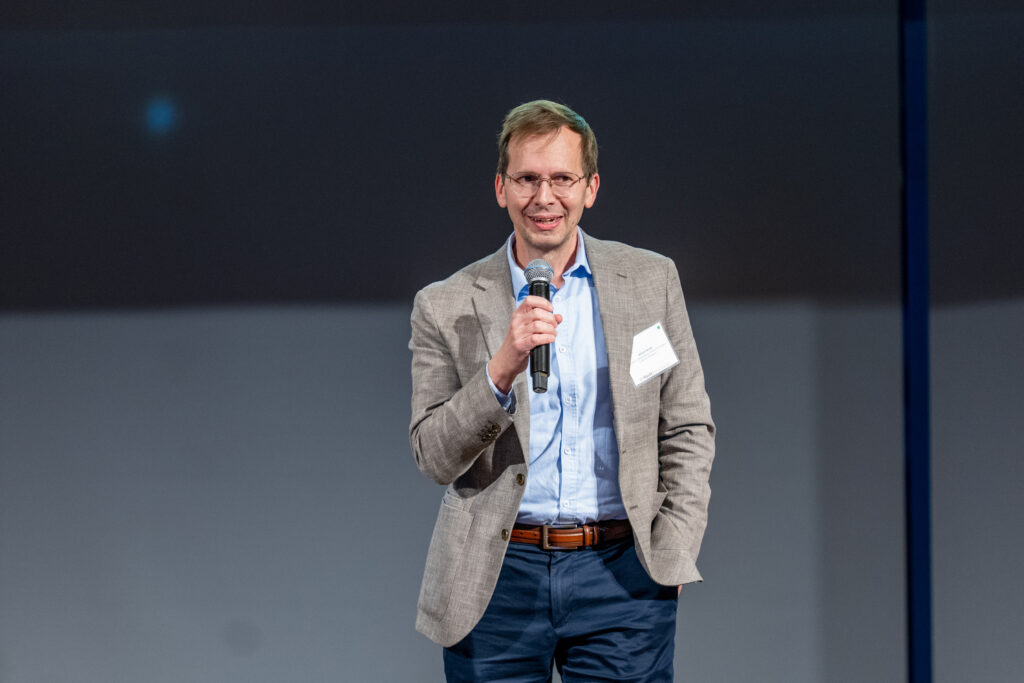
Billy, you founded and organize both the Teaching Innovation Showcase and the Research Innovation Showcase. What are you hoping to accomplish?
Acree: We’re trying to plant seeds. The audience that comes to these showcases is incredibly diverse. Not everyone will become an expert in biology or chemistry or political science, but we want them to understand the value of what we do, the impact of what we do, and how that can transform lives.
We want people to get excited about what’s happening in the classroom. In recent years, around 25% of WashU undergraduates have stayed in St. Louis. There’s a direct correlation between what students learn in class and what they bring to the workplace.
Describe the showcase development process. What are faculty signing up for?
Acree: A lot of work! Our application deadline was at the end of August. A review committee made selections about a week later. Presenters were notified in early September. Since then, we’ve had a lunch gathering and practice sessions, where colleagues give each other feedback.
The WashU Skandalaris Center hosted a pitch workshop. That’s really important. We’re hoping to embed a kind of entrepreneurial spirit in the way we talk about research and teaching. And over the four showcases we’ve held so far, more than 80 Arts & Sciences faculty have applied. That’s about 13% of our faculty in just a year and a half.
Presenters, what does good teaching look like for you? What would make this event a success in your eyes?
Özpolat: More people loving worms! (Laughs.) Or at least, more people appreciating worms. Love may be too much to ask.
Teaching shouldn’t be just one-way. Students should have the opportunity to engage. That was one of my aims in designing this course. I wanted a lot of interaction and collaboration. I really love hearing what students have to say!
It’s almost Socratic. Yes, I may know more than students do, but I don’t know everything. And I try to role-model that. When they ask a question, and I really don’t know the answer, I’ll say that very openly.
Olson: I’ve always thought of teaching as a kind of curation. How can I arrange a syllabus to help students develop particular ways of thinking? Lectures are about drawing lines. Why did I assign these things? Why did I ask you to read this or watch this?
That may sound a little old school, but if you provide the pieces, students start to learn to teach themselves. Which is absolutely a good thing for college students to do.
Zheng: I value the idea of standing in a student’s shoes. I think that’s key to effective teaching. You feel more confident about exploring when you know the teacher is standing with you.
I come from an experimental chemistry background. Three years ago, I knew nothing about AI. Before introducing new ideas to my class, I always ask myself: What if I were seeing this for the first time? Can I make this easier to understand? Can I remove things that might be confusing?
How can I improve my own teaching?
The 2026 Teaching Innovation Showcase will begin at 4 p.m. Thursday, Oct. 22, in Hillman Hall’s Clark-Fox Forum. The event is free and open to the public, but RSVPs are requested. A reception will immediately follow at 5 p.m.
The Teaching Innovation Showcase is an initiative of A&S Innovates, which engages the WashU community through signature events, new experiences and unique opportunities. For more information or to register for the Teaching Innovation Showcase, visit the A&S Innovates website.