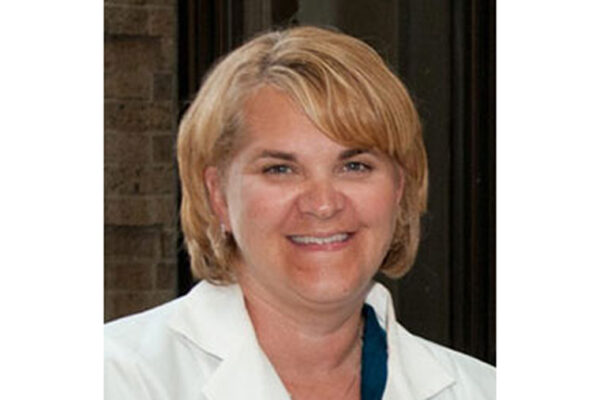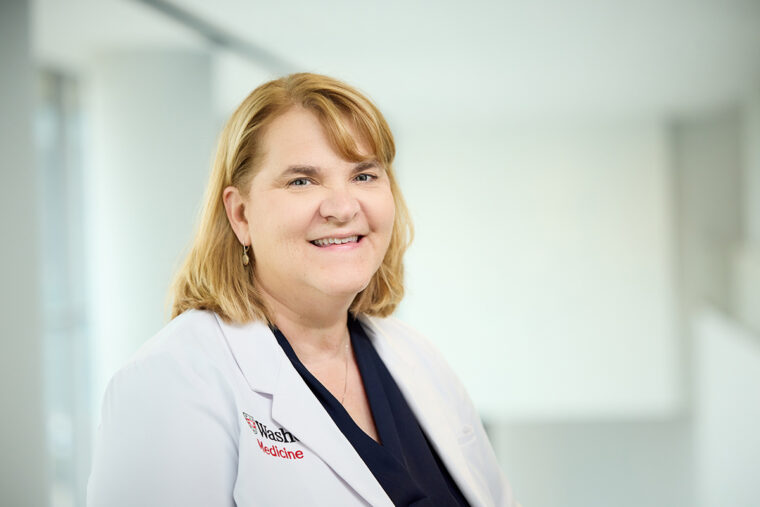
Deborah J. Lenschow, MD, PhD, a pioneering scientist who has made significant contributions to the fields of immunology, rheumatology and medicine, has been installed as the inaugural John S. Daniels Professor at WashU Medicine.
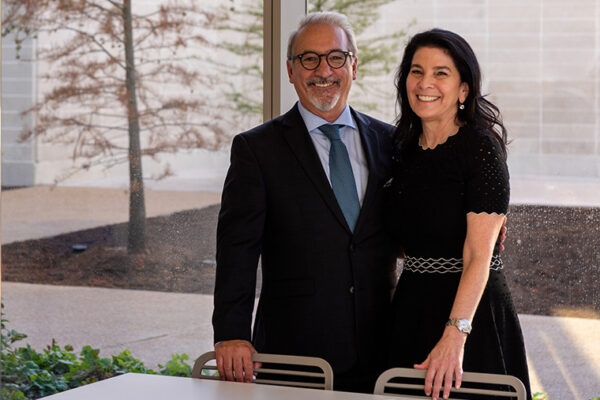
Longtime benefactors of WashU, Noémi Neidorff and her late husband, Michael, established the professorship to honor John S. Daniels, MD, a beloved former WashU Medicine clinical faculty member who specialized in treating patients with endocrine and metabolic disorders. He is known for his clinical expertise and the empathy and meticulous care he brought to each of his patients.
Lenschow was installed by Chancellor Andrew D. Martin and David H. Perlmutter, MD, who just stepped down from serving as executive vice chancellor for medical affairs, the Spencer T. and Ann W. Olin Distinguished Professor and the George and Carol Bauer Dean of WashU Medicine.
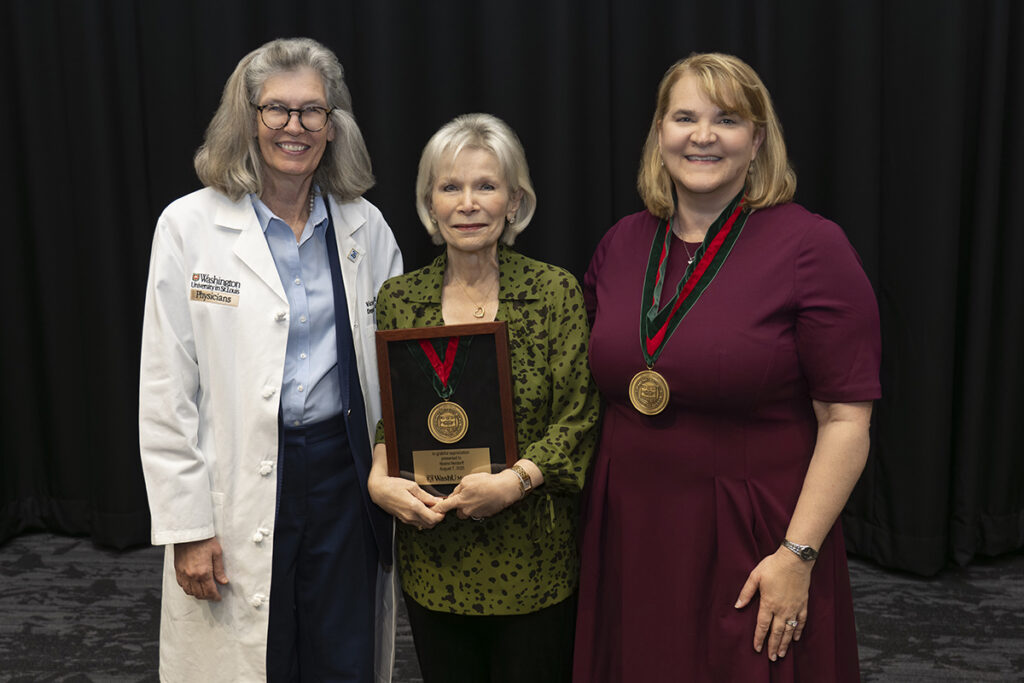
“We are deeply grateful to the Neidorffs for their enduring commitment to WashU,” Martin said. “Their generosity in honoring Dr. John Daniels makes it possible to recognize exceptional faculty such as Dr. Lenschow, whose pioneering research has advanced our understanding of how the immune system responds to viruses. Just as importantly, she has helped train and inspire the next generation of physician-scientists, further strengthening WashU Medicine’s leadership in immunology for years to come.”
Lenschow is a WashU Medicine professor of medicine, of molecular microbiology and of pathology and immunology. She also serves as co-director of the John T. Milliken Department of Medicine’s Oliver Langenberg Physician-Scientist Training Program, devoted to training physician-scientists for careers in academic medicine.
Her research focuses on how type I interferons — immune proteins that help fight viral infections — interact with viruses and how abnormal interferon responses can contribute to autoimmune diseases. Her pioneering efforts include the characterization of the protein ISG15 and its involvement in responding to viruses and regulating the immune system. Lenschow also studies the mosquito-borne chikungunya virus, an emerging virus that often leads to chronic arthritis. As part of her work, she characterized the first North American cohort of patients suffering from chronic chikungunya arthritis and investigated potential treatments for the condition.
“It is fitting that this professorship supports breakthrough research in immunology, an area in which WashU Medicine has long been a global leader,” Perlmutter said. “This field has never been more important than it is today as we confront the challenges of ever more dangerous infectious diseases. Thanks to the Neidorffs’ vision and generosity, and through Dr. Lenschow’s groundbreaking research, we can accelerate vital discoveries that will save lives in our community and around the world.”
Throughout her career, Lenschow has also demonstrated a commitment to mentorship. During her 12 years as co-director of the Physician-Scientist Training Program (PSTP), she has recruited nearly 60 trainees into the program. With Timothy J. Ley, MD, the Lewis T. and Rosalind B. Apple Chair in Oncology at Barnes-Jewish Hospital, she launched the Kornfeld Post-Baccalaureate Scholars Program to help recruit students who are interested in the physician-scientist pathway. Her leadership of the PSTP and the development of the post-baccalaureate program earned Lenschow a Dean’s Impact Award in 2024.
Lenschow is currently a Physician-Scientist Development Committee member of the American Society for Clinical Investigation, one of the nation’s oldest and most respected medical honor societies. In addition, she has received several training and research grants from the National Institutes of Health (NIH) to study the immunology of rheumatic diseases, and she co-directs WashU Medicine’s Rheumatic Diseases Research Resource-Based Center.
“Many of our faculty have appointments in two departments, but not everyone can hold down three, and that speaks to the depth, breadth and influence of Dr. Lenschow’s research and mentoring contributions at WashU Medicine,” said Victoria J. Fraser, MD, the Adolphus Busch Professor of Medicine and head of the Department of Medicine. “Her studies have led to significant advancements in our understanding of how viruses affect the host and trigger immune responses. Her commitment to advancing medical knowledge and nurturing future leaders truly exemplifies the foundations of academic medicine. We’re incredibly fortunate to have her here.”
Lenschow earned her bachelor’s degree at Wittenberg University in Springfield, Ohio. She earned her MD and PhD from the University of Chicago, where she helped conduct the foundational research that led to the development of abatacept (brand name Orencia), a medication used to treat autoimmune diseases such as rheumatoid arthritis and psoriatic arthritis. She completed a residency in internal medicine and adult rheumatology at WashU Medicine, where she joined the inaugural cohort of the PSTP. She joined the WashU Medicine faculty in 2006.
As an early-career investigator, Lenschow was recognized as a Pew Biomedical Scholar in 2008. In 2013, she was elected to membership in the American Society for Clinical Investigation. She has served on several national and international grant review study sections and is a member of the Pew Biomedical Innovation Fund National Advisory Committee. Lenschow also serves on the board of trustees of the Edward Mallinckrodt Jr. Foundation.
About Michael and Noémi Neidorff
Michael Neidorff was chairman, president and chief executive officer of Centene, a multinational healthcare enterprise with more than 14 million members. Before his death in 2022, he served on the boards of many regional and national arts, medical and educational organizations, and was a member of the WashU Brown School’s National Council.
In 2019, during Michael Neidorff’s tenure as Centene’s chairman, the company and WashU announced a partnership to advance research aimed at developing personalized approaches to preventing and treating Alzheimer’s disease, breast cancer, diabetes and obesity — conditions that affect millions worldwide. As part of the partnership, Centene provided $50 million for WashU Medicine’s Personalized Medicine Initiative, which supports innovative research to tailor disease prevention and treatment to patients based on genetic, environmental and lifestyle factors.
Noémi Neidorff is a classically trained musician and an active leader in the arts community. A native of Budapest, Hungary, Noémi Neidorff fled the country with her parents during the 1956 Hungarian Revolution. She went on to become a classical pianist after earning bachelor’s and master’s degrees from the Manhattan School of Music. She continued postgraduate studies at Columbia University.
Noémi and Michael Neidorff were actively involved with the Kennedy Center, where they served as co-chairs on the International Committee on the Arts and Michael served as treasurer on the Kennedy Center Board and chaired an extensive capital campaign called The Reach. Michael Neidorff was also chairman of the National Urban League and of the Board of Trustees of his alma mater, Trinity University in San Antonio. Noémi Neidorff was a past president of the National Symphony Orchestra’s National Trustees. She serves as a vice chairman on the board of the St. Louis Symphony Orchestra, on the board of the Budapest Festival Orchestra and on the executive committee of the Manhattan School of Music. She is the immediate past chairman of the board of Opera Theatre of Saint Louis. She also played a significant role in founding the radio station Classic 107.3 FM, a station focused heavily on classical music and the arts.
The Neidorffs have long been impressed with the quality of care delivered by physicians at WashU Medicine. When they established the John S. Daniels Professorship, they also endowed the Neidorff Family and Robert C. Packman Professorship. They previously have provided financial support to WashU Medicine for research into surgical treatments for pancreatic and gastrointestinal diseases, and to the Brown School for health disparities research. The Neidorffs, along with Centene, also endowed the Neidorff Family and Centene Corporation Dean of the Brown School.
About John S. Daniels
John S. Daniels, MD, a specialist in endocrinology and metabolism, is a beloved figure in the St. Louis medical community. The son of Holocaust survivors, Daniels was born and raised in Fort Smith, Ark., and earned his undergraduate degree from WashU in 1970 and his MD in neuroanatomy from the University of Arkansas School of Medicine in 1974. He then returned to WashU Medicine for his internship, residency and fellowship in endocrinology and metabolism. He served as chief resident in 1979 before beginning his clinical practice, which he continued until his retirement in 2020.
Throughout his 41-year career, Daniels developed lasting patient relationships, contributed to medical texts and research, maintained an active role in teaching and mentoring medical trainees and served as an editor of Missouri Medicine, a journal of the Missouri State Medical Association. Daniels has also published two novels, “The Intern” and “Second Chances.”