There are many forms of contentment. There is the satisfaction of completing a task. There is the pride of achieving a long-term goal. There is the fulfillment of building a career, nurturing a family or finding purpose in the world.

“These are the accomplishments that make your life meaningful,” writes Ian Bogost. “But those big deeds don’t tell the whole story, either.”
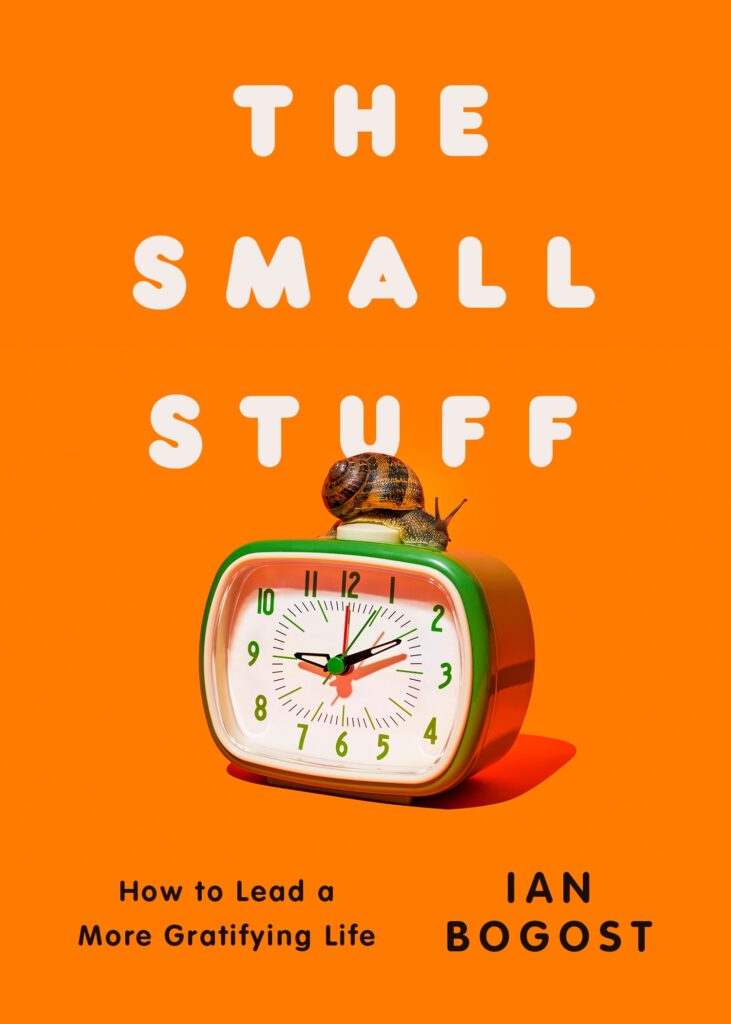
In “The Small Stuff: How to Lead a More Gratifying Life,” Bogost, the Barbara and David Thomas Distinguished Professor at Washington University in St. Louis, explores the real but often unremarked delights to be found in ordinary encounters with the physical world. It’s the warm crinkle of a coffee cup sleave, the gloopy texture of thick paint, the smooth glide of a steering wheel, the cool rumble of a hotel ice machine.
“Compared to supposedly important things — the deep, long-lasting ones that produce happiness or satisfaction — gratifying moments can seem insignificant and trite. Too small to matter,” Bogost writes. “But your life is made up of more small, seemingly inconsequential events than momentous ones.
“While you are waiting for the supposedly important stuff to arrive … a million cases of the small stuff come and go.”
‘A human body on Earth’
Philosophers have long grappled with happiness. Aristotle distinguished the pursuit of pleasure (and avoidance of pain) from higher moral and spiritual virtues. Psychologists and neuroscientists have sought to measure and develop strategies for improving it. Pleasure isn’t necessarily to be avoided, goes the pop culture wisdom, but it should serve something greater.
For Bogost, that advice poses two problems. “First, it’s a high bar to meet often. I savor meals with my friends and family as much as anyone else, but I find it impossible to imagine transforming every — or even many — ordinary experiences such as those into supposedly meaningful communions with society.
“Second, insisting that pleasure always turn into enjoyment misunderstands the nature of certain pleasures.” Big-picture happiness is amorphous and abstract. The small, everyday “delights of inhabiting a human body on Earth” are specific and immediate. They take little effort to produce.
“You have to work hard to be happy,” Bogost wrote. “But gratification doesn’t require any work. Instead, feeling gratified involves a different prerequisite: giving yourself permission to fully experience the sensory life that is always happening to you anyway.”
A skeptical culture
Gratification is often conflated with indulgence. And yes, Bogost conceded, people can pursue pleasures to their own detriment. But where indulgence is concerned with the self, gratification “is pointed toward the world — just different corners of that world than people typically value.”
Take the marshmallow test. Developed in the 1960s by Stanford psychologist Walter Mischel, the test confronts children with a choice. They can eat one treat immediately, or they can wait 15 minutes and receive a second treat.
“The very idea that Mischel would hatch the marshmallow test shows just how skeptical our culture was to gratification,” Bogost observed. Over time, proponents claimed that results predicted a range of outcomes, from SAT scores to body-mass indices, but more recent studies have raised doubts. For children in precarious circumstances, Bogost pointed out, eating the marshmallow when offered might well be the savvy choice.
“It seems the desire for a quick and simple answer — the supposed sin of instant gratification — came for the instant-gratification researchers,” Bogost dryly noted. As a result, “happiness advocates have saddled the rest of us with an impoverished and incomplete picture of gratification.
“The notion that you waste any moment not spent optimizing your life is scandalous,” Bogost added. “It splits the world into either productive work or dangerous indulgence. But in between maximizing profit and succumbing to addiction, you find a universe of other encounters.”
Dematerialization
For all the attention to happiness, the thing itself is getting harder to find. “Overall life satisfaction in the United States and the United Kingdom has declined since the 1970s,” Bogost noted. “We have found ourselves in a happiness crisis.”
That crisis has coincided with large-scale cultural and technological changes. Bogost, a prominent theorist of the digital realm, explores how automation, smartphones, data analytics, artificial intelligence and other forces are affecting daily life.
Things that once had buttons, handles or gears suddenly do not. Things once owned outright — software, cars, homes — are increasingly subscribed to, leased or rented. Many jobs that took place in specific locations can now be done from anywhere. These shifts, often individually reasonable, have collectively dematerialized human life, Bogost argued, disconnecting people from the physical world they inhabit.
“A toll-road driver once rolled down their car window by a hand crank and then hurled coins into the scooped mesh basket of the tollbooth — or placed them directly into the hand of its operator,” he wrote. “Now most car windows are automated, and tolls get paid by a dashboard sensor read by a computer. You don’t even have to slow down.
“When opportunities to connect with ordinary things vanish — even those you might not believe you really want to connect with — you will never feel the gratification they might otherwise offer. You lose a part of your humanity when you miss out on them.”
The universe of things
What to do?
“Your first instinct might be to fight it,” Bogost wrote. But individuals can only do so much. “The industrial, regulatory and managerial phenomena that have made the doors on buildings harder to open and the sinks and towel dispensers in their bathrooms frustrating to use cannot easily be identified, let alone reversed.”
Nor should gratification be transformed into yet more work. “’Oh no, I forgot to feel gratified by the clinking of dishes as I put them away into the cupboard!’” Bogost quipped. “Shrug off such contortions.”
Instead, one might think of gratification as akin to humor. “Like laughter, gratification is often involuntary,” Bogost wrote. “Have you ever tried to suppress a big guttural laugh upon hearing a funny joke or catching sight of an unexpected moment? Your whole body rebels against the effort. You cannot bottle up laughter, or gratification, in the hopes of optimizing its usage later.
“Gratification offers a way to express the mismatch between your body and the rich, dense universe of things that are outside that body, but that it nevertheless encounters,” Bogost added. “It is the good feeling you get from resolving the absurdity of the sensory world. There you are, touching an escalator handrail, which bobbles slightly in its track.”
Bogost will discuss “The Small Stuff” at 6 p.m. Thursday, July 9, at Subterranean Books, 6271 Delmar Blvd. For more information, visit publicscholarship.washu.edu.