In Brief
- WashU chemists have created a polymer that gets stronger the more it’s bent and strained.
- The material mimics biological materials in the human body, including collagen, which gives skin its strength and elasticity.
- The material could have medical applications, particularly in protecting and repairing tissues.
Most materials get weaker with use. But a team led by Chenfeng Ke, a professor of chemistry in Arts & Sciences at Washington University in St. Louis, has created a polymer that defies the usual laws of wear and tear.
“Our smart material actually gets stronger the more it’s bent and strained,” Ke said. “It has properties we have never seen before. It can remember, adapt, learn and grow. We’re excited to think about the possible applications.”
The breakthrough was described in a study published online in Nature Materials. Co-authors include graduate students Yufei Chen and Mingliang Bai and postdoctoral researcher Dan Zheng .
The patented polymer, created in Ke’s lab with compatibility for 3D printing, is made from a biodegradable blend of sugar crystals and polyethylene glycol, a compound often used in laxatives and other health products. The mixture forms a hydrogel, a flexible material that can absorb and retain large amounts of water.
In tests, Ke and his team applied the material to a flexible, knee-like joint. “We bent it 10,000 times, and the material performed just as we predicted,” Ke said. “The polymers in the hydrogel become more uniform and organized, making it stronger in exactly the places where the strain is happening.”
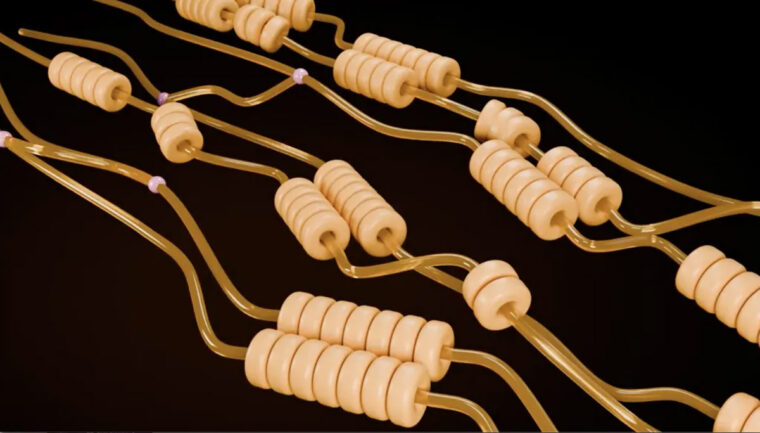
The smart material owes its strength and adaptability to cyclodextrin, a sugar-based compound that forms ring-shaped structures. When the polymer is stretched or bent, these rings slide into position to reinforce the areas under strain. “These moving rings are critical to the structural design,” Ke said.
In many ways, the material mimics biological materials in the human body, including collagen, a protein that gives skin its strength and elasticity. “Some of the most impressive smart materials are found in biology,” Ke said. “We used nature for inspiration.”
Spreading word to researchers, investors
Ke believes the polymer could have medical applications, particularly in protecting and repairing tissues.
“Because it’s made of sugar and polyethylene glycol, it’s completely compatible with biological tissues,” Ke said. “We expect this material to attract interest from surgeons or orthopedic medical device companies who are looking for new approaches.”
For example, the material could be used to support artificial joints or to repair damaged tissues. In either case, areas that aren’t subjected to stress or strain would remain soft and pliable. “If you’re putting material into a body, you don’t necessarily want it to be completely rigid,” Ke said. “The material gets stronger only where it’s needed.”
Ke is a chemist, not an orthopedist or medical device specialist, and he acknowledges that other experts may recognize applications he has yet to consider.
“We want to work with experts at WashU Medicine and elsewhere to explore the possibilities,” Ke said. “Hopefully this paper will help us get the word out to researchers and potential investors.”
So far, Ke and his team have produced the material in small quantities, just tens of grams at a time. But with the concept successfully demonstrated, they believe production could scale up to meet demand.
The new polymer builds on Ke’s broader research into creating innovative materials inspired by nature. In April 2025, he proposed a new generation of smart fabrics at A&S Innovates, Arts & Sciences’ inaugural research pitch competition.
“We’ve shown it’s possible to produce smart materials with a 3D printer and the right chemistry,” Ke said. “We see a lot of possibilities.”
D Zheng, Z Yu, Y Chen, CD Smith, M Bai, EHR Tsai, J Liu, W Zhang, S Lin, C Ke. Mechanical adaptation drives out-of-equilibrium network reorganization and self-strengthening in adapt-ring networks. Nat Mater. 2026 Nov 5.
DOI: https://doi.org/10.1038/s41563-026-02795-0
This research was supported by funding from the National Science Foundation (2413579, CAREER 2338747) and the U.S. Department of Energy (DE-SC0012704, DE-SC0022267).