(Video: Tom Malkowicz/WashU)
Rachel Penczykowski — or Dr. Rachel, as she is known by these first graders — is an associate professor of biology in WashU Arts & Sciences and an expert on infectious disease in plants. She conducts much of her research in the field — rural fields, urban parks and, on this sunny day, a garden bed at Jackson Park Elementary School in the School District of University City.
“Who remembers what I study?” Penczykowski asks the class.
“Plants,” the students shout.
“What about plants?” she coaxes.
“Plants get sick!” exclaims first-grader Nicolette.
“That’s right! Now. who’s ready to record some data?” cheers Penczykowski.
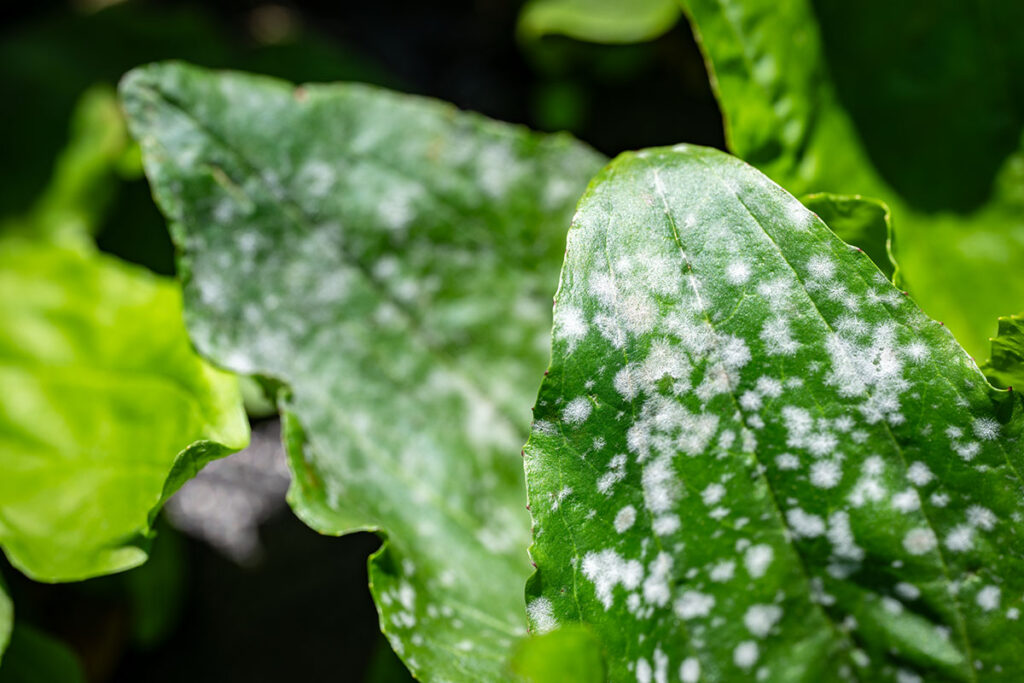
The students, each with a clipboard and a ruler, start counting the leaves and measuring the stems of the garden’s numbered Plantago plants, a common genus of weed. They also look for white spores, a tell-tale sign of powdery mildew, a type of fungus.
“I see a lot of sick,” Nasir says, as he notes how many leaves are infected with the powdery mildew.
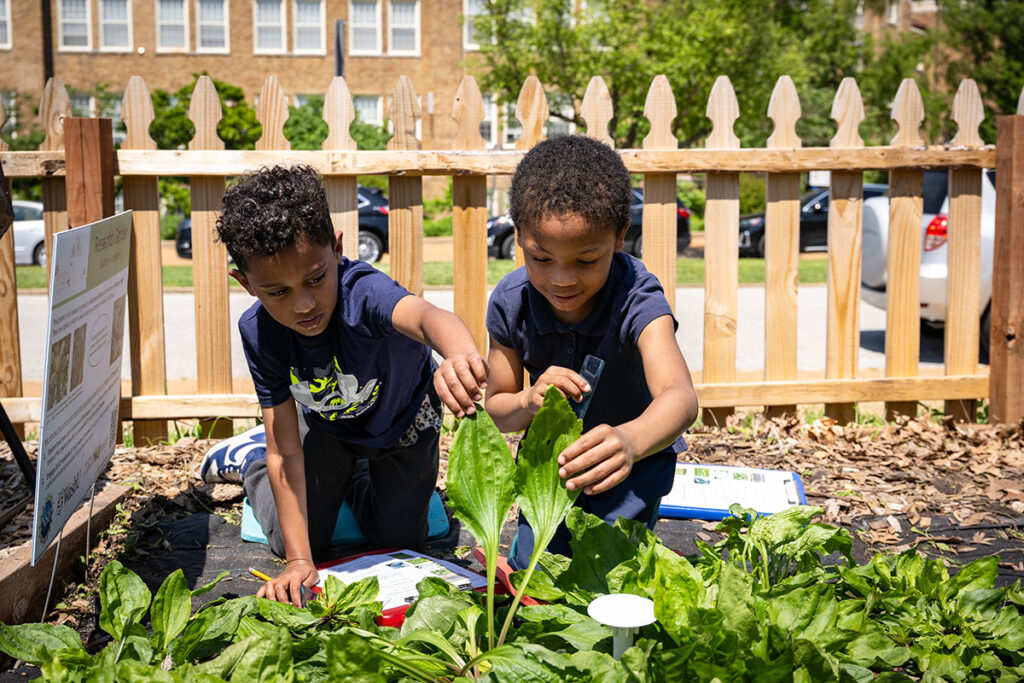
“That is important data for us because we want to know where there is mildew and where there isn’t,” Penczykowski tells Nasir.
For years, Penczykowski and her team of plant scientists have been studying the environmental factors that contribute to the spread of powdery mildew. The research is part of the lab’s larger mission to understand how pathogens respond to changes in the climate and the environment — insights that may inform crop management. Her lab will process the students’ data for their ongoing project.
“First graders absolutely can do science,” Penczykowski said. “They have brilliant questions, a lot of ‘I wonder why’ questions, lots of ‘what is this?’ questions.”
Penczykowski feels a special allegiance to the U. City district, which her children both attend. But her ultimate goal is to bring her outreach program to students across St. Louis and beyond. And why not? Powdery mildew exists almost everywhere, as do Plantago plants.
She recently partnered with the Institute for School Partnership (ISP) to produce the educational video “Plants Get Sick!” to introduce educators and their students to her research and its methods.
“The wonderful thing is that the types of things we are doing here can be done anywhere and be adapted for any grade level,” said Penczykowski, who leads another experimental garden at Brittany Woods Middle School and employs high school apprectices to conduct field research at Tyson Research Center in the summers. “Back in our lab, we have been using what we’ve learned about land use and climate impacts on this plant pathogen system to make predictions about where there should be more or less plant disease in cities around the world. One of our research aims moving forward is to test those predictions with data collected by collaborators and students around the world.”
Teacher Monique Hite-Patterson said her children love getting their hands dirty in the garden. And she loves that the project reinforces her students’ math and literacy skills, introduces them to scientists from their own community and rewards creative thinking.
“The biggest thing that I’ve noticed is that I go from having passive learners to active learners. They get to go from seeing something in a book to actually putting their hands to it. It makes it more real for them,” said Hite-Patterson, who earned an Ed.D in STEM education and was a member of the 2025 ISP Summer Teacher Researcher Program. “It’s also more culturally responsive — they are working in their own backyard and seeing scientists who are girls, scientists who are Black and brown. My goal is that they take the joy and curiosity they showed today with them into middle and high school.
That’s Kaylee Arnold’s goal, too. She is a research associate in the Penczykowski lab. She would love for more Black ecologists to join her in the field.
“I want to make sure the children know that there’s different types of science and different types of scientists,” Arnold said. “It was just fun to see them enjoying what I do for a living. They see that anyone can be a scientist.”
This material is based upon work supported by the U.S. National Science Foundation under Grant Number DEB-2240087. Any opinions, findings, and conclusions or recommendations expressed in this material are those of the authors and do not necessarily reflect the views of the National Science Foundation.