Special education teacher Stephanie Stringer knows how to identify the cognitive and social challenges of her students, adapt her curriculum to meet each student’s unique needs and create a positive classroom culture where everyone thrives.
She is less confident in her skills to effectively deploy new technologies to advance this important work. That’s why Stringer enrolled in the AT&T Digital Navigation Program, a free program offered through the WashU Institute for School Partnership that helped about 50 local educators learn how to use the right tools the right way.
“Technology always seems scary, but I feel like I’ve learned how to integrate it without it taking over,” said Stringer who works with middle school students at Gateway Science Academy.
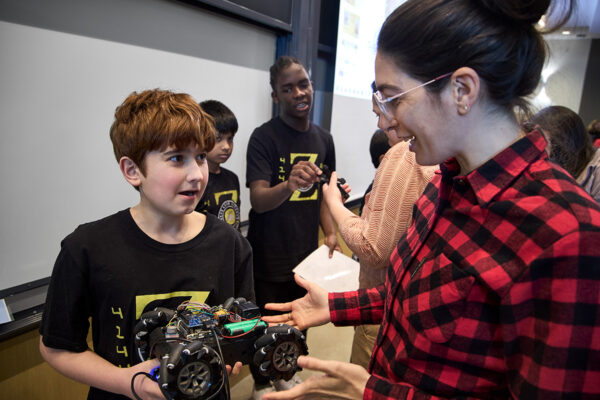
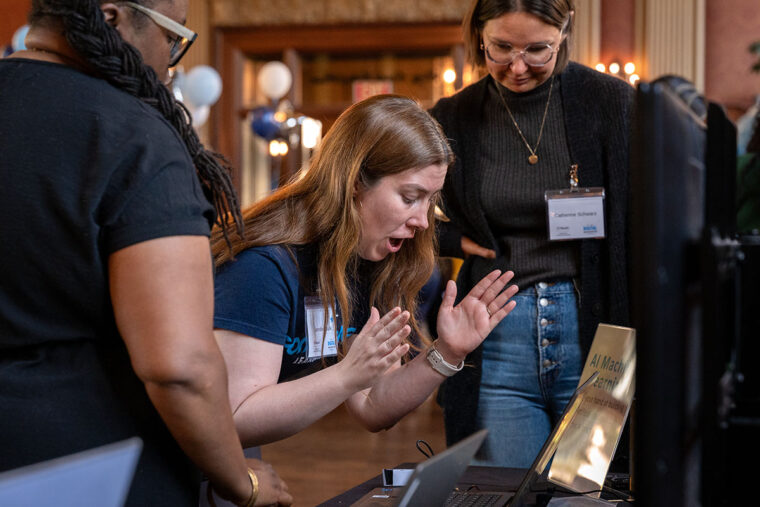
Stringer was among the teachers who presented their capstone projects at a showcase May 11 in Ridgley Hall’s Holmes Lounge attended by fellow educators, WashU Chancellor Andrew D. Martin and civic and government leaders. Julita Tabasa, of the Ferguson-Florissant School District, demonstrated how she uses Polypad, a free program that produces interactive manipulatives, to teach surface area; Gina Pereda, also of Ferguson-Florissant, explained how she incorporated Micro:Bit pocket-sized computers into a lesson about the electromagnetic spectrum. And for her capstone, Stringer used MagicSchool AI to develop a chatbot that provides her students with more opportunities to practice their conversation skills.
“A priority for me is to help my students work on those soft job and classroom skills they sometimes lack due to their different levels of disability,” Stringer said. “I was able to set up the chatbot with parameters that asked them questions and kept them on topic. Even though my class is small, sometimes it’s hard to work one on one because we are working on group social skills. Now, I can make that happen.”

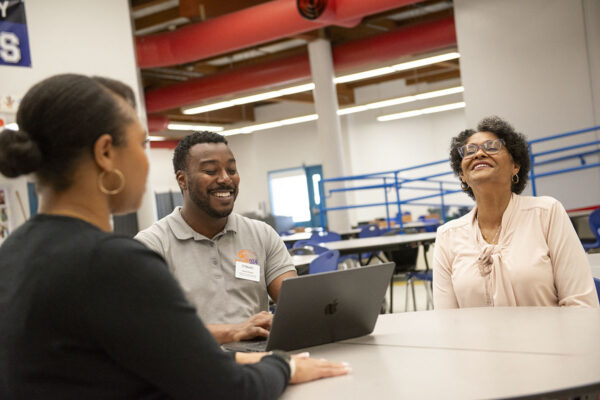
ISP instructor Shelly Lane said some of the teachers entered the program with a sophisticated understanding of educational technology; others didn’t know Canva from Canvas. Lane and her team met teachers where they were to create lessons that both engaged students and met learning goals.
“This wasn’t just tech support — it was a partnership,” Lane said. “Our mentors worked side-by-side with participants, helping them navigate and master a diverse array of tools — from AI chatbots and 3D modeling software to digital musical composition programs — ensuring technology became a seamless extension of core classroom instruction.”
Vicki May, ISP executive director, acknowledged that many teachers and parents are understandably skeptical of educational technology tools. That’s why it’s important to provide teachers with training to use such tools effectively.
“At a time of rapid technological change, especially with the rise of artificial intelligence, the role of educators as digital navigators has never been more important. We have lived through many waves of technological advancement, and each one reminds us that strong leadership matters,” May said. “Our students need educators who can think critically about the problems they are trying to solve, evaluate tools thoughtfully and make intentional, human-centered decisions about technology and learning.”
AT&T funded the program through its Connected Learning initiative, which strives to bridge the digital divide by connecting students, families and schools to the tools and resources they need to succeed.
“But technology alone is not enough,” AT&T’s Jomo Castro said. “Real impact happens when educators are equipped to use these tools effectively and to guide students and families in navigating an increasingly digital world.”