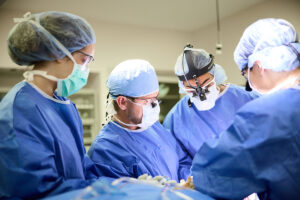
A new tool developed by WashU Medicine researchers could allow for preemptive treatment of implant-related infections that improves outcomes and reduces patients’ emotional and financial burden.
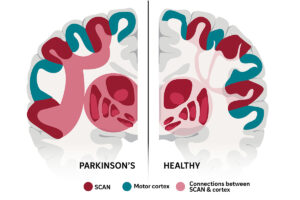
A brain network first identified by WashU Medicine researchers, called SCAN, is shown in a new study to be the neurological basis for Parkinson’s disease. Patients receiving treatments targeted to this brain region, rather than to surrounding areas, experienced greater improvements in symptoms.
WashU researchers urge institutions to reward implementation science that demonstrates benefit, improves health, reduces inequities and justifies research investment.
Washington University in St. Louis has maintained its status as a Fulbright Top Producing Institution for U.S. students. This recognition is given to the U.S. colleges and universities that received the highest number of applicants selected for the 2025-26 Fulbright U.S. Student Program.
Researchers at Washington University in St. Louis are developing mathematically rigorous and computationally efficient techniques to transform extremely complex reinforcement learning problems into a manageable domain.
WashU psychology researcher Deanna Barch has won the Atkinson Prize in Psychological and Cognitive Sciences from the National Academy of Sciences, one of the most prestigious honors in psychology.
“Unalienable Rights: 250 Years of the Declaration of Independence,” a new exhibit at Olin Library, explores all aspects of the declaration. Artifacts include a copy of the declaration that traveled to the moon, a copy of the first commercially produced declaration and WashU’s rare Southwick broadside, one of only seven in existence.
The program in Microbial, Immunologic and Neurologic Disorders is accepting joint proposals from researchers at WashU Medicine and the Weizmann Institute of Science to execute collaborative research projects. Submissions are due March 31.
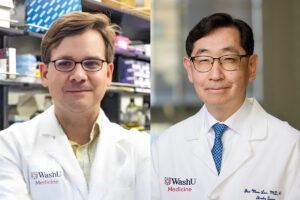
Jin-Moo Lee, MD, PhD, and Jeffrey R. Millman, PhD, at WashU Medicine were selected for the prestigious Falk Catalyst Awards, which supports bold early-stage research with the potential to transform patient care.