It’s never too early to visit your college career center — even if you have no idea what career you want to pursue.
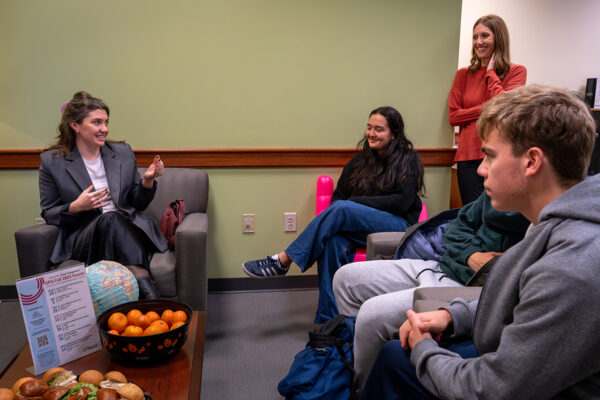
In fact, that’s the perfect time to meet a career coach, said Norma Guerra Gaier, associate vice chancellor for career development and education in the Division of Student Success at Washington University in St. Louis.
“When students tell me they aren’t sure what they want to do after college, I tell them they’re in one of the best places they can be,” said Gaier, an industry expert with more than 30 years of experience and a former president of the National Association of Colleges and Employers (NACE). “That not-knowing, but being open to exploring with the resources and coaching available at college career centers, will help them figure out what possibilities await them.”
Here, Gaier explains why students should engage with their career center early and often; how career centers have evolved in this challenging economy; and why your major matters less than you think.

When should new students visit their college career center?
The university career center is no longer just a place to get resume help for that job or internship. Rather, career coaches help students navigate the lifelong, iterative process of better understanding themselves and discovering the possibilities that await them.
Sometimes students tell me, ‘Well, I didn’t visit because I didn’t know what to ask.’ And what I say is, You don’t need to worry about that. Just come in and say, ‘Hi, I’m a first-year student and I think I have an interest in this particular type of job, but I’m not sure.’ And I promise the career coach is going to take it from there. At WashU, we start by exploring what your sense of purpose and values are. And from there, we can help you find opportunities that resonate with your skills, your personality, your interests and, most importantly, that value system and sense of purpose.
What should new students be doing today to help them prepare for careers tomorrow?
Employers increasingly are telling us, it doesn’t matter what your major is. And while grades can matter to employers as they weed through countless applications, many employers — almost 66% according to NACE research — rely on skills-based hiring practices as their primary approach to find early talent.
Students can develop these skills through a variety of experiences. Internships, of course, but also campus jobs, project-based learning in the classroom, student involvement. How were you engaged on campus? How did you incorporate critical thinking and communication skills? How did you engage on a team, whether that was a group project for class or your role on the intramural soccer team?
Every single experience students engage in, even those in a student’s first year, is going to inform their eventual outcome, whether it’s grad school or professional school or that first job.
When is the right time to create a LinkedIn page?
Right now. LinkedIn is a great way to start to develop your network. Again, find a way to talk about your experiences, whether that be working in retail or a summer camp. We know that networks are the best way to learn about possibilities and opportunities. Word of mouth is critical. And so the more people who understand your goals and interests, the more successful you’re going to be.
Critics of American higher education say college does not provide a good return on investment. How is that changing your work?
WashU and a lot of other career centers are working to expand opportunities for experiential learning. For instance, our Chancellor’s Career Fellows program is a comprehensive career education program that helps students prepare for and secure internships aligned with their career goals. Overall, the university commits more than $1 million every year to summer experiential learning, much of it in the form of stipends for unpaid or underpaid internships, with priority offered to students with high financial need.
In addition, a good coach can help a student connect the dots between their experiences to create a strong narrative. Today, more than ever, students need to own and tell their story about their career progress and aspirations in a meaningful way.
Career centers don’t do this alone, but as part of an ecosystem. At WashU, we are establishing relationships with faculty, deans, administrators and staff across campus. We know that skills like collaboration, applied problem solving and data analysis have always been taught in the classroom. The difference is now we’re using a common language across campus so that students can better recognize and communicate the skills they are building every day both in and out of the classroom.
We are seeing results at WashU. Some 93% of the class of 2025 successfully landed their next opportunity within six months of graduation. More and more, you are seeing that sort of meaningful collaboration in higher education. Build a career ecosystem and engage your partners across campus — it matters to our students and future workforce.
Read more advice about the college transition in WashU Experts: A guide for new college students.