As the nation prepares to celebrate the 250th anniversary of the Declaration of Independence signing, experts at Washington University in St. Louis are reflecting on the events and ideas that shaped this nation and their continued relevance today.
“It is important to commemorate the 250th anniversary because it has shaped so much of our current experience. We live in its light and shadow,” said Abram Van Engen, the Stanley Elkin Professor in the Humanities and director of the John C. Danforth Center on Religion & Politics.
Below, read more from experts at the WashU John C. Danforth Center on Religion and Politics, WashU Law, Arts & Sciences and the Brown School, and discover additional opportunities to engage with history through lecture videos, Lego videos, podcasts and a special event hosted by WashU Libraries July 2.
Features
The pulpit and the patriot: How religion fueled the American Revolution
In the years leading up to the Revolution, Protestant preachers, sometimes referred to as the “black-robed regiment,” used biblical texts and spiritual ideas to reframe the treasonous act of rebellion into righteous moral duty, according to Mark Valeri, the Reverend Priscilla Wood Neaves Distinguished Professor of Religion and Politics.
“Through the lens of 18th-century Protestantism, we can see how religious conviction did not merely support the Revolution, but actively constructed the intellectual and emotional architecture necessary for independence,” he said.
Why the First Amendment’s forgotten right of assembly matters more than ever
The ability to gather with others is essential to a healthy democracy — particularly at a time of deep social and political division, according to John Inazu, the Sally D. Danforth Distinguished Professor of Law and Religion.
“(America’s founders) knew that assembly could be disruptive, destabilizing, but they also knew that without the ability to gather, ordinary people had no way to resist government overreach,” Inazu said.

How Thomas Jefferson’s Quran became test case for religious liberty
Tazeen Ali, an assistant professor of religion and politics, says Thomas Jefferson’s Quran confronts us with the question of what the founders themselves knew they couldn’t avoid: Will the promises of 1776 stop at the edge of our own religion, or will they extend to Muslims and beyond?
“On this anniversary of 1776, Jefferson’s Quran offers us this choice: We can treat the founding story as a closed story that belongs to one religious group, or we can treat it as this unfinished project whose promises can be widened again and again to match its own highest claims,” she said.

Free speech and judicial independence in the age of revolution
The right to free speech and judicial independence — two foundational values our nation is built upon — were born of the founders’ distrust of unchecked power, according to Andrew D. Martin, chancellor of WashU and an expert in judicial politics.
“The colonists were upset that there was an enormous amount of power that wasn’t checked, and they began building institutions in order to check the power of government.”
Despite ongoing questions about limits to free speech or challenges to judiciary overreach, these values, born during the American Revolution, have provided an important foundation for our constitutional republic 250 years later, Martin said. These values also are interconnected, meaning a threat to one is a threat to all.
Is the American Dream in serious trouble?
As the country prepares to mark its 250th anniversary, Americans are feeling increasingly pessimistic about their ability to achieve the American Dream, according to a recent survey from the Public Religion Research Institute.
“The American Dream is really core to our identity and what America is about,” Mark Rank, the Herbert S. Hadley Professor of Social Welfare, told USA Today. “The fact that it is in trouble is something we need to pay close attention to.”
Why did the colonies declare independence?
People join movements for many reasons. The American Revolution was no different, says Peter Kastor, professor of history and American Culture Studies in WashU Arts & Sciences.
In opposing the British government, colonial settlers exhibited distinct motives, priorities and grievances, yet somehow arrived at similar conclusions. “They all agree on liberty,” Kastor said. “They disagree on what it means.”
Engage
WashU hosts Declaration celebration
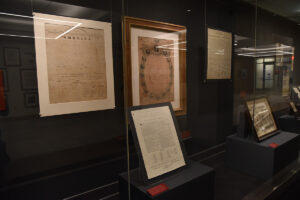
WashU Libraries will host “Unalienable Rights: America at 250,” a celebration of the 250th anniversary of the nation’s founding, at 2 p.m. July 2 at Olin Library. The free event features a talk about the Declaration and children’s activities.
The event runs in conjunction with the “Unalienable Rights” exhibition, which runs through July 19 and spotlights the university’s rare 1776 Southwick broadside as well as other printings of the Declaration, from the first reprinting published by a woman to the copy that traveled aboard the Apollo 11. Each reprinting reflects our national fascination with the document.
Happy 250th birthday America
In this new Lego art video, political scientist Dan Butler, aka “The Poli-Sci Brick Guy,” breaks down the acts leading up to the Declaration of Independence signing.
Butler’s Lego brick stop-motion universe makes learning about the U.S. government both approachable and entertaining. The videos are filled with pop culture Easter eggs and sharp humor, transforming complex political concepts into engaging lessons for high school students and others. The project is supported by WashU’s Frick Initiative.
Read More: Meet WashU’s Lego professor, a political scientist using animation to teach civics
Challenging the American narrative
To commemorate the country’s 250th anniversary, the Danforth Center on Religion and Politics offered the spring 2026 course “1776, Then and Now.” In it, students had the rare opportunity to discover the true but often untold stories behind the Declaration of Independence and the founding of the United States and to think critically about the continuing relevance and consequences of those events today.
Over the course of the semester, renowned professors in multiple disciplines from WashU and around the country broke down the political and religious influences that led to the Revolution and the political beliefs that shaped the new country.
Although the course was a one-time offering, there is good news for those who were not “in the room where it happened.” All lectures are now available online, for free, through WashU and C-SPAN.
Vittert Capito hosts First Amendment podcast
Liberty Vittert Capito, a professor of practice of data science at WashU Olin Business School, is the host of a new educational podcast, “Amended! Liberty’s Guide to the First Amendment,” produced by Voxtopica with financial support from the Frick Initiative at WashU.
“At a time when nearly everything we say or do can be amplified, scrutinized or misunderstood, the First Amendment is both more relevant and more confusing than ever,” Vittert Capito said. “’Amended!’ isn’t about telling people what to think. It’s about helping them understand the rules of the road and the history that paved the way for our freedoms.”