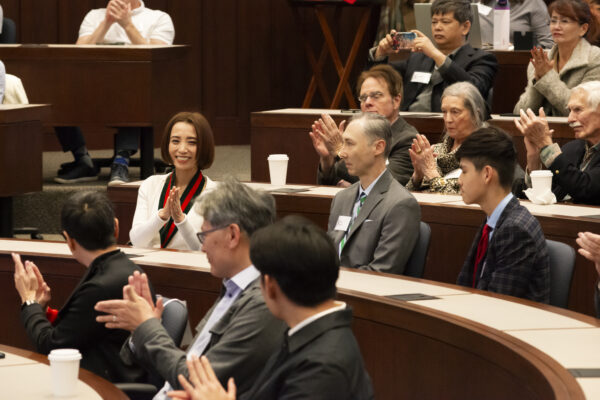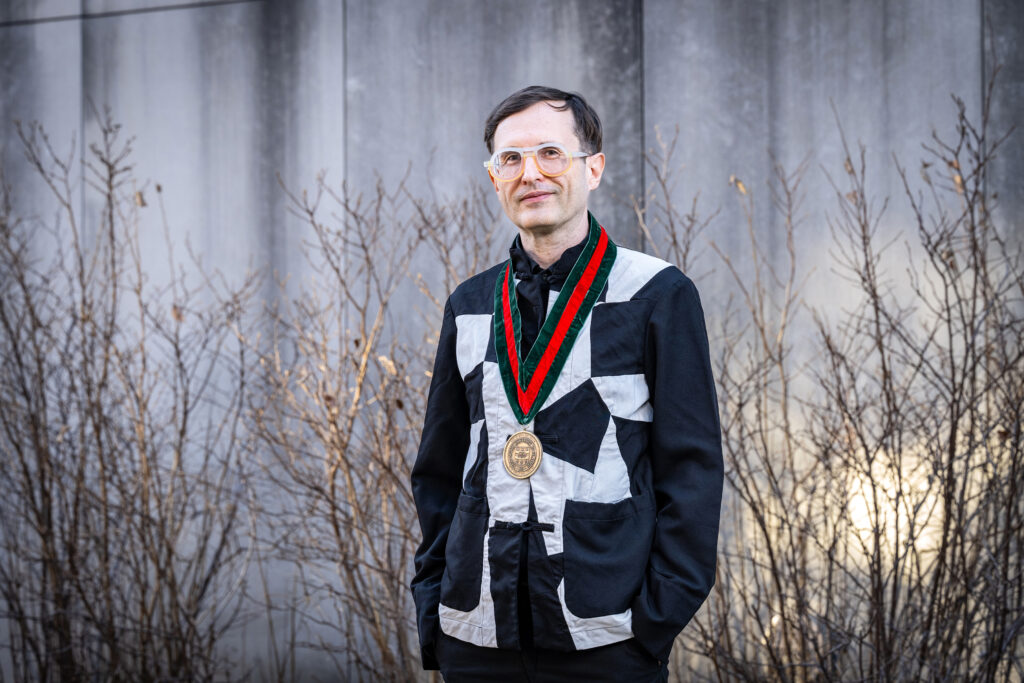
Andrew Witt has been installed as the inaugural Kavita and Krishna Bharat Professor in the Sam Fox School of Design & Visual Arts at Washington University in St. Louis. The professorship includes a joint appointment at the WashU McKelvey School of Engineering. A lecture took place Feb. 26 in Steinberg Hall Auditorium, followed by a reception in the Kemper Art Museum.
Witt joined the WashU faculty Jan. 1. He leads university efforts in artificial intelligence (AI) and design, integrating emerging technologies into both academic and studio experiences and developing new courses and research frameworks that shape the future of design education and practice. He also is a core faculty member in architecture and in the Sam Fox School’s new Master of Design for Human-Computer Interaction and Emerging Technology, which welcomed its first cohort last fall.
Witt’s professorship was established with a gift from Kavita and Krishna Bharat and in conjunction with the McKelvey Challenge. Krishna is a distinguished research scientist at Google and founder of Google News. Kavita is a classically trained dancer and a former research associate at Stanford. The McKelvey Challenge, which encourages professorships that combine engineering with other disciplines, is a component of the engineering school naming gift from trustee Jim McKelvey Jr. (AB ’87, BS ’87) and his wife, Anna.
“Andrew Witt is an exceptional scholar, a thoughtful leader and a unique creative talent,” Chancellor Andrew D. Martin said. “As institutions of higher education work through both the promise and the challenges of new technologies, Andrew has the skills, experience and insight to help WashU navigate this critical moment. I’m delighted that he has joined our faculty, and I’m grateful to Kavita Thirumalai and Krishna Bharat for their generosity in support of this important scholarship.”
During his introduction, Carmon Colangelo, the Sam Fox School’s Ralph J. Nagel Dean and the E. Desmond Lee Professor for Collaboration in the Arts, said that, in establishing the Bharat professorship, “we knew we were creating something entirely new, bridging design and engineering at the moment when AI is reshaping both.”
“Andrew is exactly the kind of thinker that this moment demands,” Colangelo continued. “His work sits at the rare and powerful intersection of architecture, mathematics, computation, artificial intelligence and software design.”
Aaron F. Bobick, dean and the James M. McKelvey Professor at McKelvey Engineering, thanked the Bharats for helping to establish a “truly forward-looking effort, one that harnesses the power of artificial intelligence and the power of the machine to elevate one of the most human tasks of all — and that is design.” Added Bobick: “It’s a great opportunity.”
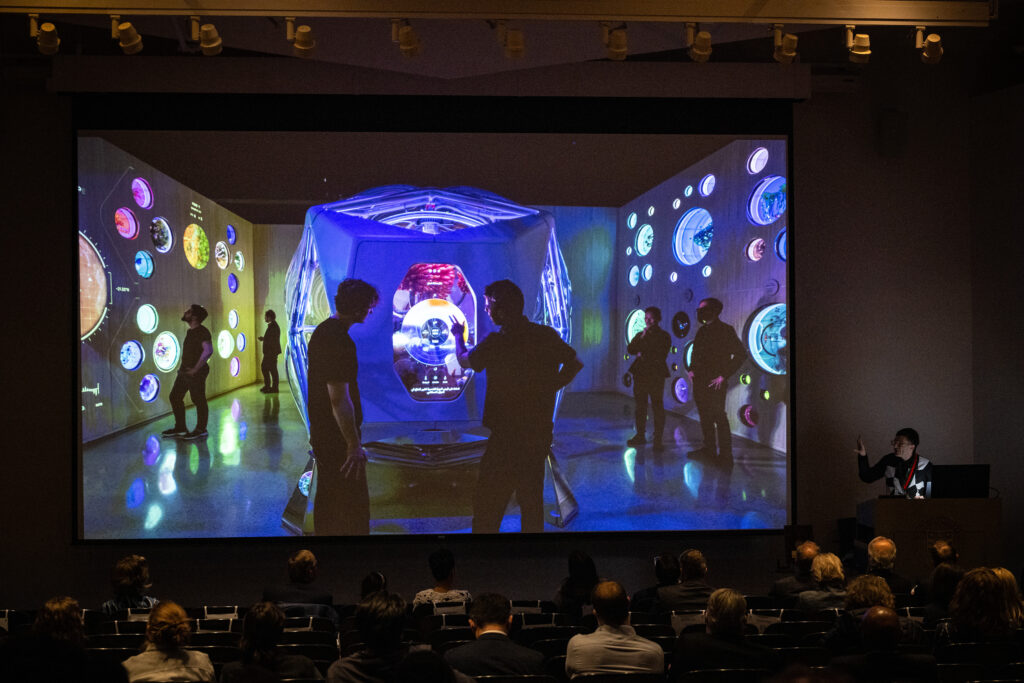
‘Data, AI and panoramic imagination’
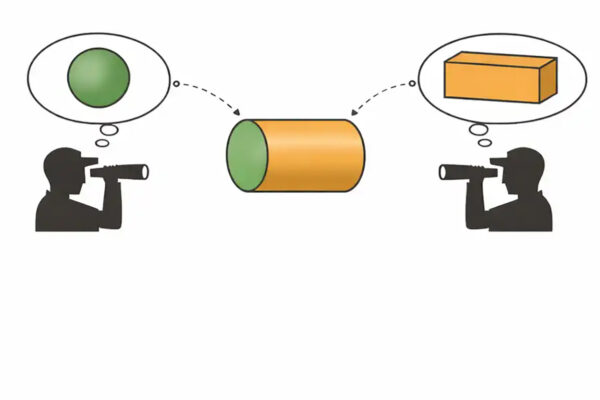
Witt’s installation address, “Data, AI and panoramic imagination,” explored and contrasted two differing ways of seeing the world: the panorama and the image matrix.
“The panorama is a unified view,” Witt said. He traced examples, from a 1528 woodcut of Vienna to 18th-century Irish painter Robert Barker to NASA’s famous 1968 “Earthrise” photo. The latter, Witt said, represented “a single panoramic data point that electrified humanity, activating a sense of collective destiny, not only between human nations, but with the Earth in totality.”
The image matrix, Witt continued, is more akin to a dataset: fragmentary, layered and stitched together. “And datasets are the language of intelligence today. To fully understand how to use them, we first must understand how to map, comprehend and bring them into the design process as a productive material.”
One extraordinary quality of AI systems, Witt pointed out, is their ability to detect patterns within complex, degraded and “noisy” datasets. “I would argue that this can help us recover what might seem beyond repair.” For example, rather than simply demolish outdated or damaged buildings, architects and builders might use AI to scan, analyze and develop reuse strategies for the constituent parts.
“Today, designers, artists and engineers must assemble knowledge as much as they assemble buildings,” Witt concluded. In so doing, they forge “new ways of seeing, creating and repairing.”
Watch the full ceremony here.
About Andrew Witt
Prior to joining WashU, Witt was on the faculty of Harvard University’s Graduate School of Design. He was co-director of Harvard’s Master in Design Engineering and the founder and director of the school’s Geometry Lab, which explores the intersection of design and the science of shape and form.
Witt’s scholarship on design and technology is internationally known, and he is the recipient of fellowships and grants from MacDowell, the Canadian Centre for Architecture and the Graham Foundation, among others. He is the author of “Formulations: Architecture, Mathematics, Culture” (MIT Press) and “Light Harmonies: The Rhythmic Photographs of Heinrich Heidersberger” (Hatje Kantz). His current book project, “The Cyborg Home,” considers the history and future of autonomous and artificially intelligent houses. He also has authored dozens of book chapters and journal articles.
In 2014, Witt and designer Tobias Nolte co-founded Certain Measures, a studio that bridges physical and digital spaces, experiences and products. The studio’s work ranges from analyzing, sorting and repurposing construction waste in a project called Mine the Scrap — now in the permanent collection of the Centre Pompidou in Paris — to developing models for reallocating water rights in the Colorado River with attention to political accountability and ecological impacts.
About Kavita Thirumalai and Krishna Bharat
Bharat is a technologist working at the intersection of computing and media. He is a distinguished research scientist at Google in Mountain View, Calif., and the founder of Google News. He started Google’s research division in 1999 and established the company’s engineering operations in India in 2004. Bharat holds a doctorate in computer science from the Georgia Institute of Technology and a bachelor’s in computer science from the Indian Institute of Technology Madras.
Thirumalai has a master’s in public health, with a concentration in epidemiology, from the University of Alabama at Birmingham. Until 2017, she was a research associate at the Center for Policy, Outcomes and Prevention at Stanford University. She is also a classically trained dancer in the Indian Bharatanatyam tradition and a curator of the Bay Area’s IDIA Dance Festival.
The couple’s connection to WashU began when their daughter, Meera Bharat, enrolled in the Sam Fox School to pursue a degree in architecture, which she earned in 2023. Krishna became interested in the impact of emerging technologies, such as artificial intelligence, on both the teaching and practice of the design arts. Together, the couple saw an opportunity to help WashU become a leader in the conversation about AI and design.