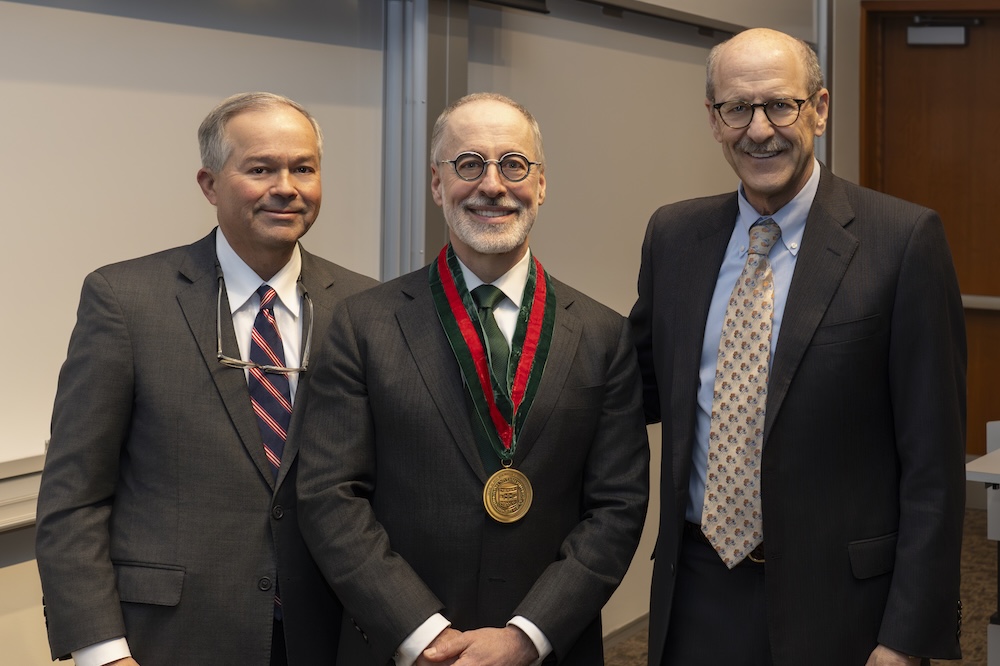
Matthew R. Rosengart, MD, whose work on sepsis and the role of circadian rhythms in immune responses has improved the care of critically ill patients, has been installed as the inaugural Theodore and Bertha Bryan Professor of Environmental Medicine in the WashU Medicine Mary Culver Department of Surgery.
Rosengart, who specializes in acute and critical care surgery, was installed by David H. Perlmutter, MD, executive vice chancellor for medical affairs, the Spencer T. and Ann W. Olin Distinguished Professor and the George and Carol Bauer Dean of WashU Medicine. The professorship was established by WashU Medicine alumnus Theodore L. Bryan, MD, and his wife, Bertha Bryan, with the goal of advancing WashU Medicine’s research into environmentally related conditions and better preparing future physicians to care for patients suffering from these illnesses.
“The Bryans were generous supporters of WashU for more than three decades, with a strong belief in the value of research and education to improve care,” said Chancellor Andrew D. Martin. “This professorship reflects their dedication to advancing research that can lead to better outcomes for some of our most vulnerable patients. Dr. Rosengart’s work embodies that mission through discoveries that are helping improve understanding and treatment of critical illness.”
Rosengart’s research focuses on the body’s response to injury and infection, in particular how sepsis — an immune overreaction to infection — can disrupt the function of mitochondria, structures in cells that generate most of the body’s energy. That disruption has been linked to long-term immune and cognitive dysfunction in people who survive sepsis. In addition, Rosengart seeks to understand how the circadian system interacts with the body’s immune responses, which could inform new treatment approaches to improve long-term outcomes for sepsis patients.
“Dr. Rosengart is a world-class investigator who recognizes that sepsis is more than an acute condition — it is a trigger for long-term consequences in the brain and immune system,” Perlmutter said. “His research is providing a foundation for developing new strategies to better treat sepsis and to improve patients’ survival and long-term recovery. This work also is helping to reshape how the field thinks about recovery from critical illness more broadly.”
Rosengart has mentored and served as thesis adviser to 40 trainees, including medical students, residents, fellows and early-career investigators. His commitment to supporting early-career investigators led to the creation of MITSEIN (Mentoring, Investigation, and Training in Science, Epidemiology and Innovation), an educational and training resource for early-career WashU Medicine faculty in the Department of Surgery who want to pursue clinical, translational and outcomes research.
Since joining WashU Medicine in 2023, Rosengart has been recognized with the Critical Care Medicine Educator of the Year Award and the Tim and Kim Eberlein Humanity in Surgery Award, the latter of which honors commitment to scientific excellence and compassionate, patient-centered care. He was similarly recognized for his teaching and mentorship at the University of Pittsburgh.
“Dr. Rosengart’s expertise in important areas in critical care surgery has brought a great deal to our department and to the field, and his installation as the Theodore and Bertha Bryan Professor is well deserved,” said John A. Olson Jr., MD, PhD, the William K. Bixby Professor of Surgery and head of the WashU Medicine Department of Surgery. “His commitment to teaching and mentorship along with imaginative and rigorous research is well aligned with the Bryans’ vision of improving care for our most vulnerable patients.”
Rosengart earned his bachelor’s degree in biology with honors from Johns Hopkins University and his MD from the University of Alabama at Birmingham, where he began his residency in general surgery. He then completed a fellowship in molecular biology, a residency in general surgery and a fellowship in trauma and critical care at the University of Washington in Seattle, where he also earned a Master of Public Health degree. He joined the faculty of the University of Pittsburgh School of Medicine in 2004 and came to WashU Medicine in 2023.
About Theodore and Bertha Bryan
Theodore L. Bryan, MD, and his wife, Bertha Benadine (Cashen) Bryan, established the first Theodore and Bertha Bryan Professorship in Environmental Medicine in 1999.
Theodore Bryan was a native of St. Louis who graduated from WashU Medicine in 1947. He met Bertha, a registered nurse, during his internship and residency at St. Louis City Hospital. Theodore Bryan served as a captain in the U.S. Army Medical Corps during the Korean War, then returned to the St. Louis area to practice internal medicine at the Medical Surgical Clinic in East St. Louis, Ill., and Belleville, Ill. He also served as medical director of Rosewood Care Center in Swansea, Ill. He retired in 1998.
Bertha Bryan was born in Belleville, Ill., and raised in Granite City, Ill. She enrolled in the U.S. Training Program for Registered Nurses at St. Louis City Hospital, completing her training in 1947 and later working as a psychiatric nurse. An active volunteer, she dedicated time to the Red Cross and the Girl Scouts and served as president of the Women’s Auxiliary of the St. Clair County Medical Society.
Theodore Bryan died in 2014, and Bertha Bryan died in 2019. Since their deaths, their initial gift has grown to support five endowed professorships in environmental medicine at WashU Medicine.