In Brief
- Earth sciences researchers found evidence that chemosymbiotic relationships between microbes and animals are an ancient evolutionary mechanism.
- Chemical signatures in fossils indicate chemosymbiosis predates the Cambrian era.
- By changing a toxic environment to benefit host organisms, microbes could have facilitated survival mechanisms that helped animal life to evolve.
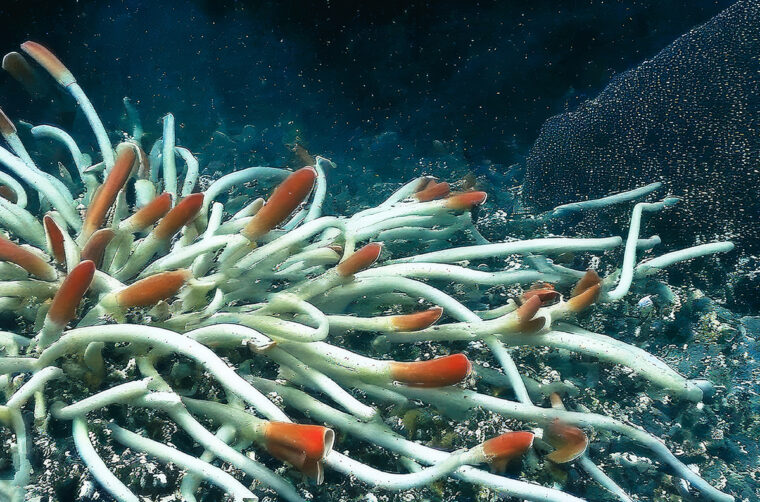
At the bottom of the deepest parts of the ocean, tube worms are living their best life thanks to help from their neighboring microbes, which oxidize the sulfide in the surrounding waters and detoxify the environment. The question is, how far back do these “old friends” go?
“There are a whole host of organisms that have these partnerships in the environment today,” said David Fike, the Glassberg/Greensfelder Distinguished University Professor of Earth, Environmental, and Planetary Sciences in Arts & Sciences at Washington University in St. Louis. He was speaking of chemosymbiosis, the process wherein microbes adjust the surrounding chemical environment to benefit the host animal.
“Previously, we didn’t know if that is a relatively recent evolutionary event, or if that emerged all the way back when animals first evolved,” he added.
The fossil record is sketchy when it comes to evidence of microbe and animal symbiosis. But modern earth science tools potentially can highlight chemical signatures that correlate with this form of symbiosis. Pyrite fossils from the seafloor can preserve those chemical signatures.
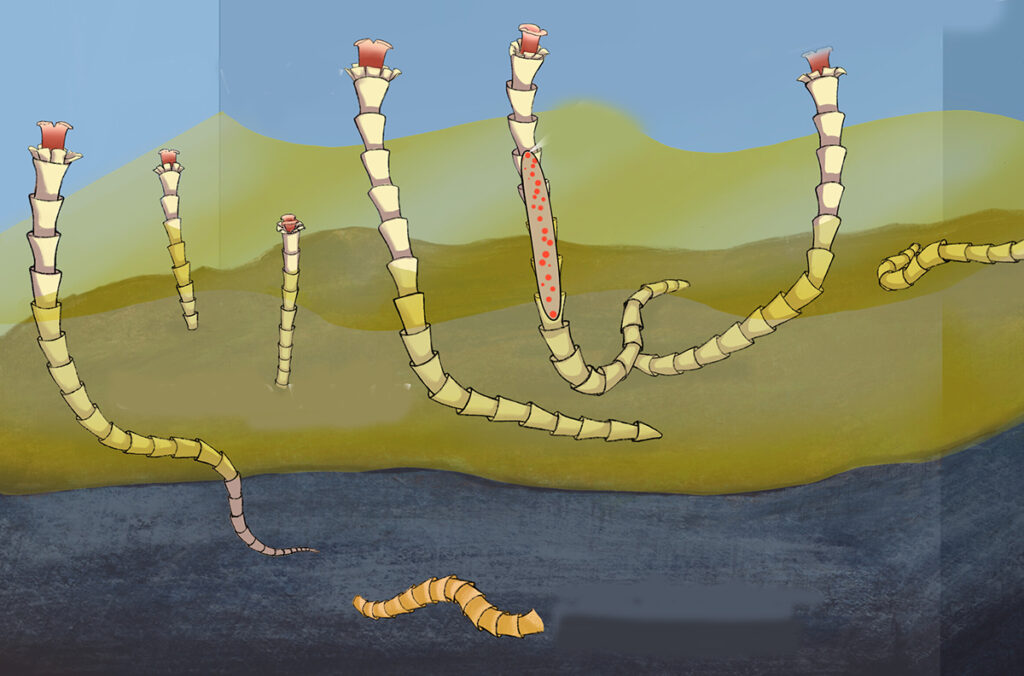
In collaborative research led by Nanjing University and published in Proceedings of the National Academy of Sciences, Fike and co-authors document how they found evidence in such fossils that chemosymbiosis is a very old trick of evolution, found in fossils from the Ediacaran Period, a time between 635 to 540 million years ago that predates the Cambrian explosion. The Ediacaran Period was when the first multicellular life evolved, and one reason such life may have evolved was microbial help making that toxic ocean a bit more hospitable.
In the new paper, Fike and his co-authors present geochemical data that suggests the proto-worms of the Ediacaran had the same symbiotic relationship with bacteria, sulfide and oxide as the tube worms of today.
“It was a very early evolutionary strategy, one that helped animals survive and spread throughout the ocean,” Fike said.
Wang Z, Peng Y, Tang Q, Schiffbauer JD, Xiao S, Fike DA, Jia Z, Feng D, Crockford PW, Cai Y, Yuan X, Pratt LM. Chemosymbiotic trophic strategy in an Ediacaran tubular animal, Proc. Natl. Acad. Sci. U.S.A. 123 (35) e2526201123. https://doi.org/10.1073/pnas.2526201123
The work was supported by the National Natural Science Foundation of China (92479205, 424B2024, and 42525202); J.D.S. acknowledges NSF support (LET-2422405) and the University of Missouri Marie M. and Harry L. Smith endowment. S.X. acknowledges NSF support (DEB-2449384). Other support came from the Fundamental Research Funds for the Central Universities (0206/14380204, 0206/14380253, 0206/14380234, and 0206/14380237), the New Cornerstone Science Foundation through the XPLORER PRIZE (to Y.P.), Open Research Fund (2025-Z03) of State Key Laboratory of Critical Earth Material Cycling and Mineral Deposits of Nanjing University, and the “GeoX” Interdisciplinary Project of Frontiers Science Center for Critical Earth Material Cycling (20250201, 20250101).