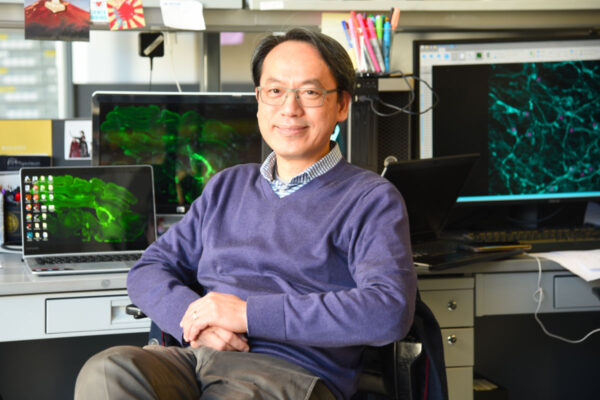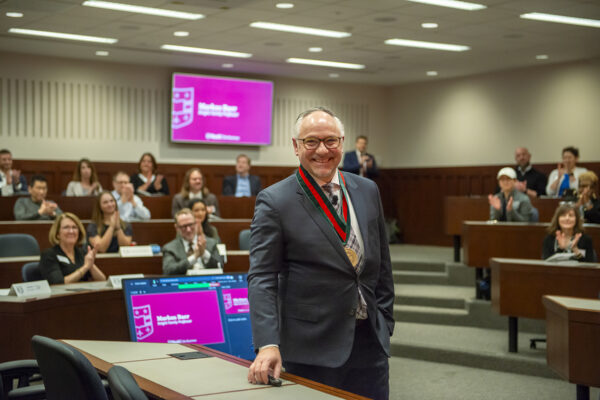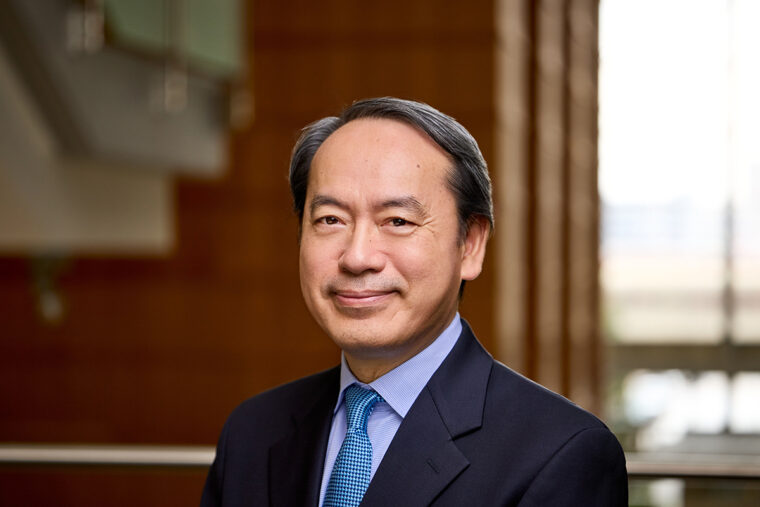
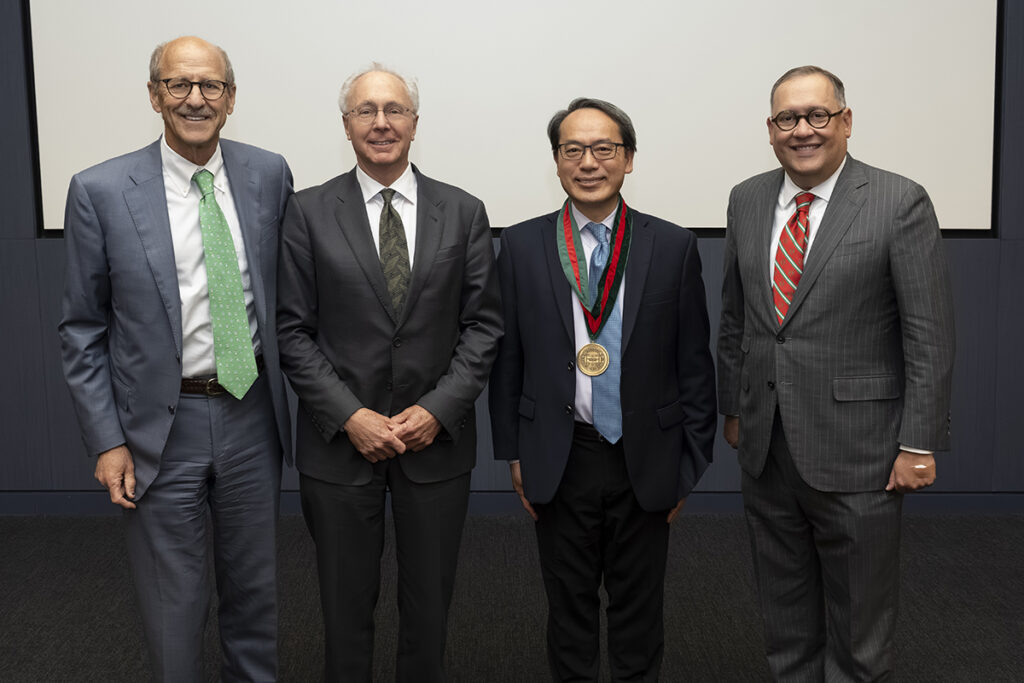
Eric J. Huang, MD, PhD, an internationally renowned expert in neurodevelopmental and neurodegenerative diseases and head of the WashU Medicine Department of Pathology & Immunology, has been installed as the inaugural Joseph M. Davie Distinguished Professor. The professorship honors the legacy of the late Joseph Davie, MD, PhD, a WashU Medicine alumnus and former head of the school’s Department of Microbiology and Immunology. Davie was a pioneering researcher and educator who later held senior roles in the pharmaceutical industry.
Davie also was a cherished mentor of WashU Medicine alumnus Roger M. Perlmutter, MD, PhD, who spearheaded the establishment of the Davie professorship. After a successful 20-year career in academic medicine, Perlmutter also moved to the pharmaceutical industry and held executive leadership positions at Amgen and Merck. He currently is the chairman and chief executive officer of Eikon Therapeutics, a company that uses super-resolution microscopy to pursue the discovery of new medicines.
“Roger Perlmutter’s WashU education was the foundation of his successful scientific career,” said Chancellor Andrew D. Martin. “Davie’s mentorship had a profound and lasting impact on Roger’s career and so many other former students and trainees who worked with Davie — as evidenced by their enthusiasm in establishing this professorship and paying tribute to his significant legacy as a gifted researcher and educator.”
Huang, who joined WashU Medicine in 2025 to lead the Department of Pathology & Immunology, was installed by Martin and David H. Perlmutter, MD, executive vice chancellor for medical affairs, the Spencer T. and Ann W. Olin Distinguished Professor and the George and Carol Bauer Dean of WashU Medicine.
“This professorship recognizes Dr. Huang’s remarkable contributions to understanding and combating neurological disorders and his continued drive to inspire future generations of scientists,” Dean Perlmutter said. “We are so fortunate to be able to recognize his accomplishments together with the legacy of Joe Davie, one of the most important leaders of biomedical research in the history of WashU Medicine, and Roger Perlmutter, whose career exemplifies the power of the Roy Vagelos Medical Scientist Training Program in developing the careers of future leaders in basic science and in industry, where new treatments are developed to improve the health of society.”
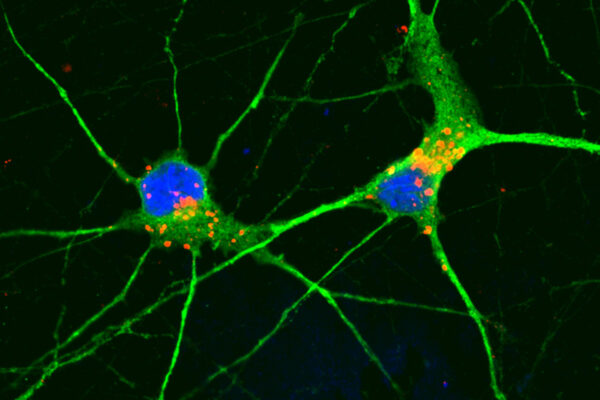
Huang’s research has helped unravel the complexities of human brain development, including the processes driving neurodevelopment before birth and during early infancy. Recently, he has identified how the human brain continuously produces specialized cells — called GABAergic interneurons — during the prenatal period and then incorporates them into brain networks during infancy. His studies also have revealed how blood vessel cells develop in the prenatal human brain and how misguided immune cells increase the risk of brain hemorrhage in premature infants, paving the way for future therapeutics to stop brain bleeds in these babies.
Huang and members of his lab also aim to understand what leads to frontotemporal dementia, the second most common type of dementia in people under age 65. Their research uncovered that overreactive microglia — immune cells responsible for protecting the brain from infection and removing dead cells — promote excessive pruning of brain cell connections. They also found that such cells work with other brain cells called astrocytes to cause the damage to and loss of neurons implicated in frontotemporal dementia.
His research has been published in top-tier journals, including Science, Nature and Cell, among others, and is currently funded by four major grants from the National Institutes of Health (NIH). Huang also serves on numerous editorial boards and study sections. He has received many awards recognizing his scientific accomplishments, including the Presidential Early Career Award for Scientists and Engineers, the National Institute of Neurological Disorders and Stroke Independent Scientist Award and the National Center for Research Resources/NIH Mid-Career Investigator Award. He was recently elected as an academician in the Academia Sinica in Taiwan, the national academy of the Republic of China that supports research activities in mathematics, physical sciences, life sciences, humanities and social sciences.
Huang earned his medical degree from the National Taiwan University College of Medicine before completing his PhD at the Weill Cornell Graduate School of Medical Sciences in New York. He completed residency training in anatomic pathology and a fellowship in neuropathology at the University of California, San Francisco (UCSF), where he also stayed to complete a Howard Hughes Medical Institute’s postdoctoral fellowship. He served on the UCSF faculty from 2000 until 2025, when he joined the WashU Medicine faculty.
About Joseph M. Davie and Roger Perlmutter
Joseph M. Davie earned his medical degree from WashU Medicine in 1968 and graduated from the school’s pathology training program in 1972 before joining the WashU Medicine faculty. In 1975, at the age of 35, he became the chair of what was then called the Department of Microbiology and Immunology. He served in this role until 1987, when he was recruited to the pharmaceutical company G.D. Searle & Company.
Davie contributed seminal findings to decipher how the immune system produces antibodies, and he performed pioneering research on islet cell transplantation, where insulin-producing islet cells from a donor pancreas are transferred into the body to treat Type 1 diabetes. He held several senior positions with pharmaceutical companies, including Biogen and G.D. Searle & Company. Davie died in 2022.
He left a legacy of training the next generation of scientists, including Roger Perlmutter, to follow in his footsteps. Perlmutter earned his medical and doctoral degrees in 1979 from WashU Medicine’s Roy Vagelos Medical Scientist Training Program, where Davie was his dissertation adviser and mentor.
“Joe Davie was always accessible and someone who brought people together — that was his defining characteristic,” Roger Perlmutter said. “He was able to attract a galaxy of important scientists to this university who came here to pursue their work, and Joe inspired them to believe that they could accomplish things they had not thought were possible.”
After earning his MD/PhD degrees from WashU, Perlmutter spent nearly 20 years on the faculty of the University of Washington in Seattle, followed by 23 years overseeing research and development programs at the pharmaceutical companies Amgen and Merck. Under his watch, Merck earned more than 100 regulatory approvals for vaccines and treatments — among them the revolutionary cancer immunotherapy Keytruda. In recognition of Perlmutter’s impact at Merck, the company recently established two career development professorships at WashU Medicine. He has been a member of WashU Medicine’s National Council since 2005 and received the university’s Distinguished Alumni Award in 2018.