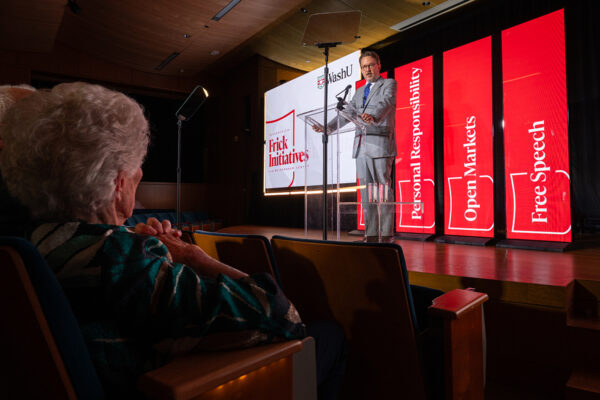
One WashU student and two recent alumni were finalists for the prestigious Rhodes Scholarship.
They are:
- Romen Der Manuelian, of Needham, Mass., a senior studying political science in Arts & Sciences;
- Mason Shaver, of St. Louis, a 2026 graduate who studied political science and educational studies in Arts & Sciences; and
- Vincent Tsay, of Manhasset, N.Y., a 2026 graduate who studied philosophy in Arts & Sciences.
“WashU is proud of these accomplished leaders, each one dedicated to strengthening the institutions of our nation and protecting the most vulnerable,” Chancellor Andrew D. Martin said. “Mason, Romen and Vincent have all made a significant impact on our WashU community and are poised to effect positive change.”
Der Manuelian, Shaver and Tsay were among an elite group of scholars from across the nation competing for the scholarship, which provides winners an opportunity to earn an advanced degree at Oxford University. WashU has had 30 Rhodes Scholars since the program began in 1902.
Der Manuelian knew at a young age that he wanted serve his nation as a prosecutor. But it wasn’t until he took an introductory accounting class that he discovered his purpose — bringing white-collar criminals to justice as a securities fraud and public corruption prosecutor. The class explored how con artists like Bernie Madoff and companies like Enron tricked their victims, wiping away millions in investments. These scandals also rocked the nation’s faith in its financial institutions.
“It made me livid, because the more I read, the more it reminded me of the dynamic of power my family fled from Soviet Armenia — power without accountability, institutions corrupted from within and ordinary people left with nothing,” Der Manuelian said. “As a country, we lose so much when the institutions we trust betray us. That’s why it’s so important to hold our institutions accountable. The fairness of the markets goes hand in hand with a better society.”
Der Manuelian is president of Student Union, WashU’s student government; and served as president of WashU Democrats and as a captain of WashU Mock Trial. In addition, he has gained hands-on political experience raising funds for The Next 50 PAC, an organization which supports next-generation leaders in Democratic politics, and helping lead the successful re-election campaign of his hometown state representative.
In the classroom, Der Manuelian distinguished himself as a quick learner who can distill and interpret complex judicial decisions.
“Romen’s superior analytic rigor is coupled with, and partially attributable to, a level of deep and sustained attentionality that I have very rarely found fully activated in an undergraduate,” said Michael Cannon, former university executive vice chancellor, who met Der Manuelian in the course “Legal Conflict in Modern American Society.” “Romen arrived in my course armed with all the meticulousness, seriousness of purpose, boundless curiosity and intellectual firepower needed to undertake case law study at a high level.”
Der Manuelian has been accepted to the Harvard Law School Class of 2032 through Harvard’s junior deferral program. He plans to study the impact of artificial intelligence (AI) on financial institutions and build the skills necessary to combat new types of AI-powered fraud.
“I don’t think even white-collar criminals are prepared for how much they’re going to be able to get away with in the age of AI,” Der Manuelian said. “This will be a global challenge.”
Der Manuelian, a born competitor, is ready to do his part.
“I can contribute most meaningfully where I have the highest marginal utility,” Der Manuelian said. “Give me the toughest challenges and the toughest battles to do the most for my country.”

Shaver’s mission to help children whose parents abuse substances is born out of his own painful history. Shaver’s parents struggled with substance abuse, leaving Shaver to largely fend for himself and his younger sister.
“I hope to help build a world where children and parents can seek the support they deserve and where a child’s future no longer depends on being one of the lucky ones,” Shaver said.
Mason Shaver
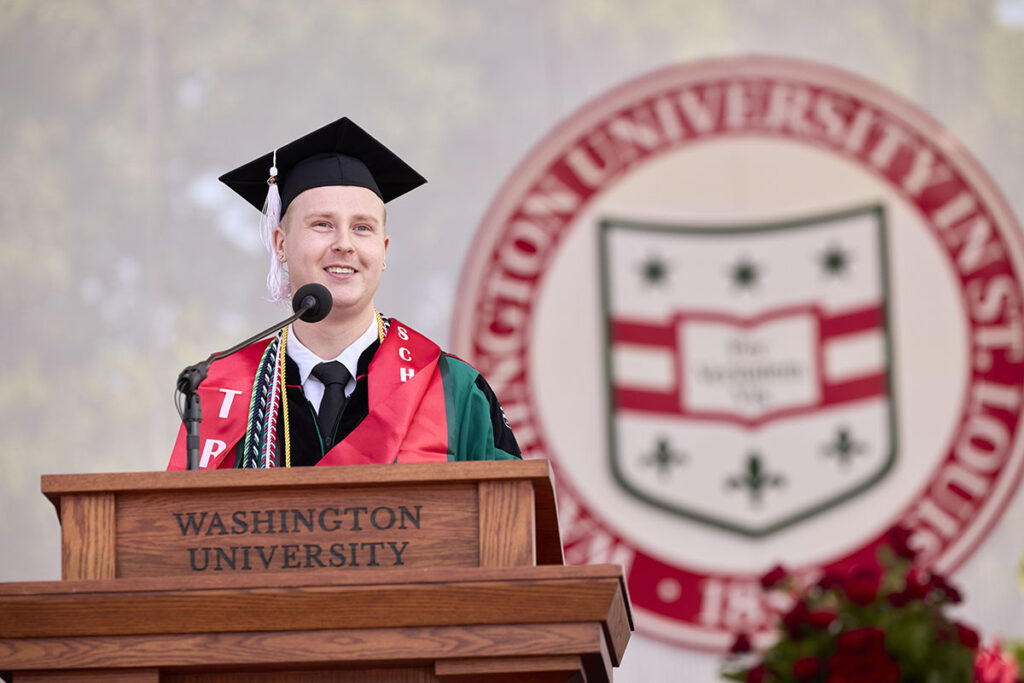
Hometown: St. Louis
Degree: Graduated in 2026 with degrees in political science and educational studies
Words of wisdom from Shaver’s Commencement address: “Our growth, our success, our failures and our ability to bounce back from those failures would not have been possible if we were not vulnerable to one another and eager to learn what we did not know.”
Shaver has, indeed, been lucky. Despite his challenges, Shaver had a caring support system at Bayless School District, including one teacher who convinced him to join WashU’s College Prep Program, which serves lower-income high school students from the St. Louis region. That experience led to a cascading series of opportunities: a QuestBridge Scholarship to attend WashU at no cost, acceptance into the Yale Launchpad Scholar Program, Gephardt Institute and Pershing fellowships and an invitation to represent his class as a Commencement speaker.
Shaver has paid his good fortune forward, serving as a College Prep Program assistant and a tutor for the School of Continuing & Professional Studies’ Prison Education Project at the Missouri Eastern Correctional Center.
Today, Shaver serves as an AmeriCorps holistic advocate in the Missouri State Public Defender’s office, connecting clients with housing and healthcare resources and preparing mitigation documents.
“It’s all about showing up and to keep showing up,” Shaver said. “Many of my clients are incarcerated and don’t have the closest ties with their families. I might be the first person that they’ve seen in weeks. To earn their trust, I need to be there when I say I’m going to be there, to be transparent about what I can do and to let my clients define the goals. ‘What do you want to achieve and how can I help?’ The work can be emotionally draining, but I love it.”
Shaver plans to earn a PhD and ultimately serve as an elected public official or leader in the Children’s Bureau at the U.S. Department of Health and Human Services. He believes boots-on-the-ground engagement, coupled with rigorous data analysis, can improve outcomes for families in crisis.
“Yes, I have my own experience, and I’ve struggled, but that’s one data point,” Shaver said. “By listening to the perspectives of those I’m trying to serve and understanding the systems that impact their lives, I am better prepared to create policies that support children and families.”
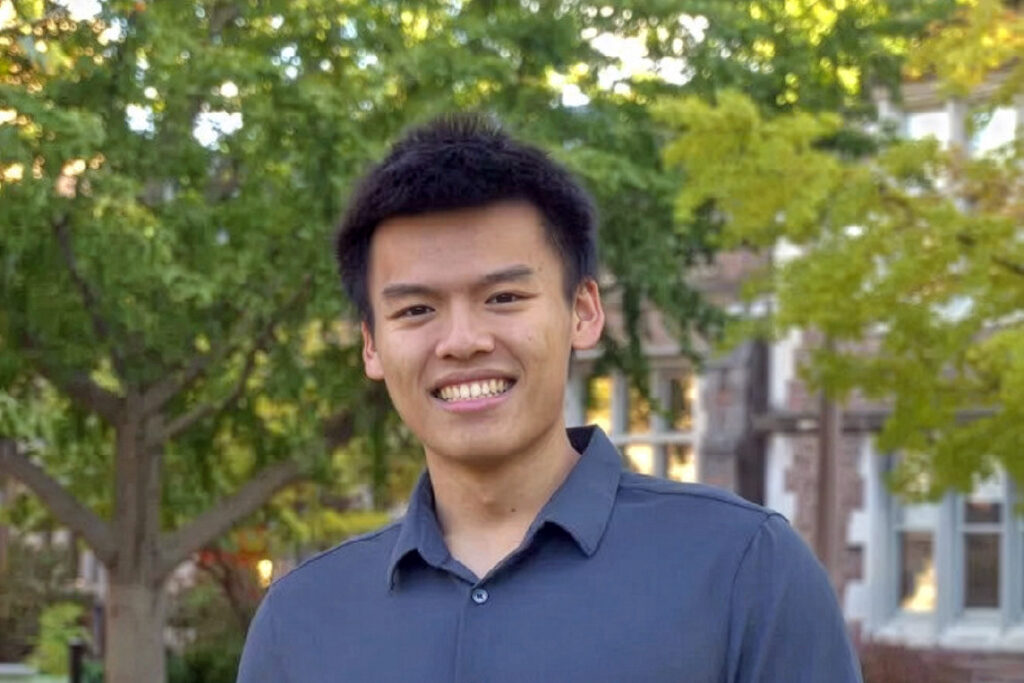
Vincent Tsay

Hometown: Manhasset, N.Y.
Course of study: Philosophy
Why public service: “I’m very grateful to be born in this country. My parents are both immigrants who came to the United States. Public service offers me a vehicle to give back to the nation that raised and educated me.”
More about Vincent: Tsay is a recreational classical piano player and speaks fluent Mandarin. His brother, William, is a junior at WashU.
Tsay discovered chess before he discovered his love of law. Growing up in New York as a competitive chess player, he came to St. Louis for a handful of tournaments. The city is known as the chess capital of the United States.
“That’s how I found WashU in the first place,” Tsay said.
He competed nationally in scholastic chess and was named to the All-American Chess Team three times, earning awards such as the National Scholar-Chessplayer Award (2022). As part of the International Chess Federation and the U.S. Chess Federation, Tsay achieved the FIDE Master and National Master titles. Tsay also co-founded Chess for Unity, a student-led organization dedicated to expanding access to high-level chess instruction, community workshops and youth leadership opportunities worldwide.
In chess, players think several steps ahead.
“You always anticipate what your opponent is going to play, and adjust accordingly,” Tsay said. “That element of strategy is similar when you’re an advocate in the law, and you’re trying to win. You’re trying to anticipate your opponent’s arguments.”
Tsay decided to pursue a career in public service law after a judicial internship at the Southern District of Florida in 2025. Over the course of eight grueling weeks, Tsay observed more than 20 different court proceedings, including a four-week murder-for-hire jury trial and a civil bench trial. He also drafted court orders and memoranda on topics ranging from a cruise line tort dispute to a class action cryptocurrency lawsuit. He admired the rigor that the judge brought to this diverse list of cases.
“Public service in the legal profession means advocating for interests beyond yourself,” said Tsay who also served as a judicial intern in state and federal courts in Missouri, New York and Illinois. “And, in particular, advocating for interests like justice, that are beneficial for people at large.”
At WashU, Tsay participated in the U.S. Army ROTC program and leaned into his philosophy classes, serving as co-editor-in-chief of the Washington University Review of Philosophy, one of only two undergraduate-led journals in the United States that publishes the works of professional philosophers.
Ultimately, Tsay hopes to serve as a federal prosecutor and, eventually, a federal judge. Tsay has already spent more than 1,000 hours in federal courts across the country.
“My country needs advocates who can defend independent courts through comparative evidence that shows citizens what happens when courts cannot check government power,” Tsay said. “I hope to be that advocate.”
— Talia Ogliore