This summer, 35 students from 28 local elementary and middle schools spent their days on the WashU Danforth Campus sketching, designing and building. In other words, living the life of an architectural student — albeit with more snacks and playtime.
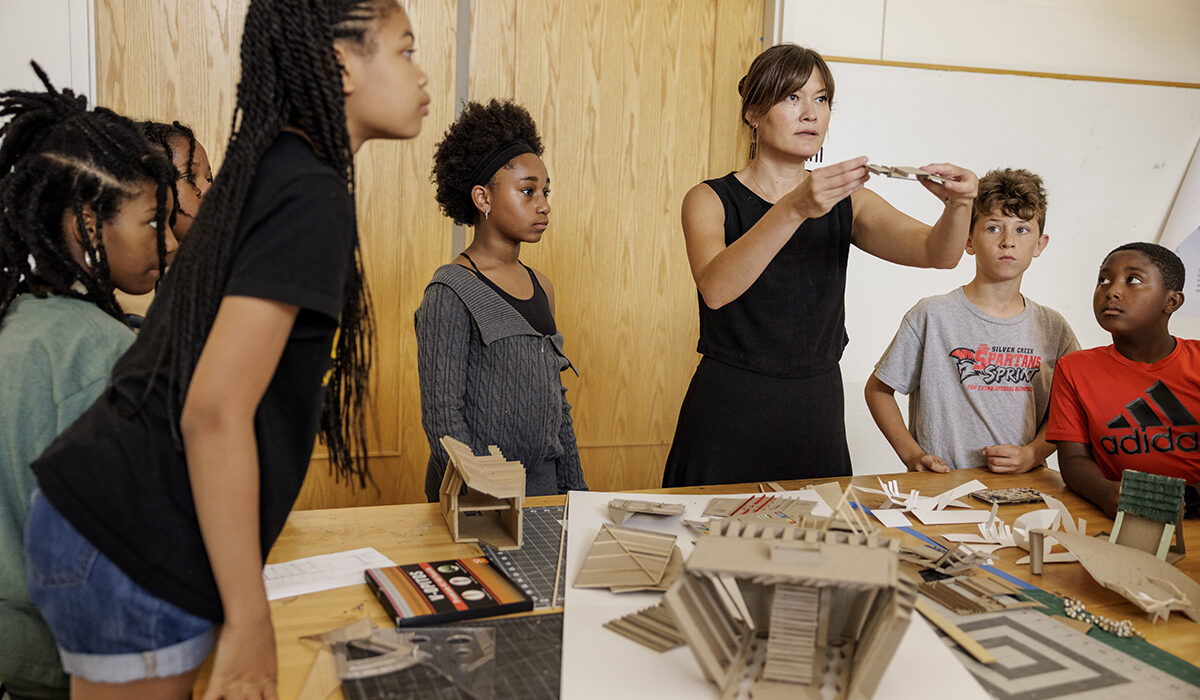
Launched in 2007, the Alberti Program at the Sam Fox School of Design & Visual Arts offers young people a hands-on introduction to architecture, a discipline rarely explored in grade school. The students work in the same buildings and use the same tools — some sharp! — as real-life WashU architecture students.
“In our undergraduate program, students spend a lot of time making models, and so do our Alberti students,” said Kelley Van Dyck Murphy, an associate professor of architecture at the Sam Fox School and faculty director of the Alberti Program. “Chipboard, basswood, X-Acto knives, tacky glue — those are the tools they would see at any architecture student’s desk. We want them to see themselves in this world.”
Murphy structures daily learning around architectural elements — floors, walls, roofs — not architectural periods. She is supported by a team of WashU architecture students, each one responsible for instructing and mentoring a group of six students, and program manager Nat Hilterbrand. Hilterbrand arranges field trips to architectural attractions such as the St. Louis Zoo’s Sea Lion Sound, designed by PGAV Destinations, a leading master planner of zoos and theme parks; and Energizer Park, co-designed by HOK, the award-winning architecture firm founded by WashU alumni George Hellmuth and Gyo Obata.
“Every stair, every city, every zoo exhibit is the result of somebody making a decision. That’s design thinking,” Hilterbrand explained. “Once students recognize that everything that they see in the environment is built and designed by someone, they are able to think about how they might change it.”
How are students learning design?
On this day, Murphy starts the day by giving the students 30 seconds to sketch the facade of Steinberg Hall, completed in 1960 by Pritzker Prize-winning architect Fumihiko Maki. The time limit forces the students to home in on the building’s most dominant element — the zig-zag patterns that cross the building’s facade. Murphy then gives them 10 minutes to draw the neighboring Kemper Art Museum. Time’s up, and the students lay their sketchbooks on the grass.
“Who wants to pick a drawing to talk about?” Murphy asks.
One student admires how a friend conveys the building’s reflective surface by drawing the trees caught in its reflection. Another student explains that she shaded alternating panels to highlight the building’s accordion-like facade. Another student drew the connection between the vertical folds of the Kemper’s facade and the horizontal folds of the Steinberg roof.
“That’s a really interesting observation,” Murphy comments. “Architects often are inspired by other architects.”
“Sketching is a way of seeing the world and interpreting it,” Murphy explains as the students enjoy a snack break. “Hopefully when they’re walking around on their own, they start to look at things more closely and question why they’re built or designed the way that they were.”
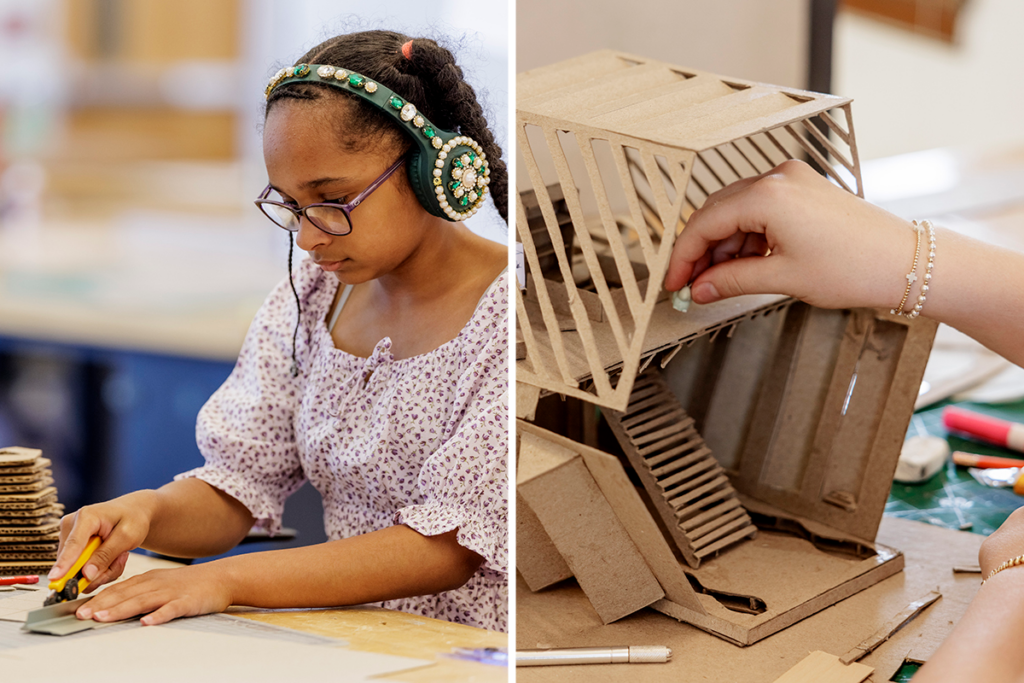
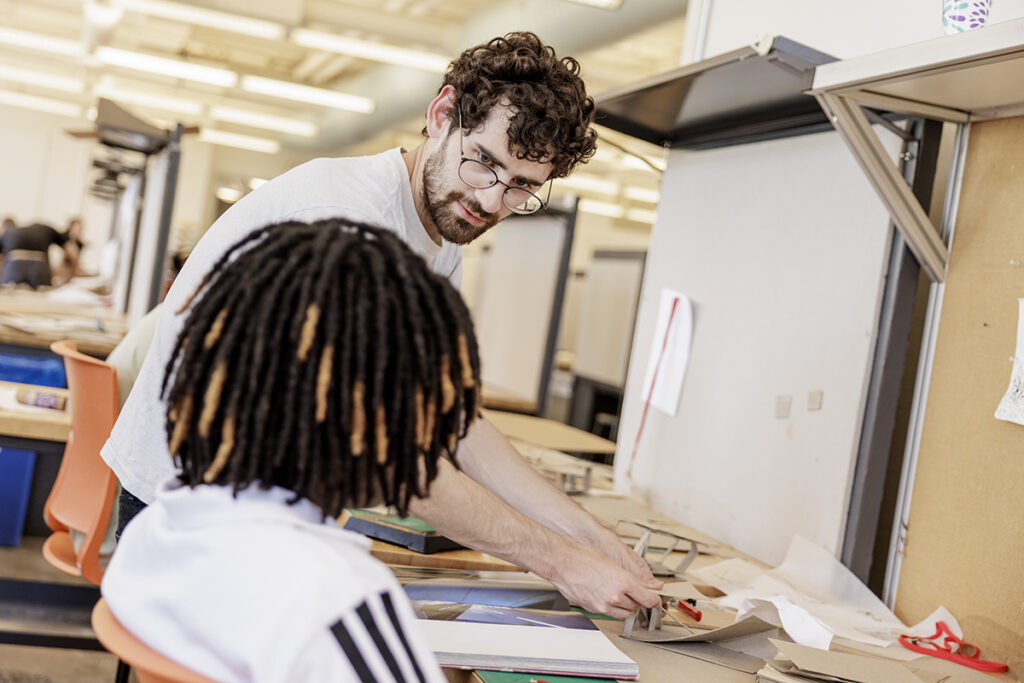
Back in the studio in Givens Hall, the students get to work on their models. Carolyn, a returning student and eighth-grade student, uses a box cutter to slice a piece of cardboard for her model — a college library with an indoor garden. Meanwhile, teaching assistant Miles Diekemper, a Sam Fox School graduate student, consults with Amari, another returning student and eighth grader, who is making a sculpture pavilion. About half of all Alberti students return for one or more summers.
“Every year I like to incorporate a folding aspect into my design,” Amari tells Diekemper.
“Nice. I like the intuitive way you are thinking about your tiles,” Diekemper says.
Bruce Lindsey, the E. Desmond Lee Professor for Community Collaboration, and Gay Lorberbaum, a retired senior lecturer, founded the program to widen the pipeline to architecture, a field that has historically struggled with representation. About half of the program’s participants are returning campers, and 60% receive a full scholarship.
“The Alberti program builds on decades-long work of Gay Lorberbaum’s advocacy for the environmental rights of young people and helping them believe in the impact they can have,” Lindsey said. “While the environmental challenge they face is not their fault, it is their problem. They are a renewable energy source.”
For Hilterbrand and Murphy, the mission is personal.
“I know firsthand how stepping foot on a college campus like ours can really change what they believe is possible,” Hilterbrand said.
Murphy didn’t even know architecture was a job growing up in Paris, Tenn., population 10,500.
“I was always a maker,” Murphy said. “I would have loved to have access to something like this as a kid.”
In addition to leading the Alberti Program, Murphy led the Pathways course at Sumner High School, which, like the Alberti Program, is an initiative of the Sam Fox School’s Office for Socially Engaged Practice. Last year, she worked with about 50 Sumner students in a design-build project for the school’s library. Her partnership with St. Louis Public Schools was recognized in April with a Provost Impact Award from the Confluence Collaborative for Community Engagement.
“We met a lot of students who had never met an architect, so we were able to show them what it means and that architecture can be something as small as redesigning a reading room,” Murphy said.
How does imagination factor into architecture?
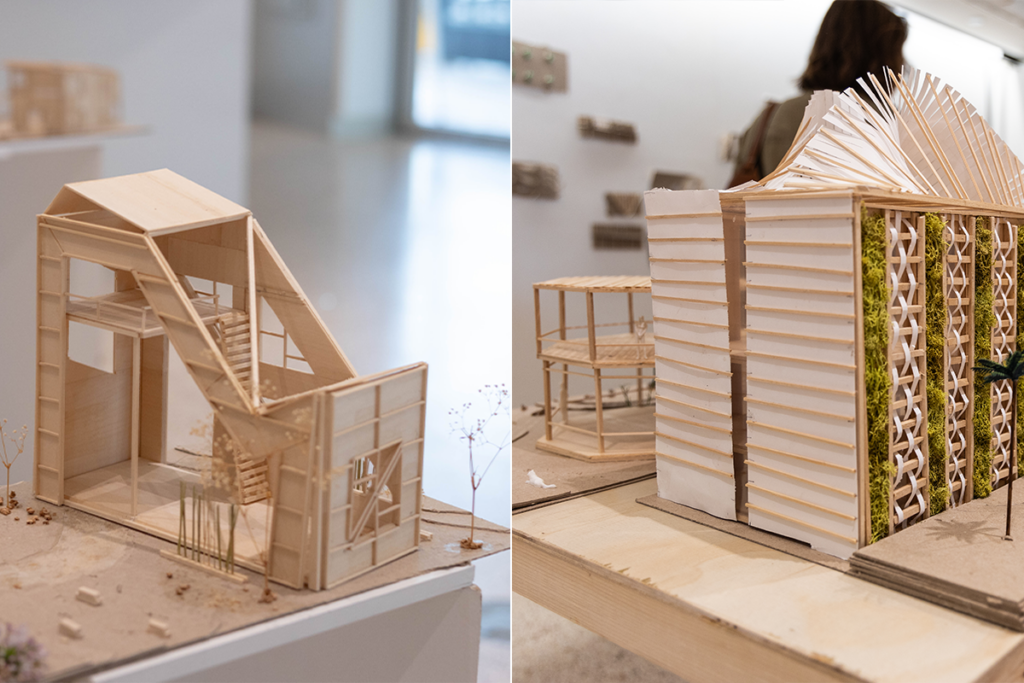
On the final day of the camp, the students show off their work at a final exhibit attended by Sam Fox School faculty and the students’ families. The models include a clubhouse for witches; an apartment complex for aliens; and a floating home with a dance floor and helicopter pad.
Yemaya, a first-time Alberti student, is excited to present her model.
“This is for the plants that need extra shelter, and this is for plants that need extra sunlight,” said Yemaya, a rising sixth grader, pointing to her model’s greenhouses. “I hope I come back next year because I really liked showing my creativity. And the more I do things like this, the more I am interested in architecture.”
Carolyn reimagined the structure of her library, adding more texture to the walls and expanding the windows to add more natural light. Diekemper compliments the model.
“There is a real focus on the craft with the precision of the cuts and measurements,” Diekemper said.
Murphy said this year’s cohort showed a lot of imagination and dexterity.
“You can see how they really developed their design-thinking skills over these past weeks,” Murphy said. “They approached their projects in a really critical way, thinking about the people who are using the building, the materials, the surrounding landscape. I’m constantly inspired by where their minds go.”
The Alberti Program is administered by the Sam Fox Office for Socially Engaged Practice, directed by Matthew Bernstine,with funding from PGAV Destinations, HOK, the American Institute of Architects St. Louis, the Missouri Arts Council and individual donors.