Imagine swimming in open water and feeling slime brush against your leg. Most people might shake it off without a second thought. But what if the surface of a boat could do the same?
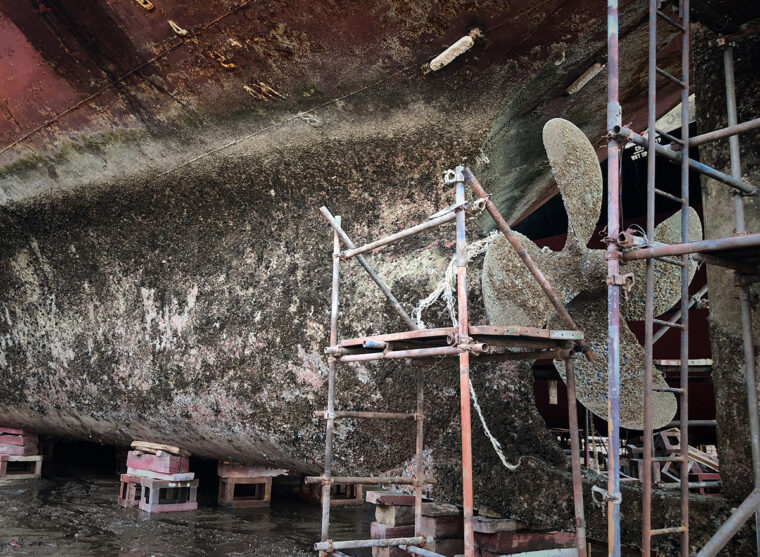
Researchers from Washington University in St. Louis’ McKelvey School of Engineering are about to find out, thanks to a $750,000 grant from the U.S. Department of Defense to develop materials that incorporate soft robotics and nontoxic polymers to fight biofouling, or the buildup of aquatic organisms in wet environments. Biofilm and barnacles are not just a messy inconvenience; they affect the function of anything in water. In the U.S. Navy’s case, fouled-up watercraft reduces fuel efficiency and vastly increases costs for fleet upkeep.
There has been recent concern that the 1,500 ships parked in the Gulf of Oman could cause a “super spreader” event when shipping lines reopen. When vessels remain anchored in those waters, organisms native to the Gulf of Oman and the Strait of Hormuz can set up shop on the ships’ hulls. Then, when normal shipping resumes, scientists worry that those vessels could accidentally spread invasive species all over the world, potentially causing major disruption to ecosystems and industries. Polymer layers that could shake off such stowaways are becoming more valuable with globalized trade.
Enter Christopher Cooper, an assistant professor of environmental, energy and chemical engineering and of mechanical engineering and materials science, who is leading the work, in coordination with researchers at North Dakota State University, where they will test samples in water. The idea is to create a system with layers that can adjust and respond to the constantly shifting aquatic environment.
Normal anti-fouling protections have a static chemical coating that can repel a particular subset of marine organisms. But other creatures can defy those protections, and once they attach, even more organisms can pile on.
“The idea is to make a soft robotic surface that can change its shape,” Cooper said.
The robotic part is a polymer that acts a soft actuator so that, when heated, it will contract, and when it cools down, it will expand. By controlling the amplitude and wavelength of the deformation of that surface, the research team can use those deformations to dislodge biofoulants. Atop the polymer that will bend and bump off biofilms, they’ll add more layers of chemical deterrent, turning it all into a “self-healing multiphase coating.”
If all goes well, this work also could have a big impact in many areas beyond shipping. For example, in salt-water treatment, the polymer coatings could vastly improve the membranes used in desalinization. Such an upgrade could potentially allow salt water to be used in many applications where it’s now unsuitable, including to cool data centers. And, in medical devices, these materials could potentially imitate the sophisticated biomechanics of human arteries, which are constantly wrinkling and unwrinkling, to affect platelet adhesion.
“This is a platform that can sense something trying to attach and develop a strategy to dislodge it,” Cooper said.