A doctor’s workday often extends beyond the time spent with patients — typing up notes after patient visits can take a few hours daily. Most physicians say they would rather devote their mental energy to patient care than to such administrative tasks. To help ease that burden, WashU Medicine and BJC Health recently made a clinical artificial intelligence (AI) platform available to physicians that captures and summarizes what is said during medical appointments, allowing doctors to focus on interacting directly with their patients and less on note-taking.
The joint Center for Health AI (CHAI) vetted the technology and is leading the rollout, starting with outpatient clinics. The center, established as part of the long-term affiliation agreement between WashU Medicine and BJC Health, is focused on developing and evaluating AI technologies to make healthcare more personalized and effective for patients and more efficient for providers.
Doctors who use the platform find that it can save time and effort over manually typing up notes or transcribing recorded notes.
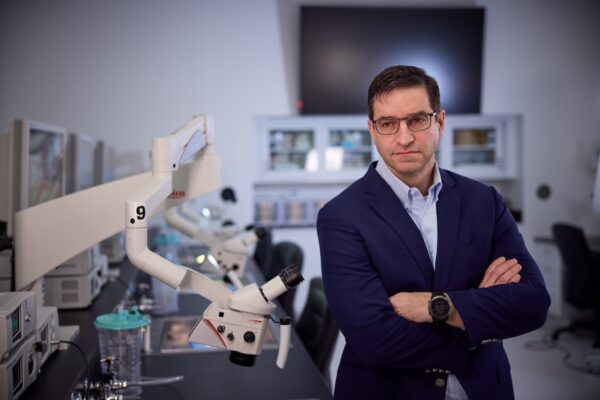
“This resource allows us to spend more time engaging directly with patients and still produces records that are very accurate. The platform captures the relevant aspects of the patient-clinician conversation and is generated within 30 seconds or a minute,” said Sam Bhayani, MD, who is a member of CHAI’s executive team as the chief medical officer for WashU Medicine Physicians, the clinical practice group that includes more than 2,550 primary care and specialist physicians.
The AI note-taking platform, called Abridge, is simple to use with a smartphone: After obtaining patient consent, the physician opens an app on their phone and the technology “listens” to the visit and generates notes that summarize the discussion. Bhayani, who is also the the Robert Killian Royce, M.D., Distinguished Professor in the Division of Urology in the Mary Culver Department of Surgery, explained that the physician can then review the notes, refer back to the transcript if necessary, and make edits and additions before adding them to the patient’s electronic medical record — a much less time-consuming process than drafting notes from scratch.
A pilot study of the platform and other similar options, conducted by CHAI and involving nearly 500 WashU Medicine and BJC physicians, generated overwhelmingly positive feedback from the doctors, Bhayani added. Early studies indicated that users of the Abridge platform had a 20% reduction in “pajama time” — the after-hours work physicians often put in to draft patient notes.
Philip Payne, PhD, the Janet and Bernard Becker Professor at WashU Medicine and chief health AI officer for BJC Health and WashU Medicine, said the adoption of the Abridge platform represents a long-term commitment by both institutions to push healthcare innovation forward using validated AI technologies. “CHAI has a lot of high-level expertise to evaluate the impact of AI platforms like this in all facets of healthcare, ensuring that they are effective at improving clinical outcomes, provider well-being and patient experience,” said Payne, adding that the rigor WashU Medicine and BJC Health bring to assessing the utility and reliability of these platforms means that decisions made here can provide a model for other healthcare systems looking to adopt these technologies.
“If the AI platform improves quality, safety, outcomes and value of care at WashU Medicine and BJC Health, then other people will look to see how we made that work, and it will have a demonstrably positive impact for patients and communities elsewhere,” he said.
A commitment to innovation
The time-saving potential of the platform is significant: Surveys by the American Medical Association have shown that physicians often need to spend extra time on top of their normal working hours on tasks related to electronic health records, including transcription, inputting additional notes after a visit or cleaning up notes.
Jennifer Schmidt, MD, an associate professor of medicine and associate chief of clinical operations in the WashU Medicine Division of General Medicine & Geriatrics, said she was surprised to find that even better than clearing her time, using the platform cleared her mind.
“I had not anticipated how much it reduces your cognitive burden so you can focus on what your patients are saying and what it means for their care, rather than trying to multitask,” said Schmidt. “For patients with more complex conditions, where there are detailed descriptions of their symptoms, this platform is really helpful because you’re not focusing on trying to write down everything they say.”
Schmidt said she has seen how adoption of the platform has allowed her and her colleagues to close out their notes more quickly. She noted that WashU Medicine’s proactive commitment to the technology positions it well to attract physicians who want to use these platforms in their practice.
“Ambient AI like this is going to be adopted everywhere, and investing in it is really important,” Schmidt said. “Physicians looking to work here want to have these platforms. This is medicine’s future.”
To help clinicians adopt the technology, Abridge representatives visit the WashU Medicine and BJC Health campuses on a quarterly basis. Physicians and staff who want to learn more about using the ambient AI platform, attend a demonstration, or speak with clinical leaders can receive updates on upcoming campus visits by completing an online form.
About WashU Medicine
WashU Medicine is a global leader in academic medicine, including biomedical research, patient care and educational programs with 3,100 faculty. Its National Institutes of Health (NIH) research funding portfolio is the second largest among U.S. medical schools and has grown 78% since 2016. Together with institutional investment, WashU Medicine commits over $1.6 billion annually to basic and clinical research innovation and training. Its faculty practice is consistently among the top five in the country, with more than 2,550 faculty physicians practicing at 200 locations. WashU Medicine physicians exclusively staff Barnes-Jewish and St. Louis Children’s hospitals — the academic hospitals of BJC HealthCare — and Siteman Cancer Center, a partnership between BJC HealthCare and WashU Medicine and the only National Cancer Institute-designated comprehensive cancer center in Missouri and southern Illinois. WashU Medicine physicians also treat patients at BJC’s community hospitals in our region. With a storied history in MD/PhD training, WashU Medicine recently dedicated $100 million to scholarships and curriculum renewal for its medical students, and is home to top-notch training programs in every medical subspecialty as well as physical therapy, occupational therapy, and audiology and communications sciences.
Originally published on the WashU Medicine website