Mateo is never too far from his music.
His mom, Dala Rosado of St. Louis, learned early on that it soothed her 4-year-old, especially when visual processing challenges made loud environments overwhelming. But while Mateo attends swimming lessons, he can’t listen to his music at the same time.
Rosado wondered if there was a wearable waterproof speaker vest on the market that could move with Mateo, helping him stay grounded and engaged in the water-based activities he also loves. She pitched the idea as a potential project for the 2026 WashU Assistive Tech Make-a-Thon.
The event, now in its third and largest year yet, was organized by the WashU Medicine Program in Occupational Therapy; the Spartan Light Metal Products Makerspace and the Department of Biomedical Engineering, both in the McKelvey School of Engineering, with support from Cecropia Strong, a national nonprofit that aids people with disabilities, and the MO Better Foundation.
Nine days, one mission
For the Make-a-Thon, community members in the St. Louis area, known as “co-designers,” submitted product ideas that could help them or loved ones who live with a physical disability. Ten teams of four to five students from WashU Medicine and the McKelvey School of Engineering then collaborated to design, build and test functional products that could address these challenges.
Each team met with their co-designer or client advocate to understand specific needs before they began, ensuring the end product was both functional and user-friendly. The teams had nine days to work together before the “big reveal” and awards ceremony.
Brooke Anderson, a second-year OT graduate student, and three biomedical engineering students, James Wang, Taryn Sager and Madison Denning, formed Team 6, the group that was dedicated to bringing Rosado’s vision to life.
“I’m not sure how many other schools offer this kind of collaboration,” Anderson said. “It broadens our perspectives to be exposed to students with different backgrounds. It’s also gratifying to work on something tangible that will have a direct impact on a community member like Mateo.”
Wang agreed: “As a biomedical engineering student, my work typically focuses on the technical aspects of projects. This experience was truly special because we connected with the family whose lives will be affected by our design.”


Märit Watson, an assistant professor of occupational therapy and of medicine, introduced the Make-a-Thon concept to WashU three years ago to create a hands-on event that would simultaneously expose students to community members’ needs, enable students to collaborate on solutions that would directly enhance lives and transform their perceptions from a disability focus to realizing all the abilities that individuals possess.
“This couldn’t have been possible without WashU’s buy-in, engaged sponsors, amazing ideas from co-designers and our students who are so eager to work together toward real-world solutions,” Watson said. “Watching this synergy in action — among students as well as with our co-designers — is truly inspiring.”
Winners circle
On the last night of the Make-a-Thon, each student team presented findings, demonstrated their product in action and answered questions. A panel of judges — including representatives from Cecropia Strong, the MO Better Foundation and McKelvey Engineering, and a graduate of the WashU Medicine Program in Occupational Therapy — helped determine the winners.
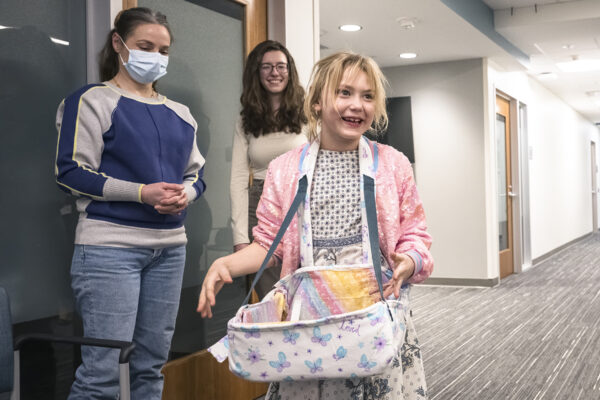
Several co-designers also attended the culminating event, including the Rosados. Mateo tried on his assistive technology for the first time, and the audience cheered as he instantly started dancing when “The Wheels on the Bus” began playing from his new vest.
After thoughtful deliberation, four teams were presented with awards, including the Judges’ Choice award for Team 6.
“It’s like magic how it all came together,” Rosado said. “As a mom of a special needs kid, you come to realize that the world is truly not designed for them. This event was so special, partnering with students to make Mateo’s world a little bit easier.”


Originally published on the WashU Medicine website