Episode overview
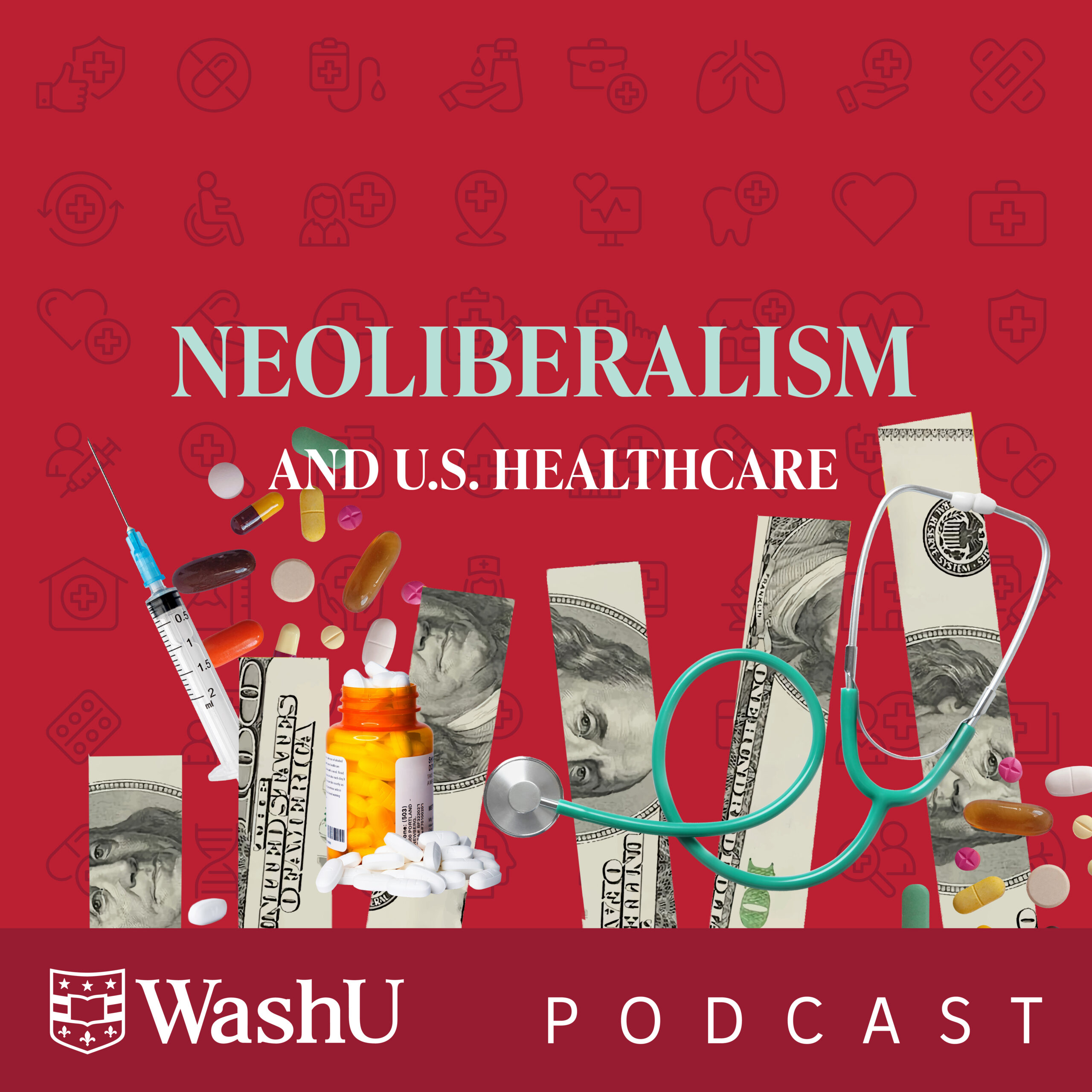
Is a neoliberal approach—the for-profit embrace of free market values—driving inequality in U.S. healthcare? And how can healthcare become more universal in an age where monopolies are increasingly the norm?
In this episode of Ideas Matter, WashU’s Sandro Galea, dean of the Bursky School of Public Health, and John McDonough, professor at Harvard’s T.H. Chan School of Public Health, explore neoliberalism’s impact on everything from insurance and managed care to politics, the healthcare workforce, and corporate consolidation.
Transcript
[Sandro Galea]
Welcome to Ideas Matter, a podcast hosted by WashU. I am Sandro Galea. Neoliberalism is, roughly speaking, a political and economic system in which free markets, privatization, and the looser regulatory climate are embraced as primary drivers of progress. Neoliberalism has yielded much of value: economic growth, innovation, cheaper goods and services in many sectors, but it has also caused problems. They include growing inequality, market instability, and a fraying social safety net. There is a place where the strengths and challenges of neoliberalism perhaps uniquely converge, and that is the American healthcare system. On one hand, our healthcare system generates cutting-edge innovation and curative excellence. On the other hand, under neoliberalism, these assets are out of reach for many. Economic precarity and a patchwork social safety net keep healthcare far from universal, even as Americans’ health challenges remain acute. Many books have been written about neoliberalism, and many have been written about healthcare, but few, if any, have been written about healthcare under neoliberalism. But today’s guest has written just such a book. John McDonough is a professor of public health practice in the Department of Health Policy and Management at the Harvard T.H. Chan School of Public Health, and formerly director of executive and continuing professional education. Between 2008 and 2010, he served as senior advisor on national health reform to the U.S. Senate Committee on Health Education, Labor, and Pensions, where he worked on the Affordable Care Act. He served as executive director of Healthcare for All, Massachusetts’ leading consumer health advocacy organization, where he played an important role in the passage and implementation of the 2006 Massachusetts Health Reform Law. Before that, he was a member of the Massachusetts House of Representatives, where his service included co-chairing the Joint Committee on Healthcare. And John was also my teacher when I was in graduate school. John’s new book is America’s Wrong Turn: U.S. Healthcare in the Neoliberal Era. John, welcome.
[John McDonough]
Thank you. It’s a pleasure and honor to be here with you, Sandro.
[Sandro Galea]
So let’s start by asking about you. How did you come to be interested in healthcare? Obviously, you’ve done healthcare for 30 years. Where did that come from, and how did that lead as a straight line to this book today?
[John McDonough]
Actually, it’s about 42 years.
[Sandro Galea]
I undercounted. Keep going.
[John McDonough]
I was a professional organizer after college:, labor union organizer, housing tenant, community political. And in 1984 got elected to the Massachusetts House of Representatives from the Jamaica Plain neighborhood of Boston. And I accidentally ran into someone from the city who, when I was thinking about what committees I want to get on, suggested to me that I ought to ask for the healthcare committee because there was no one else from Boston on the committee, and I could carve out a niche for myself as the Boston voice on healthcare. And I said to her, I said that sounds great. However, I don’t know anything about healthcare. I don’t know Medicare versus Medicaid. And she said to me, she said, I remember her words. She said, “Don’t worry, we’ll tell you.” And by we, she meant this growing new population of activists who were working in communities and in institutions to try to change and reform the mess of Massachusetts healthcare, which resembled the mess around the country, and they became an important, vital force for everything that’s been achieved in the past 42 years. So I got on the healthcare committee, and I fell head over heels instantly in love with health policy, and that was about 42 years ago. And I’ve never had a day since then that I’ve been bored because every day is just so interesting, invigorating, challenging, and stimulating.
[Sandro Galea]
Let’s move to the book. So neoliberalism is one of those words that’s tossed around a lot. It’s a useful word for activists. How do you define it in the context of U.S. healthcare and lead us through how neoliberalism intersects with the healthcare sector.
[John McDonough]
So, my favorite definition actually comes from Naomi Oreskes from Harvard College, who refers to it as free market fundamentalism. It’s taking free market values and pushing them to the limit, to beyond what we would look at as being somewhere in the middle where you take different things. It’s an all-or-nothing approach, which I think epitomizes the approach of Milton Friedman, for example, its strongest U.S. advocate, oh since the late 1940s. And it didn’t start at all looking to reform healthcare as a prime objective. It had much higher goals of changing monetary policy and trade and immigration and many other things were much more interesting to them. But healthcare has become so big and so important in the U.S. economy that it’s just impossible that you could have the kinds of changes that we’ve seen through the neoliberal era of 1980 to 2020, and healthcare could somehow escape. And when I started at Harvard in 2011, started teaching, I would show classes of students and executive ed people a chart from the Commonwealth Fund that showed U.S. spending on health as a percent of gross domestic product, and it would compare it with 10 other leading nations.
And the interesting thing about the chart is it started in 1980. So if you go back to 1980, the U.S. was the high spender, and we were very much in the pack of the 11 nations. We were top, but everybody, somebody’s got to be on top, and it was not a big difference at all. But then, starting in the early 1980s, and you see this on the chart, the U.S. jackrabbited up and beyond, and it has been up, up, and away since the 1980s. And so, a lot of students and exec ed participants would ask me, say, “What the heck happened in the 1980s that made this deviate?” And honestly, in those days, I didn’t have a clear answer. I thought I could put out hypotheses, but over the time, more and more people asked me, and and my friend Austin Frakt, a health services researcher, did an article for the New York Times Upshot section in 2018, and the headline was “Medical Mystery: Something Happened to U.S. Healthcare in the Early 1980s,” and he interviewed about 20, 25 people, and nobody really had a firm, clear answer on what it was, and that made me say, you know, there’s a book here, and somebody’s really got to nail this down and put it together, and so that’s what started me on the pathway to writing the book. I thought I could do it in about two to three years. It took me about five and a half years because of all the other distractions and things like that. But it’s been you know I have a saying that in the best courses the person who learns the most is the teacher, and it’s similar I think with books. I think the best book is where the person who learns the most is the author because of the pathway and the process of discovery, getting from start to finish, and that very much happened to me. And I know it happens to you all the time. I’m sure as well.
[Sandro Galea]
It does. I couldn’t agree more. Let’s get specific. So let’s talk about what specific policies or institutional changes can best illustrate the neoliberal turn of the U.S. healthcare system.
[John McDonough]
I’d suggest two. One is antitrust or monopoly or corporate consolidation concentration in the U.S. economy and very much in the U.S. healthcare space. One antitrust expert says that if you want to understand why costs are so high in the United States in the medical care system. It begins with corporate consolidation and monopoly. It has just been staggering. So today in the United States, about 90% of hospital markets, county by county, are defined as highly concentrated. The highest rating it can go. About 75% of insurance markets are highly concentrated. 65% of physician specialties are highly concentrated, and those are just the headlines. It permeates every level, and there was a change. We used to take antitrust and antimonopoly much more seriously as a country, but in the 1970s and early 80s, the neoliberal movement presented an idea that we were doing antitrust, antimonopoly all wrong.
Big was not bad, they argued, as long as consumers somewhere would get lower prices, and so if they can prove that someone will get a lower price, they should get a green light for merging, consolidating, taking over whatever. And that actually happened. And the Reagan administration in the early ’80s changed the antitrust guidelines by the Federal Trade Commission and the Department of Justice, and we were just asleep at the wheel for the most part for about 40 years, and especially in the healthcare sector. So that’s one where it’s a it’s not a dotted line; it is a hard, clear line. This was a victory of the neoliberal movement transforming monopoly practice with terrible results.
The other thing I’ll mention is private equity, which has exploded as a source of financing, and which really is the organizational realization of Milton Friedman’s verdict or or opinion that he issued in the New York Times in 1970, September 13, 1970. The title of his article was “The Sole Purpose of the For-Profit Corporation Is Profits to Shareholders and Nothing Else.” That column triggered a revolution, and I affirm that because on September 13, 2020, unbelievably, the New York Times had a full eight-page pull-out section, a 50-year reflection on Milton Friedman’s op-ed. I can’t think of an op-ed that has had more of an impact than that. It created a movement called maximizing shareholder value in corporate America in business schools that became, frankly, a religion, and it has a lot of practitioners today, the organizational manifestation of maximizing shareholder value is private equity. It is an organizational construct that is set up for the sole purpose of taking over sectors, taking over companies, revamping them for good or for not good, and then reaping, extracting the profits, and returning them to the shareholders and the owners, and that’s it. That’s what they exist for.
They like to stay in a company takeover situation for five to seven years, and then get the heck out of Dodge as quickly as possible. And so those are the two manifestations: the monopoly developments and what we’ve seen with private equity and maximizing shareholder value that has had an enormously negative impact across the healthcare spectrum. Such that there is a growing national movement in states to combat the growth and the spread of private equity in healthcare systems, specifically because of the damage that’s been done there.
[Sandro Galea]
Those are terrific examples. You know, when we discuss the healthcare system in this country, a lot of argument ends up centering around our reliance on private insurance, rather than universal public coverage, and we, depending on one’s political stripe, one tends often to hold the latter as an exemplar. How has neoliberalism affected where we are today on insurance?
[John McDonough]
So, private insurance started back in the 1930s, and particularly in the 40s, and that’s when commercial insurance really began, so it precedes neoliberalism, which had its start in a little Swiss village in 1947. But the impact can be felt, and the examples that I would give, most specifically, where I believe the neoliberal revolution had a big impact, is in the Medicare program, which was set up for the government to run and manage the delivery of coverage to senior citizens and later a lot of disabled people, and today, and this started in the 70s and it grew and it took different forms, more than half, about 55 percent of people enrolled in Medicare enroll in a program called Medicare Advantage, which is taking your Medicare enrollment and joining a private commercial health insurance plan, and that has grown enormously. The companies that are doing it have made enormous money. There is a huge amount of problems in terms of upcoding and prior approval and other kinds of things, but that’s a big example of privatization. And one of the core beliefs of neoliberals in the early years. This was articulated by Stuart Butler from the Heritage Foundation in the early 1980s, he wrote a book, a report on it, saying, ‘Listen, where you can’t get rid of a public program, then the least you should do is privatize it. Take it out of the hands of government bureaucrats, and let the private sector do it, and disempower public unions’ and all kinds of things like that.” The other example is the Medicaid program for low-income Americans today. More than 80% of non-elderly, non-disabled Medicaid enrollees are in private commercial Medicaid managed care plans. So we can see the impact of the privatization push in insurance today, and people can argue about the benefits of it, but it has been richly rewarding, primarily to the commercial insurance companies that have been able to control these populations.
[Sandro Galea]
Talk us through managed care. So, how did the rise of managed care reflect or challenge neoliberal approaches to healthcare delivery?
[John McDonough]
Managed care goes back to the 1930s and the Kaiser health plans, but they were not picked up and copied very much until the late 1960s when people began to innovate with different forms to try to rationalize the healthcare system. And out of that, managed care grew from the 60s into the 70s. But also, in particular, the HMO or the Health Maintenance Organization again was the organizational manifestation. Lots of people on both sides, Republicans and conservatives, liked managed care because they thought it was a way to get control of costs. And lots of liberals, in particular my former boss in the U.S. Senate, Senator Edward Kennedy, were big fans of managed care. They looked at the nonprofit models like the Harvard Community Health Plan in Boston and other versions, the Group Health Plan from Puget Sound, where there was a lot of interesting dynamic work being done.
And they got together in 1973 and they passed a federal law, the HMO Act, and the HMO Act was designed to help jumpstart managed care and HMOs across the whole private healthcare system. It gave a lot of money to HMOs to get started and to grow and develop, and to get the federal money, the HMOs had to be nonprofit. And in those days, most of the HMOs were nonprofit. When the Reagan administration came in with its neoliberal agenda, they looked at managed care and they said, ‘Yes, we like that, and we like HMOs and so forth. We think they can control costs, but we don’t like that they are nonprofit. We think they should be for profit.’ So they suspended all federal financial support for nonprofit HMOs, and they actively turn their HMO office into a program to help facilitate and encourage HMOs to switch to for-profit status, to be able to go out into the market, to maybe consolidate and align with another company, so that by the end of the 1980s, literally over 10 years, the vast majority of people who were in managed care were already in for-profit managed care, and so that was a neoliberal impact on that. We still keep some of the nonprofits. The Kaiser health plan is still growing. It’s one of the largest plans. It has been unable to be replicated in any meaningful way. And most of the plans that we looked at that were nonprofit either no longer exist or exist in some other form, usually for profit.
[Sandro Galea]
Jump ahead to the Affordable Care Act, Obamacare. You were quite involved in that. So, has the ACA fundamentally changed neoliberalism in healthcare, or has it largely been co-opted by a larger neoliberal trend?
[John McDonough]
So, when we get to the ACA and Barack Obama in 2009 and 10, there was a strong commitment to do national health reform and to take it as far as it could go. And there were many, many people who wanted to see a single payer, a Medicare for all. There were many other groups that thought that was too far, and so let’s just get a public option built in so that there is a public foothold in this structure. The Obama administration was supportive of both approaches, but was not supportive of Medicare for all because there was no way it could ever pass the Senate. There’s no way it would ever happen. They were supportive of the public option, but there was fierce resistance to it, including from within the Democratic ranks, there were a couple of senators, particular Joe Lieberman from Connecticut, Ben Nelson from Nebraska, who said that they would not vote for a bill that had a public option in it. And because we needed 60 out of 60 Democrats, they had to remove the public option from the final version of the bill.
That was a huge disappointment, I think, to many people who were looking for a more ambitious piece. But that’s an example of what happens in the neoliberal era, which is that the beliefs and the assumptions and the premises of the time have a way of discounting some of the more far-reaching reforms, and so they can’t get to the starting gate. And I think that’s what we saw. The other thing we saw was a big part of the ACA was the so-called value-based care revolution, the organizational form of that accountable care organizations, and there was a belief and a hope that this was going to be the revolution that would tame cost growth in the system, and it would do so in a way that would then enable the growth of these approaches.
One of the things that came up very early in 2000. 2011 and 12 was that the hospital industry and some of the other participants said, ‘Listen, we can’t go inform these ACOs unless we get some relief from the antitrust requirements of the law.’ And so there were changes made not to the law itself, but through the regulatory process and through other kinds of executive rulings, such that the Federal Trade Commission and the Department of Justice basically said that ACOs can run outside of worrying about whether they will be sued for violating the antitrust law. So that’s an example of how processes and things that are put in place then, over time, not even at enactment, but further down the line, have to conform and bend to the requirements and necessities of the era in which it’s operating.
[Sandro Galea]
Let me ask you a couple of concrete consequences of neoliberal approaches to policy. Number one, healthcare workers: How has neoliberal policy making affected healthcare workers’ wages, working conditions, personal autonomy, unionization?
[John McDonough]
I’d say the sharp end of that we see worker burnout, we see moral injury across the healthcare sector, and that comes from healthcare workers across the board. And these days, including other nations like France and Great Britain, and also, but very much in the United States, and the sharp end of that in the United States is private equity. When you’re working in an emergency department, and the department is privatized and given to a maybe private equity involved group, or maybe you’re just a physician and you belong to a staffing firm that supplies the physician and other staff to the emergency department, and the requirements on you are to follow the dictates of the private equity leaders, those forces that are directing where it goes. And that means speeding up seeing patients less or less amount of time, upping the level of services that are given to them to get higher reimbursements for the private equity owners, cutting operations, lowering staff. These are a part of a movement of physicians across the country to try to fight back on, particularly in states and some degree in the federal government, but that’s been a lot harder to make happen. But that’s kind of the sharp end where we see the extreme examples of how difficult this is getting for physicians, particularly emergency department physicians, nurses, nurse practitioners, and all healthcare workers. That’s probably where it shows the most prominently.
[Sandro Galea]
And let me ask you again about neoliberal policies. How have they affected racial, geographic, socioeconomic inequities in access to healthcare?
[John McDonough]
So there is a belief, and this is straight out of Milton Friedman and his books that he’s written, including Capitalism and Freedom and so forth. And he basically says there’s a choice you have to make in society. It is a choice that everyone needs to make individually and as a society. One choice is he defines as economic freedom, the freedom to do what you want within the bounds of the law, to make as much money as you can and become wealthy and successful, and that is counterposed to demands for equality or equity. And Friedman’s point of view is: it’s not, is there a gray area in the middle? Is there a compromise? Is there a little bit of both? He says it’s all or nothing. You can have economic freedom, or you can have equality. If you have equality, the economy will be destroyed, and you probably won’t have much freedom or equality at the end of the day, but if you take economic freedom, then the market will blossom. Everybody will prosper, and the problems of inequality and inequity will disappear. That belief is very much a part of the backlash to DEI and to the other forces that do not want to see attention paid to racial and ethnic disparities and inequities in care. And so there’s the relationship there that is quite strong, and it reflects a difference these days very much between the political parties. But that’s probably the strongest example.
[Sandro Galea]
Let me flip the script for a second. So, are there examples from U.S. health policy where market-oriented reforms have produced genuinely positive outcomes, and are there successes that complicate this critique?
[John McDonough]
So, this is not complete decimation of for-profit healthcare. It has a role. It has a function to play. One could argue that the competitiveness and the ability to make large returns has a lot to do with the progress that’s been made in terms of developing new pharmaceuticals. Whether or not that’s done in a way that is maximally beneficial to the public, or whether it becomes much more costly than it needs to be, is a matter of of debate, a lot of intense debate on that. There are examples like that, and in the innovation economy, the difficulty is that the principal belief of neoliberalism and private equity, in particular, as the organizational form of that, is that the shareholder comes first. And the principal belief in medical care is that the patient comes first. And so, you have in an organization, a medical care organization, where you have private equity, for example, you have a serious conflict between the demands for return on equity to shareholders versus caring for patient needs first, and that is the heart and soul of the conflict.
And we don’t hear much about it in the public spaces in terms of trying to address that or reconcile with that, but it is a fundamental disconnect. So it is not that for profit is always bad in all circumstances, but when you take it to the extreme and you say that the primary goal of the medical care system is profits to shareholders, that does go in a direction then which creates real harm. There were warnings about this back in the 1980s. I’ll just mention one of them. Arnold Relman, the former editor of the New England Journal of Medicine, wrote an article in the mid 80s where he warned of the emergence of what he referred to as the medical industrial complex, where the goals of medical care, as he had been brought up to practice them, going back to the 40s and 50s as a medical doctor, were becoming he saw it badly distorted by the entry in the 80s in a massive way of for-profit values and practices as the determinative factor for how the system would move and direct itself.
[Sandro Galea]
Let me ask a question about alternative models that might be viable, and I want to ask it about today, but I’m not going to ask about today because I actually don’t think much is viable until we get past 2028. There’s too much turmoil and churn. So let’s say post 2028, regardless of what happens at federal election then, what alternative models might be viable, Like single payer public option, expanded social insurance, stronger regulation? What do you see as the most viable options?
[John McDonough]
Well, there are two categories to that. The first one is: are they viable from a policy perspective? And just about all the ones that you mention, I think, including single payer, could be viable if they were done effectively. The difficulty is then the intersection with the political process, and then the second question is: Are they politically viable? Because if they’re not politically viable, then we can debate and talk about them ad infinitum and not get very far very fast. And so it is that that double channel that you have to go down of both policy effectiveness and political reality, and where those happen, we don’t know. We don’t know in terms of, you know it is possible that there will be support for a public option after the 2028 elections. But we won’t know that until after the election is done, and we see what the Senate looks like. Because unless you’re at 60 votes or at least very close to it, it’s impossible to imagine the Republican Party as they currently define themselves and constitute themselves as ever allowing that to happen, unless there were another mini revolution in the Senate, were to abolish the filibuster, which is also an option on the table and hard to say. There’s a lot of talk. Donald Trump has been pushing to get rid of the filibuster, and Senator Thune refuses to acknowledge it. Pretty much, he just says we can’t do it. He can’t do it because he has members of his own party who are deeply opposed to that. That would also be true on the Democratic side as well. So it’s this double side.
It’s the policy and the politics that have to come together to be able to understand. And I think there’s wonderful, exciting, dynamic work going on right now to figure out what are the realistic and the viable options, and to do as much policy work, financial legislation writing, organizational implementation, thinking through all of those things is tremendous work, which reminds me of 2005 and six before Obama got in several years, I think we’re going through another phase like that, and it’s a very exciting and stimulating time. And how far we can go is going to be something that we won’t know until we know the results from the 2028 elections, not the 2026. 2026 is important in terms of some kind of slowing down in resistance to the harm that’s being done, 2028 is then the moment when the nation can look forward to okay, where can we go from here?
[Sandro Galea]
You know, the politics you do such a good job of describing the partisan realities. I’m trying to separate from the partisan realities. What are the honest, intellectual, political challenges that need to be overcome in this country to find a way forward to a post-neoliberal U.S. healthcare system?
[John McDonough]
So one of the challenges, and this is not unique to me, many people have said this, but the political campaign financing system right now is thoroughly corrupt and disreputable, and the ability for wealthy interests to spread money around is a major obstacle that we didn’t even really face in the same way in 2009 and 10 when we were doing the ACA. It is just so much more effective right now because the Supreme Court has financialized campaign giving, has opened up the campaign financing process so that wealthy interests like, Elon Musk, for example, can just throw as much money as they want at any particular issue. Happily, we see example after example where candidates are winning who are way behind in terms of money relative to their opponents. But that can only get you so far, and so some people say you can’t really do major health reform in 2009 or 10 unless you precede it by doing significant campaign finance reform. I hope that’s not true because both are gargantuan efforts, and there is, there is the challenge of how much can the system take on in terms of gargantuan efforts at once. But I fully agree. I was a politician. I sometimes refer to myself as a politician in recovery. I had to go out and raise campaign cash from people and deal with all those conflicts. But it’s nothing compared with the size of the money that is flowing into these systems today. And it is quite harmful to good policy, and it’s quite harmful to democracy as well.
[Sandro Galea]
John, what gives you hope in the moment?
[John McDonough]
I think that we are entering a potentially promising era, I’m seeing a lot of excitement and energy by people who focus on policy design, policy formulation, thinking about the political process and how that needs to be navigated. A lot of stimulating ideas in all kinds of directions. There’s damage, severe damage that needs to be fixed from what has happened just in these 18 months of the Trump administration, with the one big beautiful bill act, with the expiration of the ACA subsidies. There’s a lot of harm, and there’s going to be a larger number of uninsured than we would have had had the Trump people not followed that pathway. So there’s damage to be done, but there’s also then a recognition we can’t just try to put back what was there. We need to look forward. We have to get at, for example, the explosion in cost sharing on individual consumers on deductibles and co-insurance and copays, we need to really look at bringing the cost sharing and the premiums together under a single affordability standard. So right now, under the ACA, it was with the subsidies, no one should have to pay more than eight and a half percent of their household income on premiums, and that’s great. That’s really good. But you really need to make it eight and a half percent on premiums and cost sharing as well, and join that together. And how to do that, and how to pay for that, all of those are are serious concerns. But I see the work going on in a level of excitement and energy and creativity that I haven’t seen since 2005, 6, and 7.
[Sandro Galea]
That is a perfect note to end on. I’m Sandro Galea. I have been talking with John McDonough about neoliberalism and U.S. healthcare and his new book. Thank you, John, for joining us.
[John McDonough]
Thank you. It’s been a pleasure and honor to be with you.
[Sandro Galea]
Thank you to everybody for joining us for Ideas Matter. I look forward to continuing the conversation.