My father was the mainspring of my life and when he died I was so grieved. I’ll have the chicken, please, and the soup.
— Isabella, from ‘Top Girls’
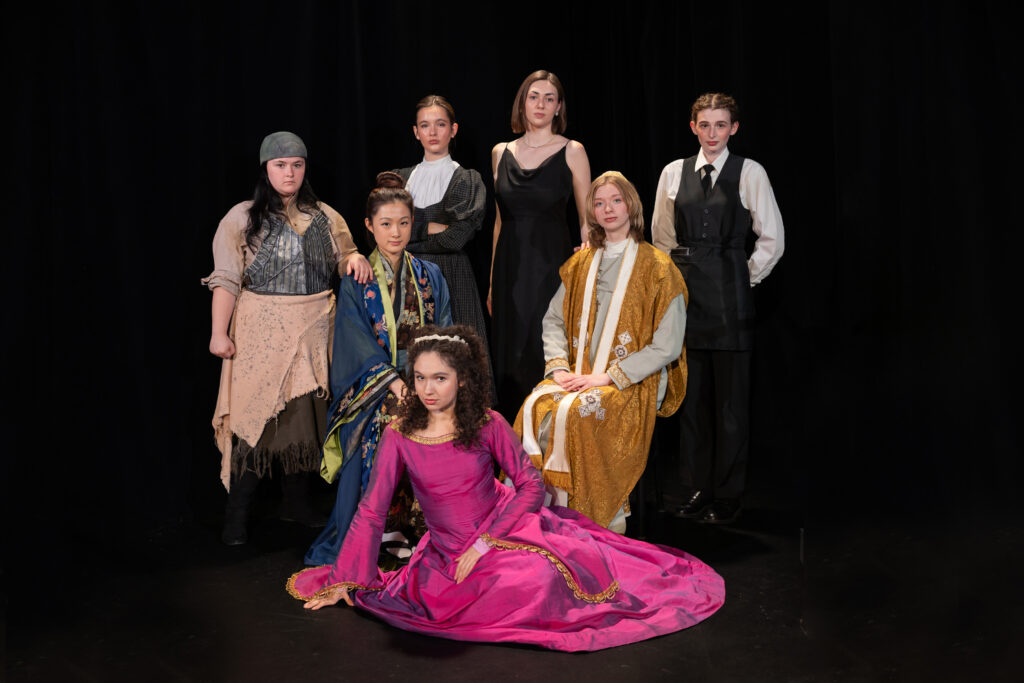
Joan rules the Vatican. Isabella travels the world. Nijō wanders the countryside. Griselda obeys her husband. Gret fights with devils.
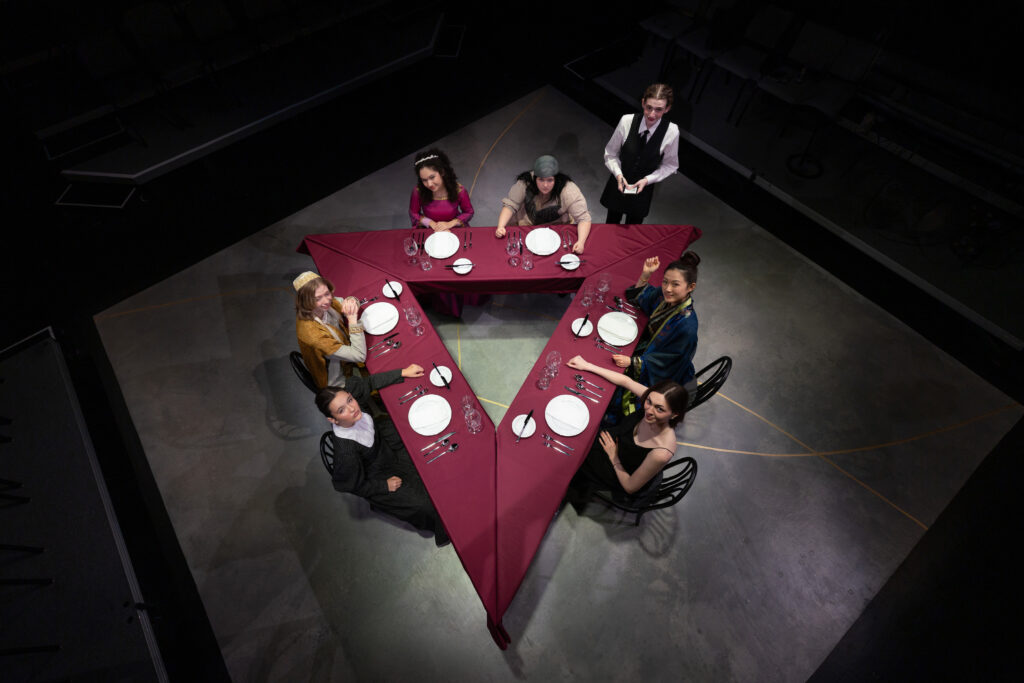
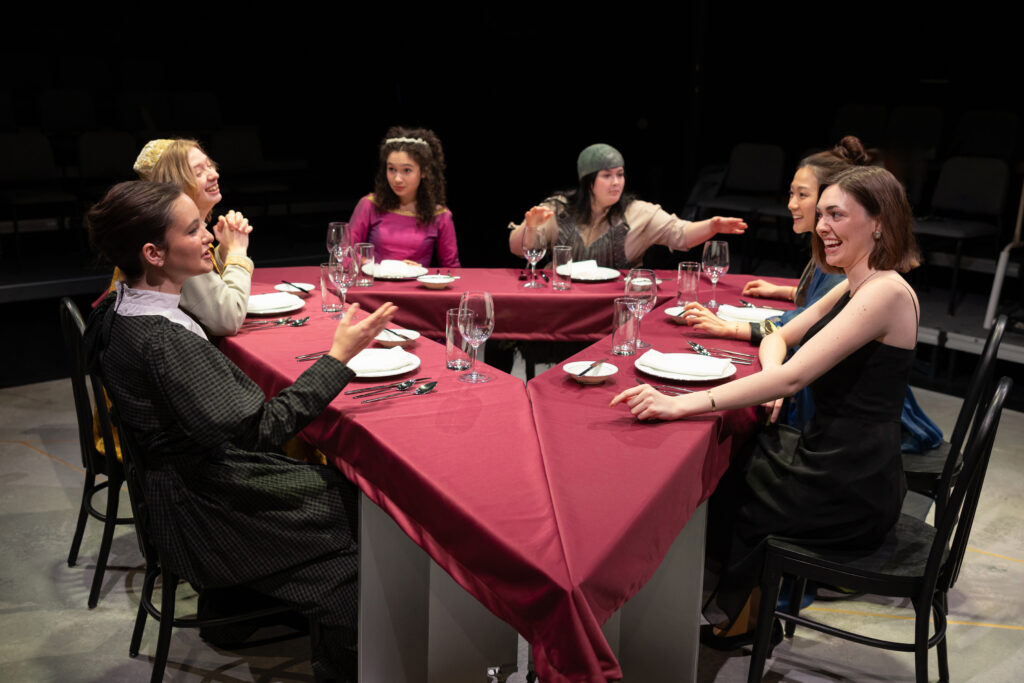
On a Saturday night, at an upscale restaurant, these five women, drawn from history, folklore, literature and art, gather for dinner. Welcoming them is Marlene, a successful businesswoman who just received a big promotion.
In “Top Girls,” British playwright Caryl Churchill interrogates history, gender and definitions of success. The Performing Arts Department in WashU Arts & Sciences will present the Obie Award-winning classic Nov. 19-22 in the A.E. Hotchner Studio Theatre.
“Caryl Churchill is an amazing writer,” said Andrea Urice, a teaching professor of drama in Arts & Sciences, who previously directed Churchill’s “Cloud Nine” and “Love and Information.” “The characters are rich. The language is buoyant. The content and form are groundbreaking. Directorially, these are exciting landscapes in which to work.
“These women lived hundreds of years apart,” Urice added. The dinner is an impossibility. And yet through their interactions, Churchill uncovers surprising commonalities. “We see the things they’ve had to do, the things that they’ve achieved, and the losses that they’ve endured.”
A modern classic
Churchill is a celebrated dramatist. She has authored dozens of plays as well as radio dramas and television adaptations. In 1974, she became the first female playwright-in-residence at London’s Royal Court Theatre. Eight years later, and three years into the tenure of Margaret Thatcher, the U.K.’s first female prime minister, “Top Girls” debuted at the Royal Court. It remains one of the most acclaimed British plays of the 20th century.
The iconic opening act comprises roughly half the show. Marlene, as host, introduces her guests. Conversations ebb and flow. Isabella, the Victorian traveler, and Nijō, a 13th-century itinerant nun, discuss their fathers. Joan, the 9th century pope, and Griselda, a medieval wife in a cruel marriage, debate forgiveness. Gret, a taciturn woman painted by Bruegel with armor and sword, describes storming hell after the death of her children.
“These are remarkable women who’ve done magnificent things,” Urice said. “The rest of the play is more naturalistic. We move into worlds that we recognize filled with people we recognize.”
Act II begins with Angie, Marlene’s abrasive niece. She boasts to her friend Kit; complains about Joyce, her working-class mother; and idolizes her glamourous aunt. Meanwhile, at the Top Girls employment agency, Marlene banters with colleagues, interviews job candidates and rebuffs Mrs. Kidd, who argues that her own husband deserves Marlene’s promotion.
“If there are ‘top girls,’ as the play’s title implies, then then are also people below that,” Urice said. “We see people at different socioeconomic strata who try to achieve, and sometimes don’t achieve, their own hopes and dreams.”
The final scene jumps one year back in time. Marlene has brought Joyce and Angie a stack of belated gifts. While Angie tries on a dress, the sisters bicker about Marlene’s absence, politics and the mother she hasn’t seen in years — but whom Joyce visits every week.
“Marlene isn’t always likeable,” Urice said. “Joyce is a tough cookie. They both weave in and out of the audience’s sympathy. I like how Churchill complicates these women — it’s a complicated situation.
“1982 was more than 40 years ago,” Urice added. “Debating Margaret Thatcher can sound like ancient history. But a lot of this stuff still resonates. How do women seek power? What are the obstacles? And what do we do with women who aspire to be top girls today?”
Cast and crew
The production stars Raquel (Elle) Brouwer as Marlene. All other actors play multiple roles. Parker Lesher is Isabella, Joyce and Mrs. Kidd. Cas Prewitt is Gret and Angie. Faye Ma is Lady Nijō and Marlene’s co-worker Win. Charlotte Ortega is Griselda and Marlene’s co-worker Nell. Clara Nipper is Pope Joan and Louise, a job applicant. Rounding out the cast is Anna Schwartz as Kit, the waiter and job applicants Jeanine and Shona.
Scenic design is by Lucy Li. Costume design is by Kayla Lindsay. Lighting design is by Jonah Glass and Ella Pankonin. Sound is by Sean M. Savoie. Emily Frei is props manager. Evelyn Tham is scenic charge artist.
The stage manager is A.J. Harness, with assistance from Ryan Pulbratek. Adam Jehle is technical director. Production manager is Jimmy Bernatowicz.
Tickets
Performances of “Top Girls” will begin at 7:30 p.m. Thursday, Friday and Saturday, Nov. 19, 20 and 21; and at 2 p.m. Saturday and Sunday, Nov. 21 and 22.
Performances take place in WashU’s A.E. Hotchner Studio Theatre, located in the Mallinckrodt Student Center, 6465 Forsyth Blvd. Tickets are $20, or $15 for seniors, students and WashU faculty and staff, and free for WashU students. Tickets are available through the WashU Box Office. For information, call 314-935-6543 or visit pad.wustl.edu.
“Top Girls” is presented by arrangement with Concord Theatricals on behalf of Samuel French Inc.